
First a master's degree, then a world championship title
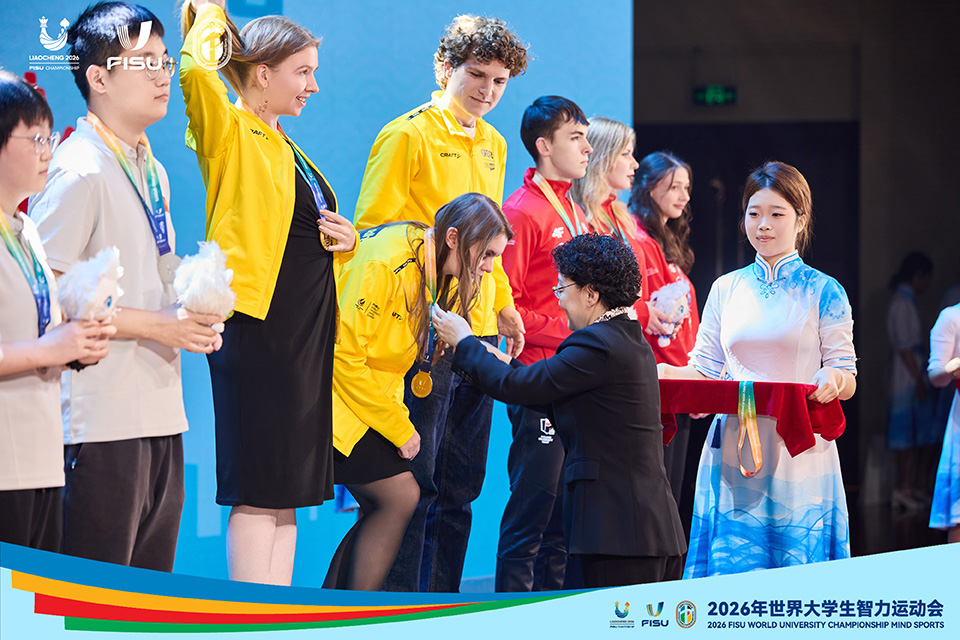
11/17/2026Jana Schneider is the World University Chess Champion. The Würzburg psychology student won gold in China, just a few weeks after completing her master's degree.

Jana Schneider won two gold medals at the FISU World University Championships in mind sports. Her victory in the individual competition in classical chess also contributed to the team's success. The championships took place from 11 to 16 October in Liaocheng, China.
For Jana, it is another major achievement. She recently completed her master's degree in psychology at Julius-Maximilians-Universität Würzburg (JMU). Now a world champion, she is moving on to Bamberg.
A world champion in the making
Jana learnt to play chess at the age of four. At the time, her father, a teacher, was running chess classes at his school. "At first, he thought I was too young for chess as a kindergarten child. But when it turned out that I had apparently understood it quite well, he started running a voluntary chess group for preschool children at my kindergarten, too," the newly crowned world champion recalls.
Her exceptional talent soon became apparent. At six, Jana joined a chess club, and at seven, she qualified for her first German Youth Championship.
She currently plays for Bad Königshofen in the Women's Bundesliga and for Regensburg in the mixed second Bundesliga. Her list of achievements is impressive. In 2017, at just 14 years old, she became the second-youngest player ever to win the German Women's Chess Championship. At the 2022 Chess Olympiad, she represented Germany on board five and won an individual gold medal. Jana is also the reigning German women's champion.
Funding opens up a new opportunity
However, the grandmaster had never competed in a university championship before. "That had been difficult in the past because chess hadn't received any financial support from the adh (German University Sports Federation). Things were different this year, so those responsible wanted to put together a strong team to ensure that chess would remain part of the funding programme," Jana explains.
And that is exactly what they did. In Liaocheng, around 400 kilometres south of Beijing, the German university athletes won team gold in both classical and blitz chess, as well as one gold, three silver, and one bronze medal in the individual competitions.
Special challenges in China
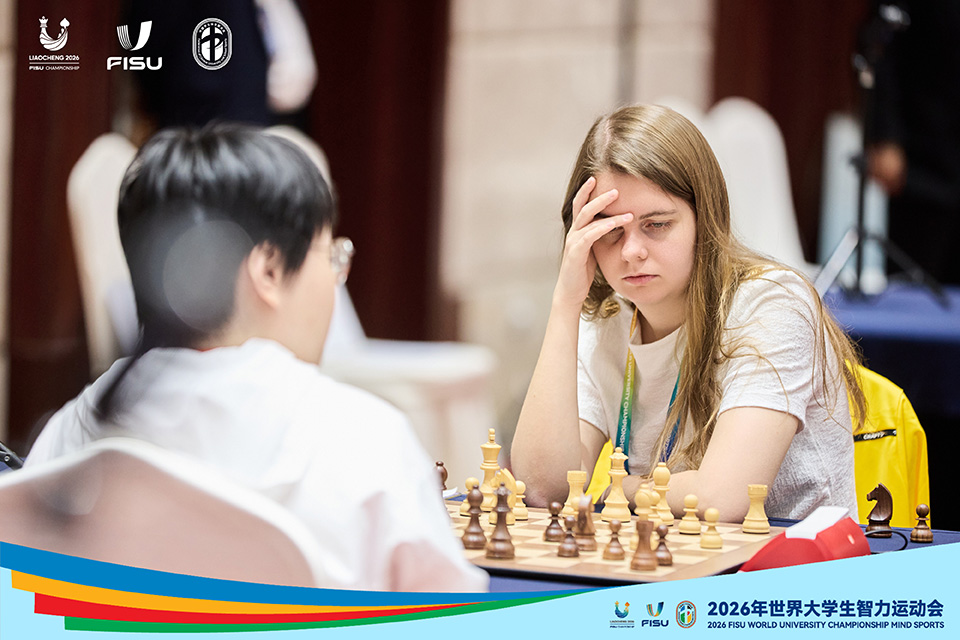
Based on her Elo rating, the mathematical system used to measure a player's strength, Jana was seeded second in the classical chess competition, behind China's Yan Tianqi.
"So there were certainly some expectations. But of course, you don't know all your opponents, and Elo ratings can be less reliable in some countries. I definitely didn't want to put too much pressure on myself."
The competition also presented a number of challenges. A six-hour time difference with virtually no time to adjust, combined with a demanding tournament schedule, made for an exhausting experience.
The tournament featured double rounds, meaning two games in a single day. "You have to bear in mind that a game of classical chess can easily last several hours. Playing two of those in one day really requires stamina."
Jana, however, maintained her concentration, overcame some tricky moments, and secured the world championship title without losing a single game. Her performance also counted towards the team standings, where she won another gold medal alongside Lara Schulze (fifth place) and Luis Engel (silver medallist in the men's competition).
With plenty of medals in their luggage, the athletes spent a few more days exploring Beijing before returning home to Germany.
From Würzburg to Bamberg
Back home, a new chapter awaits Jana. She had successfully completed her master's degree just a few weeks before the championships.
Do chess players have an advantage at university? "Well, I can concentrate for long periods and sit still, which certainly helps when studying," says the world champion.
Originally from Aschfeld in the Main-Spessart district, Jana has now moved from Würzburg to Bamberg in Upper Franconia. She has taken up a position as a research associate at the Chair of Work and Organizational Psychology at the University of Bamberg and is currently looking for a topic for her doctoral thesis.
Additional images