
Tracking down the causes of Alzheimer's and co.
04/14/2026Irina Dudanova is new to the Instituteof Anatomy at the University of Würzburg. She is researching the molecular and cellular mechanisms of neurodegenerative diseases and wants to understand why some nerve cells are particularly susceptible to degeneration.
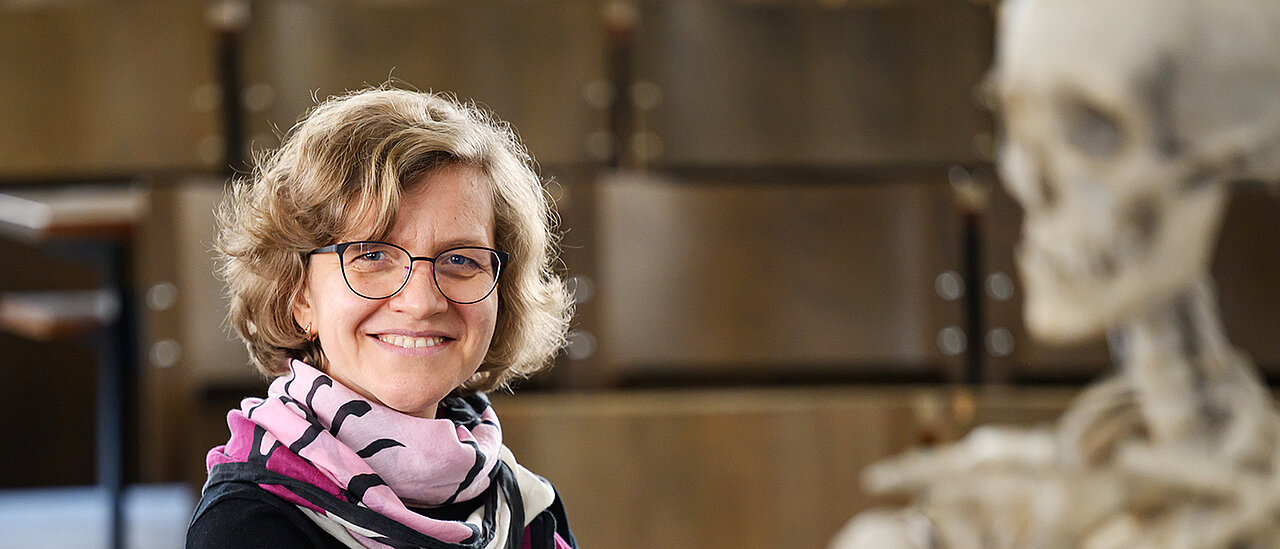
Neurodegenerative diseases such as Alzheimer's, Parkinson's or Huntington's disease are becoming increasingly common in an ageing society, but there is still no effective therapy. "The nervous system is extremely complex and has a huge variety of cell types that are affected to varying degrees by these diseases," explains Irina Dudanova.
The scientist, who moved to the Chair of Anatomy I at Julius-Maximilians-Universität Würzburg (JMU) on 1 April 2026, wants to start right here: Among other things, she is researching why some neurons die while other cells in the immediate vicinity are spared for a long time. Perhaps this secret hides an approach for an effective therapy.
A beacon for anatomical research
For Dudanova, the move from Cologne to Würzburg was a conscious decision in favour of a location steeped in tradition. "Würzburg is an important centre of German anatomy and is world-famous thanks to names such as Kölliker and Röntgen," says Dudanova. In Würzburg, she sees ideal conditions for expanding her research. And the upcoming renovation of the new institute building on the grounds of the University Hospital offers her clear prospects for the future.
In order to decipher the complex processes in the brain, Dudanova's working group relies on a combination of state-of-the-art technology and basic biological research. One of the tools she works with is a specially developed "proteostasis sensor mouse".
The sensor uses fluorescent images to visualise when a cell suffers from accumulations of damaged proteins, even before permanent damage occurs. "This gives us a time window in which we can intervene experimentally and try to reverse the damage," explains the professor. In addition to mouse models, she also uses human stem cells and tissue samples to transfer her findings to humans.
Enthusiasm for dissection and modern teaching
Despite her intensive research, Irina Dudanova is passionate about training medical students. She finds the classic dissection course, in which future doctors get to know the human body through dissection, and anatomy seminars in small groups particularly formative. "You work very closely with the students there, which creates a very different personal relationship than in a frontal lecture," she says.
Nevertheless, she would like to modernise teaching. Interactive formats such as anonymous digital surveys or the use of 3D apps and VR glasses to explore the body virtually are planned. The early connection to the clinic is also important to her: by integrating ultrasound, MRI or X-ray images, for example, students should already understand the significance of what they have learnt for later diagnoses during anatomy. Her courses in histology are also designed to impart knowledge about the cellular and molecular structure of the body, which is crucial for the personalised precision medicine of the future.
Career and family as a team effort
Irina Dudanova is the mother of three children and would like to serve as a role model for young female scientists. She believes that having to choose between a career in cutting-edge research and a family is an outdated prejudice. "It's not always easy, but with discipline and a supportive partner, it's absolutely doable," she emphasises. She is particularly keen to promote young women and encourage them to aspire to leadership positions.
About the person
Irina Dudanova was born in Petrozavodsk, Russia, in 1981; she studied human medicine in Russia. She came to Göttingen for an international master's and doctoral programme in the field of neuroscience, where she received her doctorate in 2007. After many years of research at the Max Planck Institute of Neurobiology/Biological Intelligence in Martinsried, most recently as head of the "Molecular Neurodegeneration" research group, she accepted an appointment at the University of Cologne in 2022. Since 1 April 2026, she has held the Chair of Anatomy I at the University of Würzburg.
Contact
Prof Dr Irina Dudanova, T +49 931 31-82976, irina.dudanova@uni-wuerzburg.de