
Insects: A treasure trove of data for science and nature conservation
02/24/2026How is biodiversity among Bavaria's insects changing - and why? Researchers at the University of Würzburg are now using the Karla.Natur database of the Bavarian State Office for the Environment to model future trends.

Insects are very important for humans. They pollinate fruit trees and other crops, helping to ensure that there is enough food on the table.
Around three quarters of the plants we grow and more than 80 out of 100 wild plants need insects to bear fruit. Worldwide, this pollination is worth up to 577 billion US dollars a year. And this is just one of many reasons why humanity should keep a close eye on the well-being of insects.
How has the distribution and biodiversity of insects in Bavaria changed in recent years? How will insects fare in the future? What role will climate change and the various forms of land use play? And what can humans do to protect insects as effectively as possible?
These central questions are being researched at the Chair of Global Change Ecology at the University of Würzburg's Biocentre under the direction of Professor Christian Hof.
Use of the Karla.Natur species database
In order to further advance the studies, the Chair has concluded a cooperation agreement with the Bavarian State Office for the Environment (LfU): As part of the agreement, the researchers receive data on the occurrence of insects in Bavaria and exchange information with the LfU experts. The digital data in the Karla.Natur species database dates back to 1980 and in some cases even further.
"The state office's extensive database is a real treasure for us because it allows us to look back into the past," says Professor Hof. "Although the so-called insect extinction has attracted a great deal of attention from experts and, in some cases, the media and politicians, there is a lack of comprehensive data on the development of insect biodiversity."
The LfU is aware of the value of the data. "Species distribution data forms the basis for official nature conservation, species aid programmes and the biotope network. However, our database also has gaps that we want to fill using the latest scientific methods," says Ines Langensiepen, Head of the Nature Conservation Department at the LfU.
"To do this, we need a sound statistical analysis because the data has been collected very unevenly over the years and across different regions," explains Professor Hof. It is precisely this imbalance that is typical of such data collections. If they are not equalised using suitable statistical methods, the results could easily give a false picture.
Focus on butterflies, grasshoppers and dragonflies
The Würzburg researchers' initial aim is to better understand the past development of biodiversity in butterflies, grasshoppers and dragonflies. On this basis, they can then develop models to estimate the future development of these insects under different scenarios more reliably than before.
Insects in particular are very sensitive to climate change. "We are particularly interested in looking into the future. Which species need to be supported and how in order to meet the challenge of the changing conditions of our environment? This is exactly where practical nature conservation comes in," says Ines Langensiepen.
PhD student Christian Zehner is the first Würzburg researcher to benefit from the new co-operation: In his doctoral project, which is funded by the German Federal Environmental Foundation (DBU), he wants to use the LfU data to analyse the population trends of the various insect groups in Lower Franconia and other regions of Bavaria, among other things. On this basis, the causes of these developments will be analysed.
Heat-loving species are developing positively
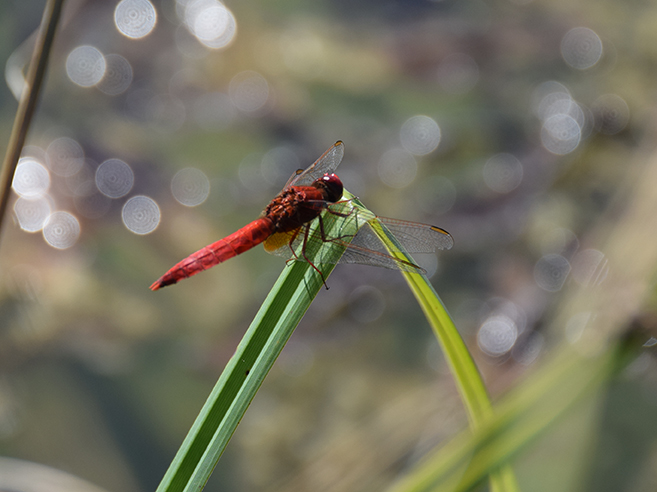
Christian Hof already researched the biodiversity of insects in Bavaria in connection with climate change during his time at the Technical University of Munich (until 2023). At that time, his team discovered, among other things, that warmth-loving species such as the fire dragonfly, which originally only occurred around the Mediterranean, are developing positively. This finding was also thanks to data from the LfU.
Link to the Karla.Natur database
https://www.lfu.bayern.de/natur/artendaten/datenmeldung/karla_natur_arteingabe/index.htm
Additional images