
Knowledge in Motion
10/13/2026AI, automation and the question of how new technologies can deliver tangible benefits: these topics took centre stage at Innovation Day 2026, organised by JMU, THWS, the Chamber of Industry and Commerce (IHK) and Region Mainfranken GmbH.
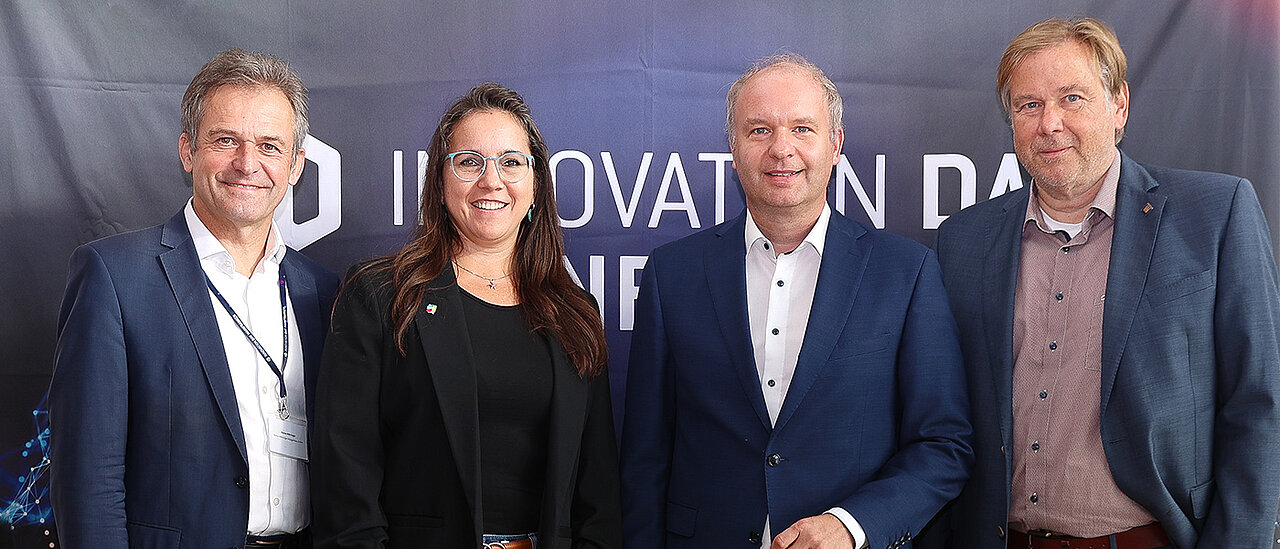
Even before the official start, the mood was clear: a sense of anticipation at seeing familiar faces, curiosity about making new contacts, and the expectation of gaining insights that could be put to use in their own companies. Around 170 participants had gathered at the Julius-Maximilians-Universität Würzburg (JMU) to be guided by presenter Johannes Keppner through an exciting day in the ‘Silvaner Valley’.
The event kicked off with Professor Matthias Bode (JMU), Professor Jan Schmitt (THWS), Dr Stefan Möhringer (IHK Würzburg-Schweinfurt) and Bettina Gardenne, Managing Director of Region Mainfranken GmbH. It quickly became clear what a vital role the universities play in the region. For instance, JMU brings around 5,000 young people to Mainfranken every year and conducts research into key topics for the future. THWS, too, is closely linked to the regional economy – particularly through the establishment of technology transfer centres in six districts to date.
For businesses, this exchange is also a way of attracting skilled workers and retaining them in the region. Degree theses, work placements and joint research projects create points of connection. In her opening address, Bettina Gardenne summed up the theme of the day: “Especially in turbulent times, we need strong universities, innovative companies and, above all, collaboration.” The Innovation Day organised by Region Mainfranken GmbH was intended to provide a forum for this.
From research to practice
Dr Iris Zwirner-Baier from the JMU’s Research and Technology Transfer Service Centre demonstrated how a research question can develop into a concrete collaboration. There, companies gain access to a broad spectrum of expertise – ranging from research and funding, through to patents and commercialisation, right up to business start-ups.
The THWS’s Applied Research Campus, presented by Dr Christian Lengl, also sees itself as a bridge between academia and industry. Collaborations are intended not only to facilitate research, but also to help companies actually put the insights gained to practical use.
AI: Tool, partner – or decision-making aid?
Alicia von Schenk, holder of the Chair of Economics of AI and Human Behaviour at JMU, then turned her attention to the relationship between humans and AI in the labour market. AI can observe, advise or act as a partner or opponent – and not just in routine tasks. It becomes particularly interesting, the professor noted, when humans and algorithms make decisions together.
As an example, Alicia von Schenk cited experiments designed to identify lies and to shed light on AI’s capabilities in stabilising group collaboration. Other studies examined recruitment decisions in which an algorithm was actively involved. Should only objective criteria such as CVs and suitability on paper be taken into account here, or should personal chemistry also play a role?
According to Alicia von Schenk, behavioural economics experiments show that human intuition is not automatically superior. Rather, algorithmic systems can, in certain situations, deliver different – and in some cases more consistent – results. The question for the future, she said, is how humans and machines can work together effectively.
Automation needs a sound framework
Professor Andreas Schiffler (THWS) turned his attention to the automation of digital processes. His starting point: “Anyone who wants to use AI effectively must first understand their own processes.” Documented processes and clearly defined interfaces are crucial for this – systems should be able to communicate with one another. However, it is essential not to lose sight of data protection and data sovereignty: Where is data processed? How long is it stored? Who has access? And what dependencies arise from individual systems? At the same time, staff need the freedom to further develop their processes themselves.
From AI model to productive system
Professor Christoph Flath, Head of the Chair of Information Systems and Business Analytics at JMU, demonstrated why companies should not focus solely on the model when using AI. What matters most is the system – the so-called ‘harness’ comprising instructions, interfaces and validation rules. “Without this framework, AI quickly gets stuck at Ctrl+C and Ctrl+V.”
With a well-defined system, existing process knowledge can become a decisive advantage, according to Flath: standards, exception rules and experience become the input, whilst the AI takes over routine tasks. For companies, this means starting small. Select a common, clearly defined and verifiable task, define standards, establish escalation procedures and then measure what the solution actually delivers.
When innovation becomes a reality
Michael Rager from F.S. Fehrer Automotive GmbH explained how research and industry can work together on practical solutions. In collaboration with universities, the team investigated, amongst other things, robotic solutions for flexible components, the automated allocation of equipment and the determination of capacity requirements. Both traditional rule-based methods and machine learning were utilised in this work. The results demonstrated one thing above all: not every problem requires AI. Scientific collaboration can help to identify the method that is actually best suited to the task at hand.
Two hours of hands-on exploration and in-depth study
After the lunch break, the Innovation Day shifted from listening to hands-on participation. In seven different masterclasses, participants were able to select two topics each and explore them in greater depth. The topics ranged from knowledge management and forecasting to robotics, including guided tours of the laboratories at JMU. In addition, the New Space network and the Main-Franconian MIND cluster were on hand as points of contact. The SFT at the University of Würzburg also contributed a workshop focusing on the use of patents.
Hubland: Innovation you can experience
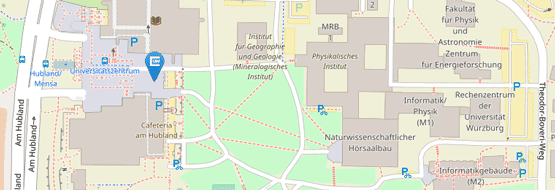
During the subsequent ‘Expedition Hubland’, attention turned to the regional innovation ecosystem. Three stops demonstrated how closely urban development, start-ups, research and technology are intertwined: from the emerging neighbourhood to the start-up ecosystem and on to the Innohubs, which serve as a home for technology companies.
During the closing networking session at Bistro Belvedere, discussions continued, laughter rang out and connections were made. Because that was precisely what Innovation Day 2026 was all about: innovation does not arise solely from new technologies. It arises where people share their knowledge, ask questions and develop solutions together.
Region Mainfranken GmbH
As the umbrella organisation for the Mainfranken Regiopol region and the regional development agency for the Mainfranken districts, the independent cities of Würzburg and Schweinfurt, and the chambers of commerce, Region Mainfranken GmbH brings together regional forces in politics, science and business to position Mainfranken competitively at both national and international levels. Through targeted location marketing, Mainfranken is made visible to potential skilled workers, investors and interested parties.
The shareholders of Region Mainfranken GmbH are, in addition to the two independent cities of Würzburg and Schweinfurt, the seven Mainfranken districts of Bad Kissingen, Haßberge, Kitzingen, Main-Spessart, Rhön-Grabfeld, Schweinfurt and Würzburg, as well as the Würzburg-Schweinfurt Chamber of Industry and Commerce and the Chamber of Skilled Crafts for Lower Franconia.