
Three young researchers honoured
07/28/2026The Faculty of Human Sciences has awarded Dr Katja Höglinger the Beatrice Edgell Prize for her doctoral thesis. The Matilda Prize for the best papers went to Dr Elena Dück and Dr Simone Schäffner.
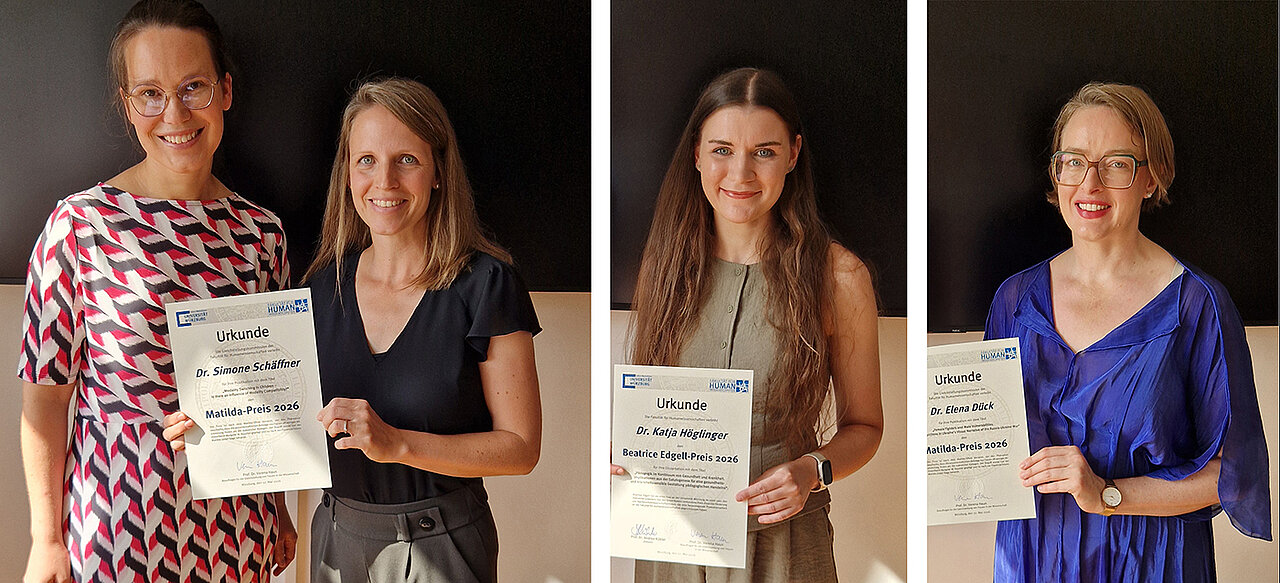
The Beatrice Edgell Prize, worth 1,000 euros, is awarded each year by the Faculty of Human Sciences for outstanding doctoral theses written by women. The 2026 prize goes to Dr Katja Höglinger from the Institute of Special Education.
Dr Katja Höglinger completed her doctoral thesis with top marks. The Würzburg-based researcher has investigated how teachers can better support children and young people with chronic illnesses – a topic that has so far received little attention in educational discourse. She developed a model to improve the educational opportunities of chronically ill children. A key focus of this work is the training of trainee teachers. The doctoral thesis was published as open access by Springer .
In its laudatory address, the faculty emphasised that the award winner has made a strong impression with further publications and an active lecturing programme. Her teaching covers a broad range of subjects; she is involved in academic self-governance and took on leadership responsibilities at a chair when it was vacant. In addition, she has secured her first external funding and designed a professional development course for teachers. Katja Höglinger is currently preparing her habilitation project with a view to a long-term career in academia.
The prize is named after the British psychologist Beatrice Edgell (1871–1948). In 1901, she became the first woman to be awarded a doctorate at the University of Würzburg. Further information on the Beatrice Edgell Prize.
Matilda Prize for Elena Dück and Simone Schäffner
The faculty also awarded the 2026 Matilda Prize for the two best papers by early-career female researchers. Each prize is worth 1,000 euros.
Dr Elena Dück from the Institute of Political Science and Sociology received the prize for a paper on the portrayal of women and men in the war in Ukraine. For this, she analysed Ukrainian social media posts published since the Russian invasion. Her research revealed that, whilst women and men are sometimes portrayed in familiar roles during the war, these role models are also changing. Her work provides new insights into how wars are narrated and shaped through images. It was published in the journal International Political Sociology.
Dr Simone Schäffner from the Institute of Special Education conducted a study involving 64 children to investigate how well they can switch between different tasks when they have to listen, look, speak or use their hands. The result: children switch tasks more quickly and make fewer mistakes when the tasks are closely related in content. This research helps us better understand how children process language and cope with multiple demands simultaneously. The paper has been published in the journal Psychological Research .
The prize is named after the Matilda Effect. This refers to the phenomenon whereby academic contributions by women are often given less recognition than those by men. The effect is named after the American women’s rights activist Matilda Joslyn Gage (1826–1898). Further information about the Matilda Prize.