

How meaningful and fair VR audits are
04/14/2026VR examinations are becoming increasingly important in medical training. However, two studies by the University Hospital of Würzburg show that these examination formats may not be fully applicable at present.
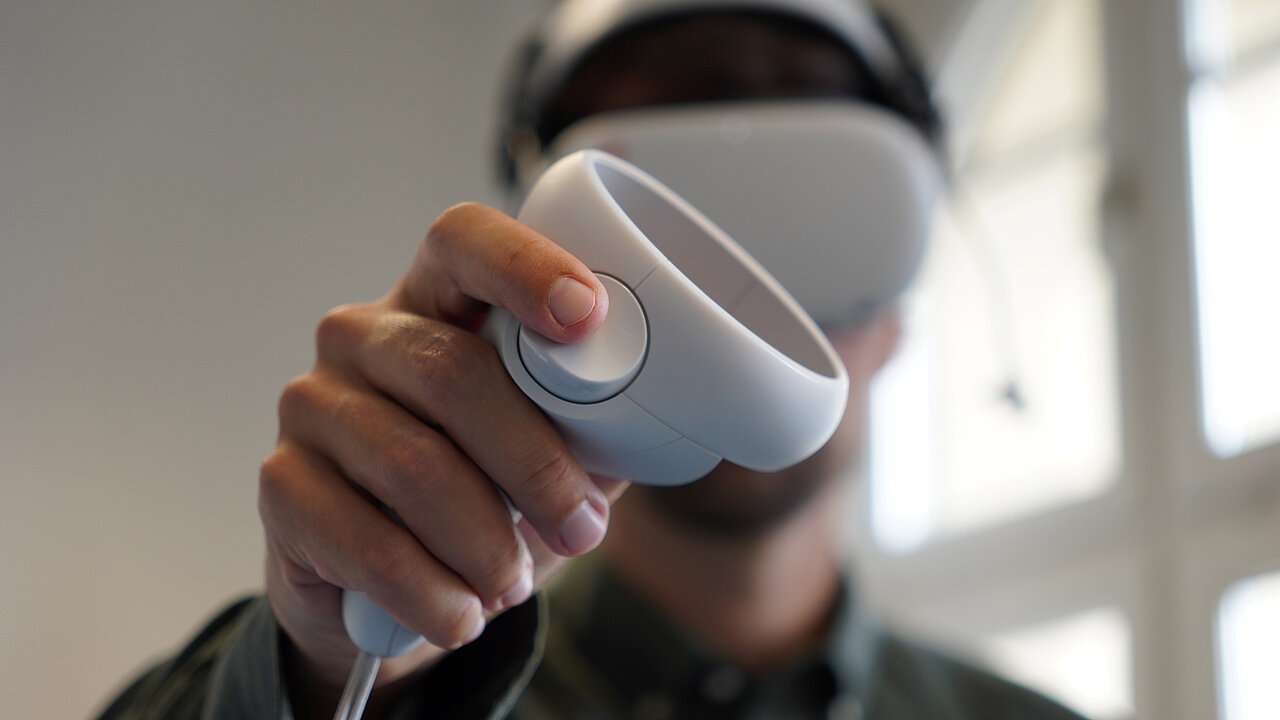
Virtual reality (VR) applications are considered a promising innovation for medical training. So-called immersive simulations appear particularly attractive for examinations on clinical-practical skills: by immersing users in a digital world in which they have to determine their own actions, complex emergency scenarios can be depicted in a standardised way. Processes are reproducible and the examination conditions can be designed identically for all participants.
However, two recent studies by the "Virtual Reality Simulation in Medical Education" working group at the Institute for Medical Teaching and Medical Education Research (IMLA) at the University Hospital of Würzburg (UKW) show that VR-based examination formats may not currently be fully applicable. The results were published in the renowned journals npj Digital Medicine, a journal of the Nature portfolio, and JMIR Medical Education.
Immersive competence influences examination performance
The studies investigated the extent to which medical examination performance in VR scenarios is influenced by immersive competence, i.e. the ability to move safely in virtual environments. This ability is characterised, among other things, by previous experience with 3D and VR applications. This could give students with intensive gaming experience a performance advantage.
The first paper published in JMIR created the methodological basis for this: together with the Chair of Human-Computer Interaction at Julius-Maximilians-Universität Würzburg, an instrument was developed and tested for the first time that can be used to assess immersive skills directly within a VR application.
In the randomised controlled study based on this, the immersive competence of some of the test subjects was specifically trained. The trained group subsequently achieved significantly better medical results in a VR emergency scenario than the untrained control group.
"Our data indicates that VR exams not only measure medical knowledge and clinical behaviour, but also the use of the technology itself," explains Jan Schaal, first author of the validation study and doctoral student at the IMLA. "This creates the risk of digital prior experience unintentionally becoming an advantage - regardless of actual performance," adds Verena Schreiner, also a doctoral student and first author of the method-centred study.
Training alone does not automatically compensate for differences
Another key finding concerns preparatory VR tutorials. Such training should create a level playing field. However, the Würzburg data suggests that the current standard introductions may not be sufficient to fully compensate for existing differences. In certain constellations, the training could even increase rather than reduce initial differences in performance.
Consequences for the digital transformation of teaching
The results suggest that the use of VR in future examinations must be carefully prepared and monitored. An intuitive and accessible design of VR hardware and software, targeted training to develop immersive skills and careful scientific scrutiny of validity and fairness are crucial before results determine progression in studies.
"VR offers enormous potential for medical training - but we need to examine very carefully what we are actually measuring," emphasises Dr. Tobias Mühling, head of the research group and last author of the studies. "If VR is also to be used in graded examinations in the future to determine the progression of students, the results must be reliable and offer the same opportunities for all students," adds Professor Sarah König, head of the institute.
Publications
Schreiner V, Backhaus J, Lindner M, Heinisch M, König S, Oberdörfer S, Mühling T. Specific Immersive Competence in VR-Based Medical Assessments: Development and Exploratory Evaluation of an In-Situ Measurement Approach. JMIR Medical Education. 24/02/2026:82136 (forthcoming/in press). DOI: 10.2196/82136
Schaal, J., Leutritz, T., Lindner, M. et al. Immersive competence as a source of bias in virtual reality clinical assessment. npj Digit. Med. (2026). https://doi.org/10.1038/s41746-026-02482-z