
A health check for the Congo Basin
04/14/2026Climate change is impacting water, food, and health supplies in the Congo Basin. An international team led by a researcher from Würzburg is now addressing this issue.
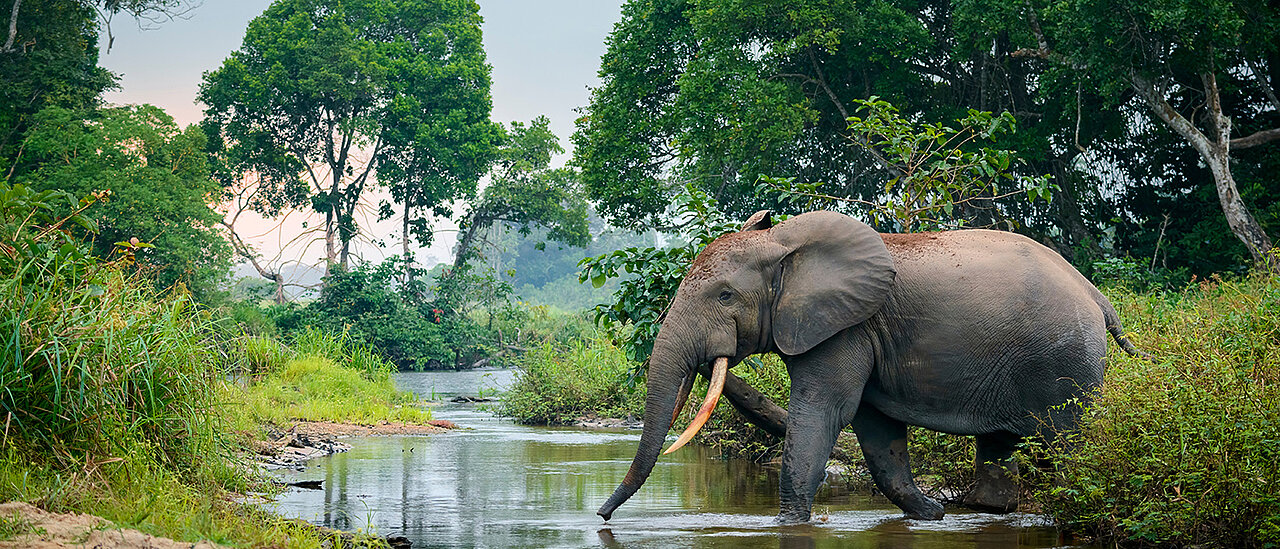
The Congo Basin contains the second-largest contiguous tropical forest area on Earth. Nearly 25 percent of the world’s tropical rainforests are in the lowlands that stretch like a bowl over the Democratic Republic of the Congo and neighbouring Central African countries. However, climate change is taking a toll on the basin: It is promoting the spread of diseases such as Ebola and malaria, threatening biodiversity, and could render the area uninhabitable due to heat.
An international project is now investigating the “state of health” of the Congo Basin on multiple levels. The Federal Ministry of Research, Technology, and Space (BMFTR) is funding the initiative. The project is led by Professor Freddy Bangelesa, a climatologist at Julius-Maximilians-Universität Würzburg (JMU) and researcher at the School of Public Health of the University of Kinshasa. He is a member of the Working group Climatology headed by Professor Heiko Paeth.
“We want to gain a comprehensive understanding of the climate-related dynamics in the Congo Basin. After all, the climate also influences the supply of water, energy, and food, as well as the health of the inhabitants,” says Bangelesa. The project addresses questions such as: Is the water supply threatened by rising temperatures? How does the climate influence the spread of diseases? What effects can be expected on crop yields?
Würzburg team analyses climate data
So far, there has been little research and hardly any systematic approaches to these questions regarding the Congo Basin, says the climatologist. To tackle such an interdisciplinary project, Bangelesa is coordinating an international research team.
The researchers at JMU are focusing on the climate. They are analysing high-resolution climate data intended to show how temperatures and precipitation in the basin have changed so far, what consequences are already visible, and what damage may still occur.
“Our initial simulations show that the Congo Basin could face an annual decline in precipitation of 500 millimetres per square meter. That is roughly equivalent to the annual rainfall that falls on the same area in Würzburg,” warns Bangelesa. Given the current annual precipitation of just under 6,000 millimetres per square meter, this represents an enormous loss.
An international team
A team from the School of Public Health of the University of Kinshasa is handling the health dimension. To this end, it is engaging with local communities to document and monitor the health of residents. Researchers from the University of the Witwatersrand in South Africa are mapping vulnerable ecosystems and developing potential protective measures.
Researchers from the University of Neuchâtel (Switzerland) are investigating how policy could sustainably improve life in the Congo Basin. The dissemination of the result will be facilitated by the Congolese Young Academic of Science. Additionally, three doctoral positions for the project have been established in Würzburg, South Africa, and Kinshasa. And two postdoctoral positions in Switzerland and South Africa.
“We are bringing together researchers from the Northern and Southern Hemispheres to solve a problem together. In addition, a Congolese doctoral student will participate at JMU and continue his research in the Congo after completing his doctorate,” says Bangelesa. This helps raise awareness on site about climate change and its local impacts.
The goal of the project is to provide recommendations for action to residents, farmers and Congolese authorities. “We are training experts where they are needed to secure the future of the Congo Basin,” says the climatologist.
Funding
The project “Integration of Climate, Water, Food, and Energy Systems for Sustainable Development and Health Resilience in the Congo Basin” is receiving a total grant of just under 650,000 euros. The initiative is supported by the Belmont Forum. The funders are the National Research Foundation (South Africa), the Swiss National Science Foundation, the international research program Future Earth, and the BMFTR. The latter is funding the Würzburg team with approximately 150,000 euros. The project will run for three years.
Contact
Prof. Dr. Freddy Bangelesa, Working group Climatology, Institute of Geography and Geology, T +49 931 31-81168, freddy.bangelesa@uni-wuerzburg.de