
General practice knows no boundaries
10/20/2026General practice in undergraduate studies, postgraduate training and the healthcare system: this was the topic discussed by members of the European network EURACT at a meeting in Würzburg. The event was hosted by Professor Anne Simmenroth.
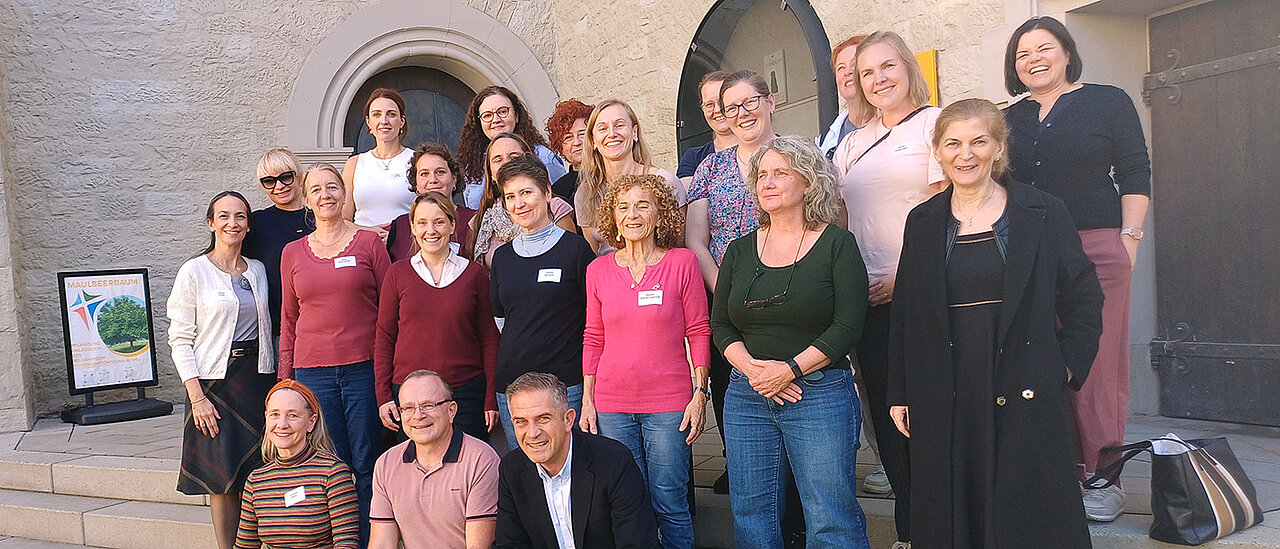
From Iceland to Israel, from Portugal to Ukraine – the European Academy of Teachers in General Practice (EURACT) brings together teachers of general and family medicine across the borders of the European Union. In mid-October, delegates from more than 35 member states accepted the invitation from Professor Anne Simmenroth, Director of the Würzburg Institute of General Practice, and travelled to the Lower Franconian university and royal city for the EURACT Council Meeting. Together, they worked on studies and position papers with the aim of optimising the training of general practitioners in Europe and adapting it to current needs.
EURACT meets in Würzburg for the first time
“It’s a fantastic committee; the work is incredibly enjoyable and we can learn a great deal from one another,” says Anne Simmenroth. The general practitioner and researcher has now been elected as Germany’s representative on EURACT for the fourth time. For the past two years, she has also chaired the network’s ‘Study’ section. Twice a year, the EURACT delegates meet in various European university cities to further develop their areas of focus.
“I am delighted that the city of Würzburg is hosting this important network meeting for the first time,” says Anne Simmenroth. “There has never been anything like this before, and there probably won’t be in the foreseeable future.” In two years’ time, Simmenroth would like to hand over her role to someone younger.
What is the situation here regarding teaching and continuing professional development? “In terms of teaching, Germany is well positioned by European standards,” says Simmenroth. General practice is now firmly established in Faculties of Medicine; chairs have been set up and teaching practices are also integrated through structured programmes and financial remuneration. This places Germany in the top third when compared with the rest of Europe. In some countries, however – for example in parts of Eastern Europe – there is a lack of chairs, staff and sufficient funding for general practice teaching.
Further training is lagging behind
According to Simmenroth, there is a significantly greater need for Germany to catch up when it comes to further training to become a specialist in general practice. Countries such as Finland, Sweden, Norway, England, the Netherlands and the Baltic states rely on clearly structured further training programmes with fixed rotations through various specialist departments and institutions, mentors and regular teaching. As a result, further training is organised more like an extension of the degree course, ensuring that all trainee specialists gain comparable knowledge and experience.
In Germany, by contrast, much still depends on the specific training post and the prevailing conditions. Whilst the first training networks and centres of excellence are creating more structure, they do not yet match the established models of other European countries.
A shortage of young talent everywhere
However diverse medical education, further training and healthcare systems in Europe may be, they all have one thing in common: the shortage of young doctors. The shortage of doctors in primary care, particularly in rural areas, is in fact a global problem. Whether in Australia, Brazil, Canada or Europe – everywhere we see a decline in GP provision. EURACT is also discussing this issue: what measures can be taken to actively shape and support the generational transition in general practice? “Everyone has their own ideas and experiences on how to inspire young doctors to take up general practice,” says Anne Simmenroth.
For the GP, the diversity, breadth and continuity of the specialism are the perfect combination. “I treat a wide variety of conditions, have to keep learning, and support many people over long periods of their lives. In a way, I live alongside them. It’s absolutely brilliant,” enthuses Simmenroth. During her last consultation, for example, she first saw a four-year-old child and later made a home visit to a 92-year-old patient – surely a formative experience for the clinical placement student who was present.
Numerous doctors confirm the fascination of this profession. Nevertheless, there are too few of them to secure the future of GP care. “Without career changers – that is, internists taking over GP practices – it simply wouldn’t be possible,” says Simmenroth. The second major group of career changers comes from the fields of anaesthesia and surgery.
About EURACT
The European Academy of Teachers in General Practice is the European network for teachers and trainers in general practice and is officially recognised as the educational network of WONCA Europe. The World Organisation of Family Doctors is the global umbrella organisation for general and family medicine.
Among other things, EURACT offers international continuing professional development programmes for teachers, courses on examination and assessment methods, as well as conferences and symposia. Furthermore, EURACT develops and publishes recommendations, standards and teaching materials for training and continuing professional development in general practice. The network comprises representatives from around 40 countries across geographical Europe and is therefore not limited to the Member States of the European Union.