
Recognising warning signs of excessive alcohol consumption in a fun way
10/27/2026A study involving 603 people with alcohol use disorder shows: Smartphone-based tests designed in a gamified format could help to identify at an early stage periods of increased risk of relapse or alcohol consumption.
For many people, alcohol is part of everyday life, whether it’s when eating together, celebrating or relaxing. However, some people develop a craving for alcohol that is almost impossible to control. Despite negative health or social consequences, they find it difficult to drink less or to stop altogether.
Experts refer to this as an alcohol use disorder. The key factor here is not just how much someone drinks, but how negatively their alcohol consumption affects their behaviour and daily life.
Which comes first: a change in behaviour or increased alcohol consumption?
Studies have shown that people with an alcohol use disorder have difficulty controlling their behaviour and impulses, and that they are more likely to make risky decisions.
However, it has so far been unclear what is the cause and what is the effect: do the changes in thinking and behaviour precede increased alcohol consumption, or are they a consequence of it?
Professor Lorenz Deserno and Dr Hilmar Zech from the Centre for Mental Health at Würzburg University Hospital (UKW), in close collaboration with Professors Michael Smolka and Thomas Goschke from Dresden University of Technology, as part of a project within the Transregio TRR 265 ReCoDe Collaborative Research Centre. And indeed, they have managed to bridge this gap in addiction research to some extent.
Measuring cognitive functions with smartphone games
Lorenz Deserno and Hilmar Zech share expertise in how cognitive functions can be measured using smartphone-based games.
“We don’t ask what or how people are thinking; instead, we let them play the games we’ve developed ourselves, in the comfort of their own homes, on their smartphones. From small differences in behaviour – for example, in reaction times – we can then draw conclusions about their cognitive functions,” explains Hilmar Zech.
“The advantage of conducting experiments on smartphones is that our study participants do not have to come to our laboratory, but can carry out the tests as part of their everyday lives. By presenting the experiments in the form of a game, we entertain people and keep them engaged,” says Lorenz Deserno.
It is precisely this combination that has enabled the TRR265 study team to monitor 603 people, most of whom have mild to moderate alcohol use disorders, over the course of a year and to link their regular reports on alcohol consumption with the results from the games assessing cognitive control and decision-making behaviour.
Significant fluctuations in alcohol consumption
Every other day at 12 noon, participants received a prompt on their mobile phones asking them how much they had drunk over the previous two days. They could select the appropriate amount from twelve examples – ranging from spirits in a shot glass to beer in various units, and wine by the glass or bottle.
“The fluctuations in consumption were marked. Some drink regularly, others not at all during the week, but drink heavily between Thursday and Sunday,” says Lorenz Deserno. However, their lives are not yet as severely affected as those of people with severe alcohol dependence who require withdrawal treatment.
It was precisely these risk trajectories that needed to be investigated. This is because they are often a gateway to a severe addiction.
The participants were therefore selected very carefully. At the start of the study and every three months, they also underwent laboratory tests and brain scans. In addition, they were asked questions at regular intervals about their mood and self-control, how they were feeling and whether, for example, they would like to drink less. Finally, they were allowed to play four games, each lasting five minutes, once a month.
Games test impulse control, working memory and risk-taking behaviour
The games were developed at TRR265 and the UKW, partly based on a collaboration with University College London, where Lorenz Deserno worked for several years.
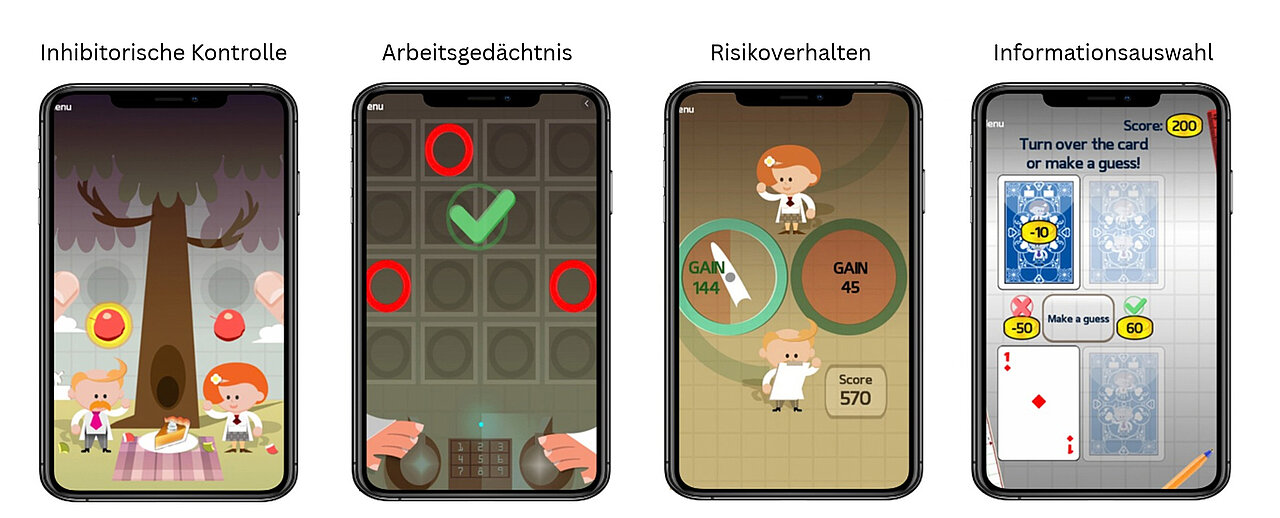
The approximately 20-minute gaming session began with a game testing impulse control. In this game, participants were asked to pick fruit from a tree. As soon as a piece of fruit turned brown, they were no longer allowed to click on it. The test demonstrated how quickly they could interrupt a reaction that had already become automatic – a skill that also plays a role in controlling addictive behaviour.
The second game focused on working memory. The participants were asked to memorise increasingly complex patterns and then reproduce them.
The third and fourth games examined risk-taking behaviour. For example, participants were allowed to choose between a guaranteed score of 30 points and a wheel of fortune, where scores ranging from 0 to 60 were possible. In the final game, they had to choose between two stacks of cards. The pile with the higher final total won. Participants could take a risk and decide immediately, or invest points to obtain further information about the cards. The more points invested, the more carefully decisions were prepared.
Those who make riskier decisions often drink more later on
The findings, published in the specialist journal*Biological Psychiatry: Cognitive Neuroscience and Neuroimaging*, show how fluctuations in playing style during the third and fourth games are linked to risk-taking behaviour and fluctuations in alcohol consumption.
Changes in decision-making behaviour preceded changes in alcohol consumption. Higher alcohol consumption, on the other hand, did not lead to these changes in decision-making behaviour. The first two games, which tested impulse control and working memory, did not reveal these correlations.
“Those who were more risk-taking or careless in the game often consumed more alcohol in the following month,” explains Hilmar Zech. “And that did come as a surprise to us. Not the result itself, as that was in line with our hypotheses. But the fact that we were able to confirm these hypotheses straight away using our new smartphone-based, game-like measurement methods is not often the case in research.”
Deserno adds: “We are delighted that we have succeeded in using our measurement methods to capture real-life fluctuations in drinking behaviour and in key aspects of decision-making.”
Smartphones as an early warning system for increased drinking risk
The team now intends to build on this. The findings could help to identify early warning signs of periods of increased drinking risk and provide targeted support to those affected.
“We could, for example, use smartphone-based games as a risk indicator and intervene at an early stage if measurements show cause for concern,” says Zech. Such an intervention could include not only simply making contact and providing information about the increased risk, but also counselling and conversation-based methods.
Playful interventions are also conceivable. “This preventative approach would be extremely important in the context of substance use, to prevent more serious harm arising from prolonged use and to protect individuals from severe dependence, with all its physical and socio-economic consequences,” says Deserno.
The research team is currently investigating different time intervals. To this end, they are having 150 participants play the game twice a day over a twelve-week period – four weeks at the start and four weeks at the end. Deserno: “This will hopefully enable us to understand the effects even better and to pinpoint more precisely the point at which, for example, risk preferences change.”
Publication
Fluctuations in real-life drinking in alcohol use disorder: A one-year longitudinal study using gamified tasks of decision making and cognitive control. Biological Psychiatry: Cognitive Neuroscience and Neuroimaging, 2026, ISSN 2451-9022, https://doi.org/10.1016/j.bpsc.2026.07.019