
When fungal infections threaten the eye
07/21/2026Researchers at Würzburg University Medicine are investigating how pathogenic fungi penetrate the cornea of the eye. They are also developing new approaches for more targeted treatment.
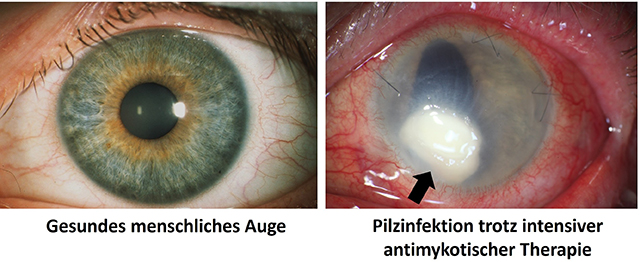
Fungal keratitis, an infection of the cornea caused by fungi, is one of the most serious diseases affecting the ocular surface. If not treated adequately, it can lead to permanent damage to the cornea, significant visual impairment and, in the worst-case scenario, loss of vision.
Contact lens wearers, people who have suffered eye injuries – particularly from plant material – and those with pre-existing corneal damage or a weakened immune system are particularly at risk.
Treatment is considered particularly challenging, as many antifungal medicines, known as antimycotics, do not penetrate the cornea sufficiently. This makes it difficult to reach the pathogens at the site of infection. The result is protracted treatment involving very frequent administration of medication, which is burdensome for those affected and yet does not always yield the desired outcome.
Funded by the German Research Foundation
This is where a new research project at the University Medical Centre Würzburg comes in; it is funded by the German Research Foundation (DFG) with 500,000 euros and brings together expertise from ophthalmology, infection biology and drug delivery systems.
It is led by Dr Malik Salman Haider, Head of the Research Laboratories at the Department of Ophthalmology at Würzburg University Hospital (UKW), and Professor Oliver Kurzai, Director of the Institute of Hygiene and Microbiology at Julius-Maximilians-Universität Würzburg (JMU) and Head of the National Reference Centre for Invasive Fungal Infections (NRZMyk).
What the researchers are working towards
The team is investigating how fungi penetrate the cornea and which processes lead to tissue damage. The focus is on Fusarium fungi. These are moulds that are widespread in the environment and are among the most common causative agents of fungal corneal infections. Consequently, people who frequently come into contact with soil and plant material in their work, such as gardeners and farmers, are among the groups at particular risk.
In parallel, the researchers are developing novel polymer-based nano-drug delivery systems. These are intended to improve the properties of existing, clinically relevant antifungal agents and increase their availability at the site of infection in the cornea. The models used for this purpose enable realistic preclinical testing of the new therapeutic approaches and can help to reduce the need for animal testing in ophthalmic research.
Expertise of Oliver Kurzai’s group
“By combining mechanistic studies of fungal invasion with the development of improved antifungal formulations, we aim to provide new insights and establish a solid preclinical foundation for more effective treatment options for fungal keratitis,” says Oliver Kurzai, summarising the project’s objectives.
The physician and microbiologist brings to the project his many years of research experience in the infection biology of human-pathogenic fungi, fungal pathogenesis and the interactions between pathogen and host. Within the project, he is focusing on the biological mechanisms of fungal infection.
Expertise of Malik Salman Haider’s group
Malik Salman Haider’s research group is dedicated to strategies for targeted drug delivery and realistic corneal models. Haider is an expert in polymeric drug delivery systems, biomaterials, ocular tissue engineering, primary cell cultures of the eye, and the development of advanced in vitro and ex vivo models for ophthalmology.
“This interdisciplinary combination provides an excellent basis for successfully investigating fungal invasion of the cornea and developing improved antifungal treatment strategies,” says Malik Salman Haider. “Our findings could contribute to the development of more effective antifungal eye drops.” In the long term, this could improve treatment outcomes, reduce the risk of vision loss and enable more targeted and efficient therapeutic strategies.