
Exploring atmospheres together
10/27/2026How does the atmosphere of a room affect us? The Human Dynamics Centre (HDC) at the University of Würzburg and the Kobe Institute for Atmospheric Studies (KOIAS) intend to collaborate on researching such questions in future.
What shapes the atmosphere in a room? Why can a learning environment feel stimulating, a town square feel oppressive, or an encounter feel instantly familiar? Atmospheric studies is dedicated to questions such as these – not a sub-field of meteorology, but a discipline at the intersection of philosophy, art, architecture, the social sciences and the natural sciences. From 23 to 26 September 2026, researchers, artists and practitioners from numerous countries gathered at Kobe University to found the Society for Atmospheric Studies (SOFAS).
In his opening address, KOIAS Director Yuho Hisayama described the gap that this new forum fills. When he was working in Germany on the cross-cultural phenomenology of the atmosphere, there was no shared platform for such work: “Back then, working on the atmosphere meant, in a sense, working alone.” Today, he said, the situation is different – and more urgent: artificial intelligence makes it possible to design immersive environments in a targeted manner, international cooperation is becoming fragile, and the planet’s atmosphere is changing. Atmospheric research is therefore “not a luxury”, but a way of asking how we inhabit a shared world.
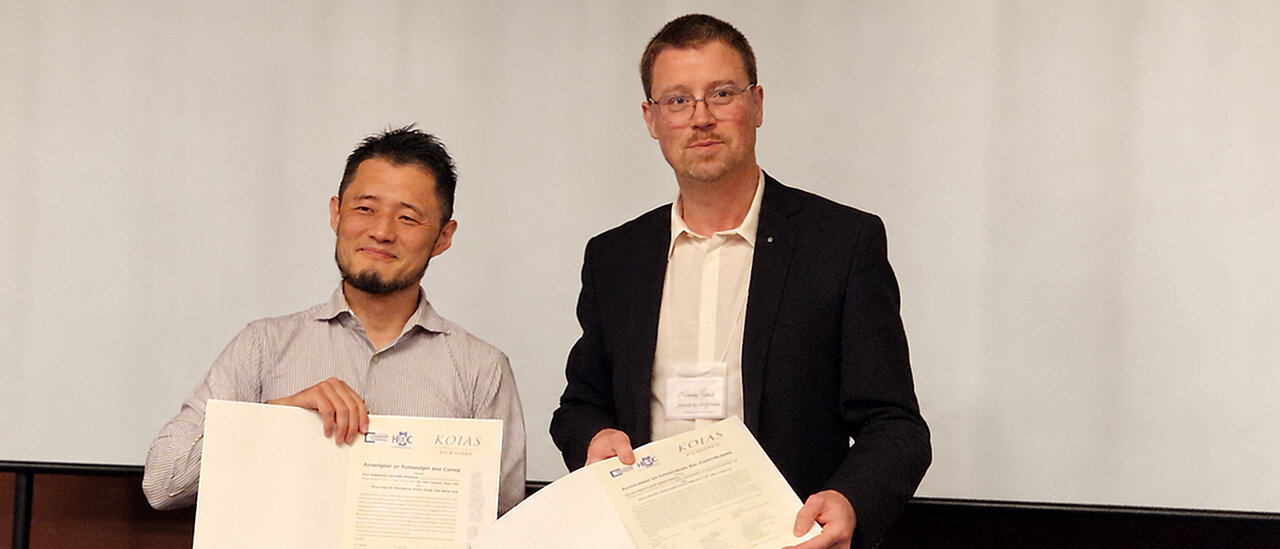
Also in attendance was Dr Andreas Rauh, Managing Director of the Human Dynamics Centre (HDC) at the Faculty of Human Sciences, Julius-Maximilians-Universität Würzburg. He introduced the HDC in a welcoming address and presented his current research. At the same time, the existing link between Würzburg and Kobe was given a new institutional foundation.
Two centres that complement each other
Founded in 2014, the HDC is an interdisciplinary think tank that brings together the research traditions of all eight institutes within the Faculty: ranging from philosophy, psychology and education through to special educational needs, political and social sciences, Protestant Theology and Religious Education to Sports Science and Human-Computer Interaction. In its first decade, the centre supported more than sixty interdisciplinary conferences, workshops and colloquia. These gave rise to networks, publications, international seasonal schools and opportunities for early-career researchers. The HDC regards knowledge transfer as a distinct mission alongside research and teaching.
KOIAS was founded in 2022 at Kobe University and has since been bringing together researchers from various disciplines and cultures to establish Atmospheric Studies as an internationally oriented field. A distinctive feature is the focus on language: terms such as ‘atmosphere’, ‘mood’, ‘ambiance’, the Chinese ‘qìfēn’ or the Japanese ‘fun’iki’ overlap, but do not mean exactly the same thing. It is precisely these differences – and the fact that some terms are untranslatable – that are “resources for thought”, according to Hisayama.
The HDC aims, as Rauh explained in Kobe, to create a “condition of possibility” for high-quality collaborative research. “Genuine collaboration also requires intellectual affinity, curiosity and trust,” says Rauh. “We have found all three at the Kobe Institute for Atmospheric Studies.”
An agreement on joint research
The “Agreement of Friendship and Cooperation” links the HDC with KOIAS; on behalf of the University of Würzburg, it is co-signed by Doris Fischer, Vice-President for Internationalisation and Alumni. The partners aim to explore opportunities for collaboration, for example through the ‘sharing of academic materials’ and the ‘development of a further research network on Human Dynamics and Atmospheric Studies’. The agreement is initially valid for one year and is automatically renewed annually; specific projects will be agreed upon jointly by both parties on a case-by-case basis.
For Rauh, the agreement is “not merely ceremonial”. It is already set to give rise to new academic contacts and joint initiatives. An international conference will be held every two years at alternating venues. The research findings of the SOFAS network will be published in a dedicated book series.
“The agreement is an invitation and a promise,” said Rauh in Kobe: “an invitation to develop joint workshops, publications, research visits and opportunities for early-career researchers, and a promise to remain open to questions that no single discipline, institution or national tradition can answer on its own.”
Würzburg’s expertise on atmospheres
Andreas Rauh has long been researching and teaching on atmospheres. The philosopher, educator and art teacher examines the phenomenon from aesthetic, phenomenological and educational perspectives – for example, by asking what material conditions create particular atmospheres or how the atmosphere of a classroom shapes learning. In addition to developing a qualitative-empirical approach to researching atmospheric perceptions, his work focuses, amongst other things, on learning atmospheres, urban experiences, materiality and the power of objects.
In Kobe, Rauh spoke on ‘Co-presence and actuality’: How can atmospheric theory and New Materialism – a school of thought that attributes an inherent agency to things and matter – be brought into dialogue with one another, and to what extent are atmospheres independent, effective phenomena? This topic exemplifies what the collaboration aims to achieve: productively linking different theoretical traditions, languages and cultural experiences.
“Atmosphere is not merely a backdrop,” says Rauh. “It is part of how human situations acquire meaning.” For the collaboration, Rauh hopes for “not just an exchange of materials, but an exchange of perspectives; not just a network of names, but a network of shared questions; and not just successful events, but lasting academic friendships”.
Researchers from the faculty who wish to participate in the collaboration can contact the HDC.
Contact
Dr Andreas Rauh, Human Dynamics Centre, T +49 931 31-86560, andreas.rauh@uni-wuerzburg.de
Further links
SOFAS Inaugural Conference in Kobe
Society for Atmospheric Studies (SOFAS)