
Visual imagery as a world view
09/22/2026An affinity rooted in a particular place: this is the theme of the new special exhibition at the Martin von Wagner Museum at the University of Würzburg. Ursula Jüngst’s paintings engage in a dialogue with Giambattista Tiepolo’s frescoes.
An artistic perspective on a work of art can sometimes help us to better understand the formal principles or the scope of meaning behind a pictorial composition. It can reveal dimensions that often go unnoticed by an ‘uninvolved’ observer – even though they may well be the more profound ones.
Ursula Jüngst, a painter originally from Miltenberg who now works in Barcelona and Nuremberg, has been impressed by Giambattista Tiepolo’s staircase fresco in the Residenz ever since her first visits to Würzburg as a child. It made such an early impression on her imagination that she intuitively incorporated certain compositional elements from it into her later paintings.
For a special exhibition at the Martin von Wagner Museum at the University of Würzburg (MvWM), Ursula Jüngst revisited the ceiling painting during several visits to Würzburg between 2024 and 2026. This – this time entirely conscious – visual experience has inspired some of the paintings that will be on display in the museum’s ‘Kleine Galerie’ in the autumn and winter of 2026/27.
“The artist’s creative encounter with her predecessor and colleague narrowed the historical distance between them,” explains Damian Dombrowski, Director of the Modern Art Department at the MvWM and Professor of Art History at the University of Würzburg. “It was as if Ursula Jüngst had recognised something in the fresco, in full bloom, which lay in embryonic form within her own formal language; from then on, the experience she had in the stairwell of the Residenz accompanied her creative work.”
Neither the 18th-century Venetian nor the contemporary painter would have been content with a mere visual perception of the world, Dombrowski continues: “They get to the very heart of it by revealing the rhythm of life that vibrates behind all appearances.” The painter chose to steer clear of the readily available knowledge about Tiepolo’s masterpiece in order to immerse herself directly in its visual world.
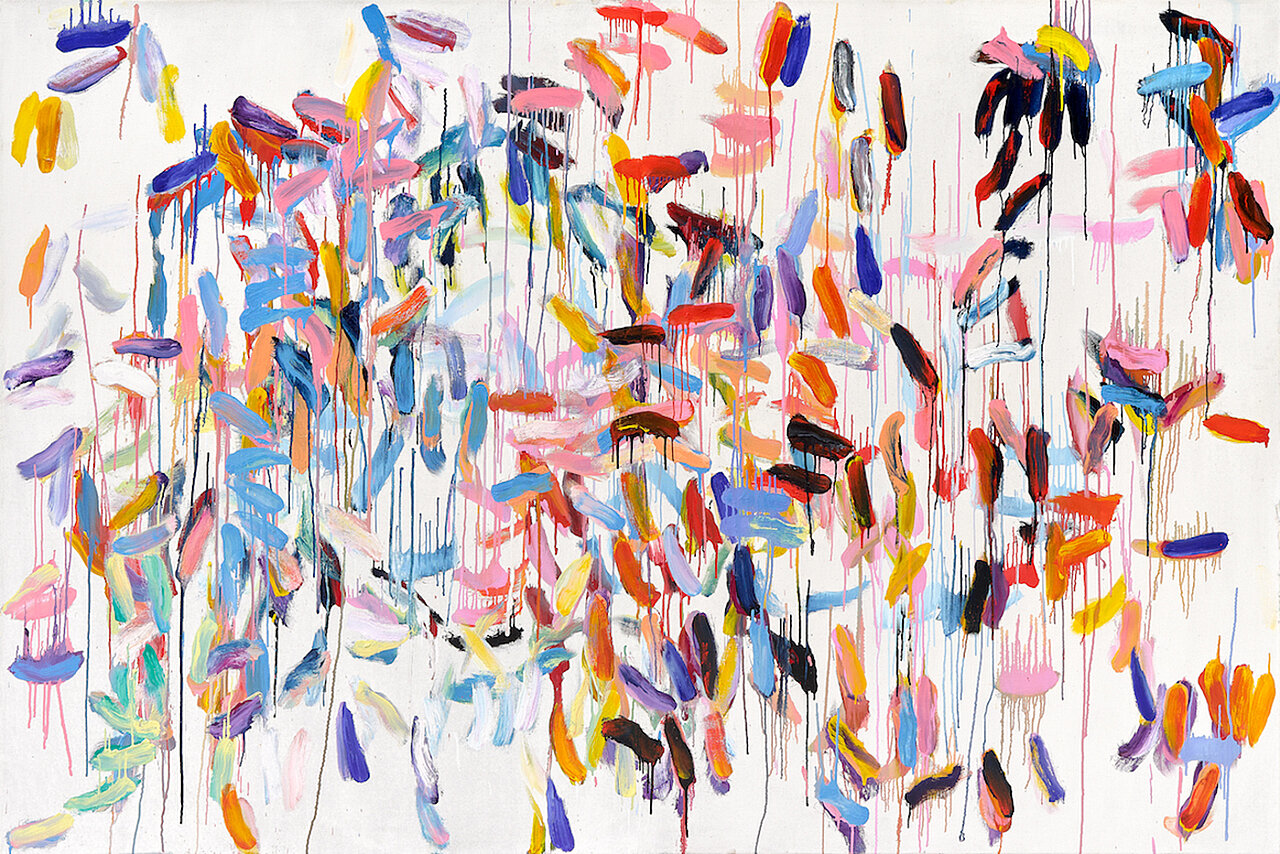
Like Tiepolo, Ursula Jüngst also strives for images that speak of the very heart of the world and deal with the relationship between the individual and the universe as a whole. Dombrowski explains the method she has devised for this: “The painter designates a specific colour form – the elongated, slightly curved brushstroke – as a universal module. These modules come together to form open, elastic, indeed breathing compositions, and illustrate the connection between elementary particles and universal order.”
Much like Tiepolo’s model of the world, her painting is also linked to fundamental questions about human coexistence. She does not depict the human being as a figure, but rather the forces, interactions, proportions and dimensions within which their existence is embedded against a universal backdrop. In her paintings, human beings encounter themselves, as it were, because she enables us to see and feel their dual participation in the atom and the cosmos.
In her own words, Ursula Jüngst perceives the stairwell fresco as though the top and bottom had swapped places, as though she could plunge into the sky as if into a sea. This ‘oceanic’ reversal is reflected in her work through a sense of immersion that has, for some years now, also stemmed from her working process: whilst painting, the artist repeatedly rotates the canvases, as evidenced by the strands of paint running down on multiple sides.
Ursula Jüngst describes the way the elements relate to one another within the picture as ‘painting against grief, pain and darkness’, as triggered by the manifold crises and catastrophes of the present day. She strives for encouragement in the face of monstrous hopelessness, for hope instead of despair, for ‘a glimmer of light despite everything’, as she puts it.
‘This approach is more strenuous and demanding than declaring social criticism to be art,’ says Damian Dombrowski. ‘Ursula Jüngst believes in visual healing, in the healing powers of aesthetic creation, just as Tiepolo believed in them.’ Yet the latter would probably also have agreed with her statement: ‘It is much harder to paint light than darkness.’
URSULA JÜNGST | TIEPOLO
DIE RHYTHMEN DER WELT
3 October 2026 to 31 January 2027
Small Gallery of the Martin von Wagner Museum at the University of Würzburg, South Wing of the Würzburg Residence, 2nd floor
Opening hours: Tuesdays to Saturdays 1.30 pm – 5.00 pm, Sundays 10.00 am – 1.30 pm (alternating weekly with the antiquities collection)
Free admission
The exhibition opens on Friday 2 October 2026 at 7.00 pm. Speakers will include the Chancellor of the University of Würzburg, Dr Uwe Klug; the Second Mayor of Würzburg, Sandra Vorlová; Professor Damian Dombrowski; and Ursula Jüngst. Due to limited seating, please register in advance:
T +49 931 31-82283, mvw-museum@uni-wuerzburg.de