
On the trail of paintings: digital exhibition on provenance research
04/28/2026How can the provenance of paintings be investigated? How can we find out who a work of art rightfully belongs to? Researchers at JMU show this in a digital exhibition.
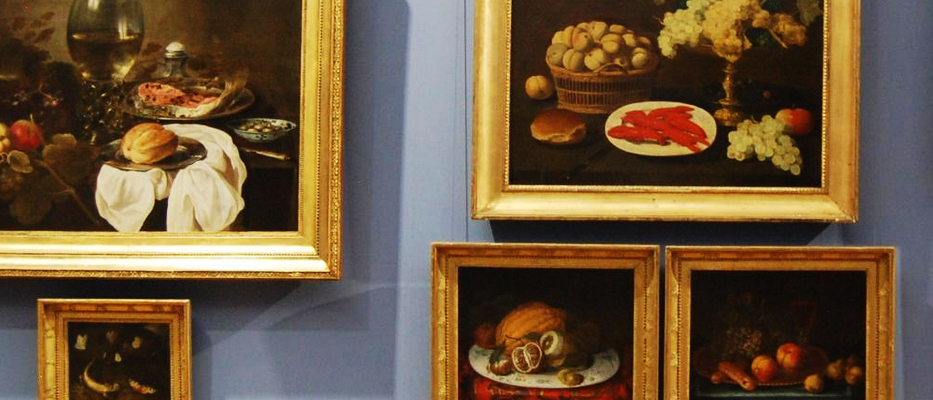
From 2019 to 2022, Würzburg museum researchers Nora Halfbrodt and Inga Benedix searched for clues in the painting collection of the Martin von Wagner Museum at the University of Würzburg. With the museum’s active support, they traced the provenance of all new acquisitions catalogued between 1933 and 1998.
This work is called provenance research. Its aim is to clarify the history and ownership of art and cultural artefacts: Were they passed on legally? Did the person handing over the object do so voluntarily and under fair conditions? Is the object currently in legal ownership? If not, to whom should it be returned?
The researchers' work ultimately resulted in the University Museum being able to return two works to their rightful owners.
Research work dramatised and digitally presented
A digital exhibition (in German language) is now making some of the results of the project accessible to the public. Susanne Bremer and Lyric Stott from the Chair of Museum Studies have developed them in story and scrollytelling format. In scrollytelling, viewers navigate through multimedia, dramaturgically interwoven elements.
The title of the exhibition: On the trail of images. How to: Provenance research in one of the largest university museums in Germany
Research in telephone directories, magazines and military records
The exhibition illustrates the methods of provenance research using eleven selected paintings. It shows how old telephone directories, auction documents, magazines and US military records helped to trace the often chequered history of the paintings.
In the case of the painting "Narcissus", for example, which the museum bought from Frankfurt art dealer Karl Lengler in 1959, it was not possible to find out anything about its previous ownership.
However, due to Lengler's biography and his connections to a man who had organised many auctions of Jewish-owned art objects, the researchers classified the painting as "orange" on the provenance traffic light. This means that there are strong indications that an unlawful acquisition took place, even if this cannot be clarified more precisely with today's knowledge.
Rightful owners of two paintings found
The painting "Death and the Miser" was marked red on the provenance list. The owners had given it to the museum under duress in 1933. 90 years later, it was returned to the Würzburg Masonic Lodge "Zu den zwei Säulen an der festen Burg".
JMU report on the return (in German)
The traffic light also showed red for a folding altar measuring 36 by 40 centimetres. The rightful heirs of the previous owners, the couple Sigmund and Sara Seligsberger, were identified. The 16 descendants, who live in Canada, the USA and Israel, decided to give the winged altar to the Martin von Wagner Museum on permanent loan.
JMU report on the case (in German)
Sponsors: The provenance research project at the Martin von Wagner Museum was funded by the German Centre for the Loss of Cultural Property (DZK) in Magdeburg. It was led by Professor Guido Fackler from the Chair of Museum Studies in cooperation with Museum Director Professor Damian Dombrowski.
Knowing how: digital exhibitions
If you would like to find out more about digital exhibitions, you should read the conference proceedings "Exponat - Raum - Interaktion. Perspectives on Curating Digital Exhibitions" (in German). It was edited by Hendrikje Cariaus and Guido Fackler. The volume is available as a free download in the eLibrary of the publishing house Brill | Vandenhoeck & Ruprecht | Böhlau.
Information on the Master's programme "Collections - Provenance - Cultural Heritage" at the University of Würzburg.