
Exhibition: Surgery from the 16th century to the present day
06/09/2026An exhibition at the Würzburg City Archive shows how operations were performed in the past to treat bladder stones and other ailments. Items from the historical collection of the Juliusspital take centre stage.
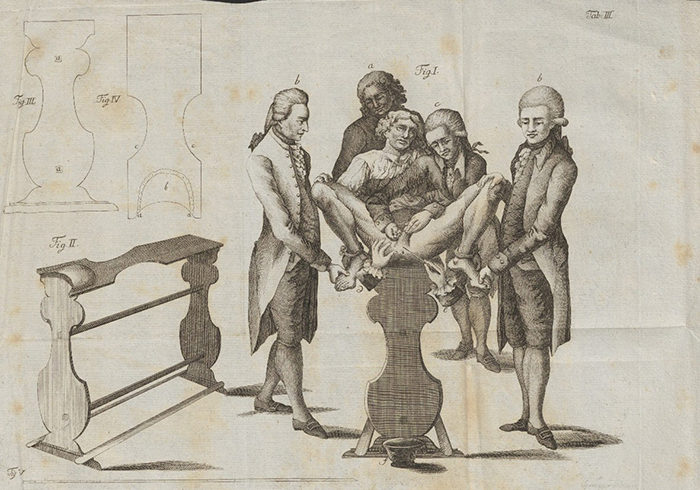
Bladder stones were widespread in the 16th and 17th centuries. Why? Because people drank a lot of wine and beer back then due to the poor water quality - this increased the uric acid and stones formed in the bladder. And these were often the size of pigeon or chicken eggs. Mostly men were affected.
In order to remove the extremely painful stones, surgery was performed at the time - without anaesthetic. The procedure was ingenious: It began with the surgeon pushing a probe through the urethra into the bladder. An incision in the perineum or pubic bone region was then essential for the further surgical procedure.
Special exhibition of the Medical History Collections
If you would like to know more about how bladder stones were operated on in the 16th century, you can visit the Würzburg City Archive. Until 14 July 2026 , the University of Würzburg's Medical History Collections will be showing the special exhibition "450 Jahre Juliusspital. Pflegen - Heilen - Lehren" (in German language only).
The exhibition covers key aspects of surgery from the 16th century to the present day. It shows which inventions from Würzburg have had a lasting impact on surgery. And it explains the significance of medical-historical objects for research and teaching to this day.
The historical surgical teaching collection of the Juliusspital, which is celebrating its 450th anniversary this year, takes centre stage. From bladder lithotomy and bloodletting to ether anaesthesia, the exhibition takes up various topics from the history of surgery and explains them using numerous highlight objects.
Opening hours and guided tours
The exhibition "450 Jahre Juliusspital. Pflegen - Heilen - Lehren" can be seen from now until 14 July 2026 on the first floor of the Würzburg City Archive at Neubaustraße 12. It is open Monday to Thursday from 8 a.m. to 4 p.m.; admission is free. A free booklet accompanying the exhibition is available.
Public guided tours take place every Wednesday at 2 pm. The meeting point is the foyer of the city archive. Registration is not required; participation is free.
Individual tour appointments can be arranged by e-mail; the contact person is julia.zehnder@uni-wuerzburg.de.
Use in teaching
The surgical teaching collection of the Juliusspital was already used to train medical students when it was established in the 18th century. It is still used in teaching today: it provides students of human medicine and dentistry as well as nursing and midwifery with insights into the history of the respective professions. The hospital's collection is preserved in the Medical History Collections of the University of Würzburg.
Organiser
The exhibition is a co-operation between the JMU Institute for the History of Medicine and the Würzburg City Archives. It accompanies the university lecture series of the same name.