
Moving with momentum into new material states
09/01/2026Controlling the properties of materials by making atoms oscillate back and forth – this is what Dr Jan Gerrit Horstmann and his new Emmy Noether group are working on at the University of Würzburg.
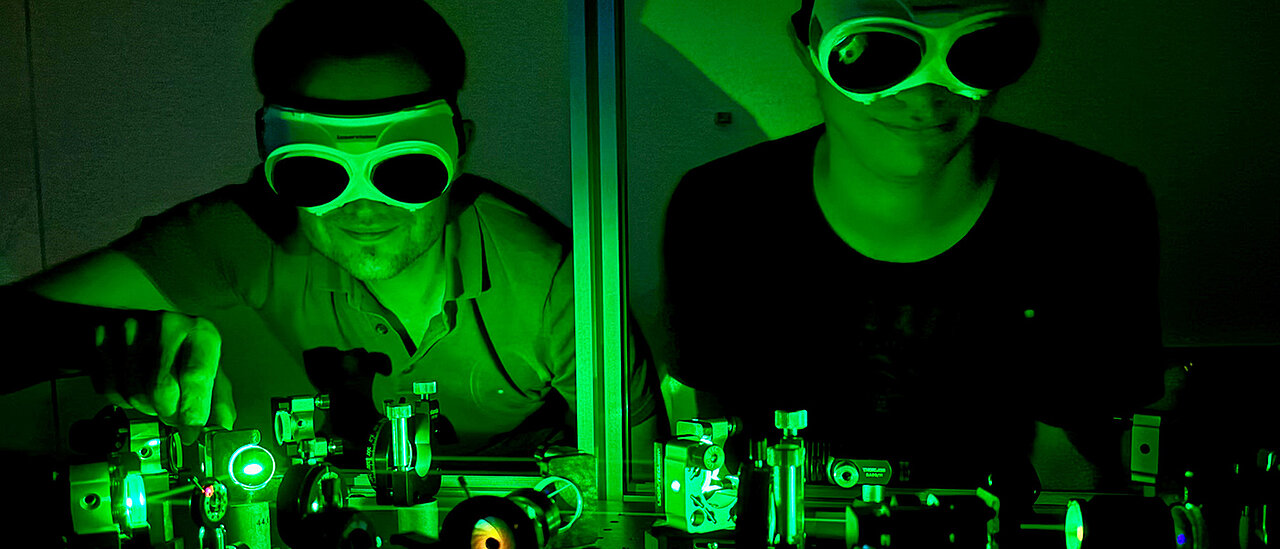
Since 16 August 2026, Dr Jan Gerrit Horstmann has been establishing a new Emmy Noether Group at the Julius-Maximilians-Universität Würzburg (JMU), establishing a new Emmy Noether group focusing on ultrafast structural dynamics, which is based at the Institute of Physical and Theoretical Chemistry. Together with an interdisciplinary team working at the interface between chemistry and physics, Horstmann will develop new approaches to the optical control of the microscopic motion of atoms.
The German Research Foundation (DFG) is funding the group with just under 2.3 million euros over the next six years.
Atomic vibrations in the (laser) focus
“The atomic structure of materials and molecules has a major influence on their physical and chemical properties, such as conductivity, magnetism or reactivity,” says Gerrit Horstmann.
However, atoms are not arranged rigidly but oscillate around their equilibrium position in various patterns of motion. “In recent years, methods have been developed that make it possible not only to specifically excite certain oscillations with short laser pulses, but also to synchronise them across thousands of unit cells at the same time. In this way, we can oscillate materials into entirely new states that could not be achieved in thermal equilibrium,” Horstmann continues.
He compares the process to a rock concert: “At first, every member of the audience claps and jumps at their own frequency. Then the band starts playing and suddenly tens of thousands of people are moving in unison. The only problem is that we cannot yet control all the atoms’ motion patterns in this way.”
Gerrit Horstmann and his team are working on this by focusing on a specific class of vibrations: so-called Raman-active vibrations. “Raman-active vibrations are of great importance for phase transitions or energy conversion processes in molecules, but cannot be directly excited by the electric field of light. In a sense, you have to find an intermediary between light and the Raman vibration – for example, electrons or other vibrations that can be excited directly,” explains Horstmann.
“Typically, this involves exciting electrons into excited states, which ultimately introduces a great deal of energy and heat into the system. In the worst-case scenario, this causes materials to melt before they can transition into new, vibration-induced states.”
This is precisely where the junior research group intends to focus its efforts. Using mid-infrared laser pulses, they are attempting, amongst other things, to strongly excite Raman-active vibrations without permanently exciting electrons. This could enable more efficient switching of processes deep within materials, as such excitation would be hardly absorbed at all.
Interdisciplinary collaboration between chemistry and physics
With its focus on ultrafast structural dynamics in materials and molecules, the research group fits perfectly into Würzburg’s research landscape.
“I am particularly looking forward to the interdisciplinary collaborations at the interface between chemistry and physics, for which there is a unique environment here at the University of Würzburg. From chemical synthesis and optical characterisation through to nanostructuring and the theoretical description of functional materials and molecules, everything comes together in one place here in Würzburg,” emphasises the new Junior Research Group Leader.
“It is also extremely exciting to have the prospect of to support existing and future collaborative projects, such as the Cluster of Excellence ctd.qmat or Collaborative Research Centres, with our structure-centred perspective on chemical and physical processes, whilst at the same time continuing the great tradition of Raman spectroscopy at the University of Würzburg.”
Background of the new group leader
Jan Gerrit Horstmann, born in 1989, grew up in Minden. From 2009, he studied physics at the University of Göttingen on a scholarship from the German National Academic Foundation, where he completed his PhD in the field of ultrafast structural dynamics at surfaces in Claus Ropers’ research group. For his PhD, which he completed with the distinction ‘summa cum laude’, he was awarded the Born-Franck Dissertation Prize by the University of Göttingen.
With grants from ETH Zurich and the Swiss National Science Foundation (SNSF), he subsequently conducted research from 2022 onwards in Professor Manfred Fiebig’s research group at ETH Zurich. Horstmann’s methodological developments for observing non-equilibrium dynamics in ferroic materials were recognised there with an ETH Seed Award.
In 2025, he accepted an offer from JMU Würzburg to return to Germany and took charge of an independent junior research group within the ‘Excellent Ideas II’ programme at the Institute of Physical and Theoretical Chemistry. Here, he successfully secured a grant from the Daimler and Benz Foundation as well as funding from the DFG for his Emmy Noether group.
Emmy Noether Programme
The Emmy Noether Programme of the German Research Foundation (DFG) is aimed at postdocs and junior lecturers on fixed-term contracts at an early stage of their academic careers.
It offers them the opportunity to qualify for a university professorship by independently leading a junior research group over a period of six years.
Contact
Dr Jan Gerrit Horstmann, Early-Career Research Group on Ultrafast Structural Dynamics, Tel: +49 931 31-83182, Email: gerrit.horstmann@uni-wuerzburg.de