

Digital twins for communication networks
03/03/2026IT professionals work with network digital twins to analyse and optimise communication networks in a fail-safe manner. Würzburg researchers are developing such twins for networks with over 10,000 nodes.
Communication networks make it possible to make phone calls with a smartphone, surf the internet at home and carry out digital work processes at work. The larger a network, i.e. the more nodes it has, the more difficult it is to permanently monitor quality and functionality.
IT specialists want to use Network Digital Twins (NDT) in order to be able to test networks safely against failures and complications. The name says it all: a digital twin of a physical network serves as a model that can be operated almost in real time. This allows networks to be simulated, analysed, optimised and potential problems to be identified. The spectrum ranges from a simple router to the national network of an internet provider.
Since January 2025, a research team from the Chair of Communication Networks at Julius-Maximilians-Universität Würzburg (JMU) has been working on an NDT for large communication networks, which can count over 10,000 nodes in size. The project is funded by the Bavarian Joint Research Programme (BayVFP) - Digitisation of the Free State of Bavaria. The project partner is the Würzburg-based company Infosim GmbH & Co.
"Our partner specialises in network management systems. This enables IT professionals to manage individual components of a network. Our aim is to marry NDT with these systems and use them to develop a future-proof, next-generation network management system," says Professor Tobias Hoßfeld, Head of the JMU Chair and project manager together with Dr. Frank Loh.
A generator to simulate national grids
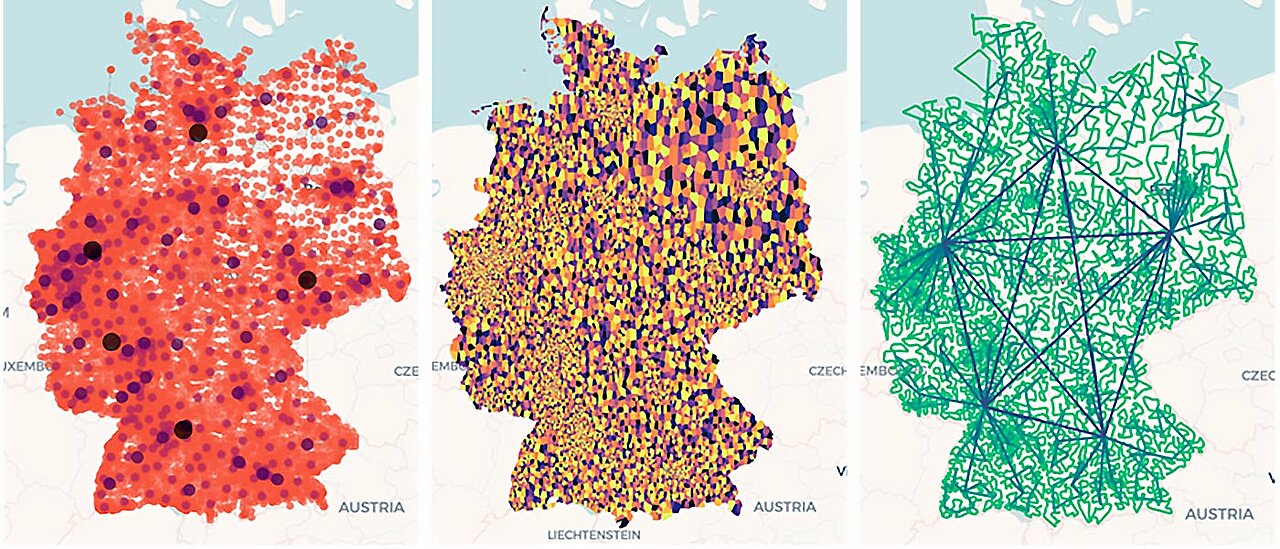
So far, the team has developed a functioning topology generator, i.e. an application that visualises the arrangement of devices or nodes in a network. This can be used to design potential networks at a national level. "For example, we created a topology for internet providers based on population data for Germany. The generator gave us a possible node distribution for data traffic at a national level," explains Fabian Poignée, a member of the chair and project team.
The software tool has already been well received by companies and the specialist audience at the NetSys Conference 2025 in Ilmenau. The generator developed by the JMU scientists provides the basis for simulations that internet providers will be able to use for network optimisation in the future. In the next phase of the project, the team will focus on identifying existing problems in large networks, analysing their resilience and testing their scalability.
Finding the right level of abstraction
"Scalability is particularly important for digital twins, as a large simulated network typically loses accuracy compared to its real counterpart in order to be calculated in a reasonable amount of time and support the real-time requirements of digital twins," says Poignée. The key is to choose the right degree of abstraction. It is important to decide which components can be removed for the simulation and which must be left in.
In the next stage of the project, Professor Hoßfeld and his team want to connect the generator to the Infosim network management system.
Further links
The topology generator POBTOG is available as open source software on GitHub.
More information about the project
Contact
Prof. Dr. Tobias Hoßfeld, Head of the Chair of Computer Science III (Communication Networks), T +49 931 31-86049, tobias.hossfeld@uni-wuerzburg.de
Dr. Frank Loh, Chair of Computer Science III (Communication Networks), T +49 931 31-88229, frank.loh@informatik.uni-wuerzburg.de
Fabian Poignée, Chair of Computer Science III (Communication Networks), T +49 931 31-85960, fabian.poignee@uni-wuerzburg.de
Additional images