
Database on the Nuremberg Commercial Jurisdiction is online
04/14/2026Unique legal-historical sources on Nuremberg as a trading centre in the early modern period are now accessible online - thanks to a research project led by law professor Anja Amend-Traut.
After ten years of research, a comprehensive database on Nuremberg's commercial jurisdiction in the early modern period has been published. It is available to all interested parties free of charge: go.nuernberg.de/datenbank_handelsgerichtsbarkeit
The database is a result of the project funded by the German Research Foundation (DFG) entitled "Nuremberg Commercial Jurisdiction. Commercial opinions, judicial practice and their contribution to the development of commercial law normativity in the early modern period".
Law professor Anja Amend-Traut, Chair of German and European History of Law, Canon Law and Civil Law at the University of Würzburg, led the DFG project from 2015 to 2025.
The aim of the project was to systematically catalogue the so-called Nuremberg Pareres - commercial expert opinions on commercial law disputes -, make them digitally accessible to the public and, in a further step, analyse them scientifically. As the City of Nuremberg writes in a press release, the database offers researchers and those interested in history a new kind of access to a unique collection of sources in Europe.
Unique serialised tradition
In Nuremberg, the market masters, as the most experienced merchants in the trading centre, prepared expert opinions on trade law issues and conflicts on request from home and abroad. Comparable expertises also came from other trading cities such as Frankfurt am Main or Leipzig.
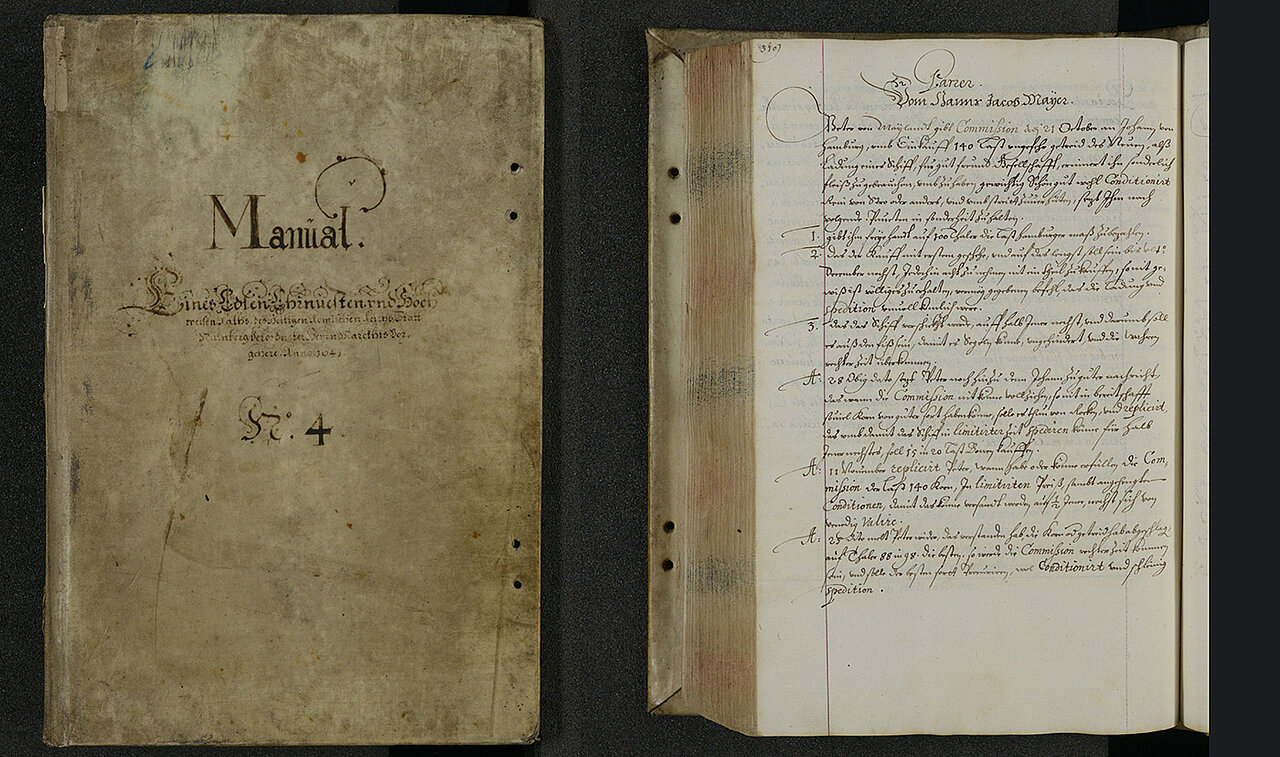
In contrast to these cities, however, the Nuremberg expertises have been preserved in an almost complete serial tradition: The so-called Pareres books document the period from 1628 to 1806 almost completely - with the exception of a lost volume for the years 1660 to 1677. With around 1,400 surviving expertises, the inventory clearly surpasses comparable collections from other trading centres.
A comparison with the so-called copy books also showed that the Pareres books do not represent a complete collection. For this reason, the project also included those expertises that have only survived in the copy books.
New access through digital cataloguing
Despite their exceptional state of preservation, the Nuremberg Pareres had hardly been scientifically analysed until now. The extent of the records and the long period of time involved made thematic research and systematic analysis particularly difficult.
This is where the database comes in: A legal-historical indexing system makes it easier to find specific subject areas. In addition, personal history, social history and location-based searches are possible. The pareres can be analysed both qualitatively and quantitatively - in relation to individual subject areas as well as the entire collection.
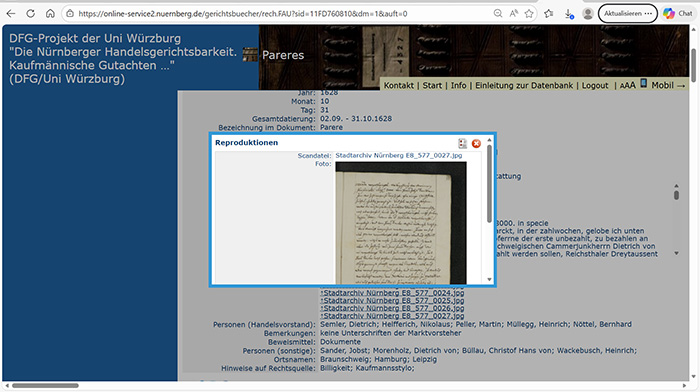
Each data record is linked to a high-resolution scan of the original source, which can be enlarged for better readability. Transcriptions of the handwritten texts are also available. This makes working with the early modern sources considerably easier and faster.
The digital platform makes it possible to view the original scan and transcription in parallel and at the same time carry out targeted searches - without having to visit the archive on site. The project thus makes an important contribution to the digitisation and internationalisation of legal-historical research.
Contact
Prof. Dr Anja Amend-Traut, Chair of German and European History of Law, Canon Law and Civil Law, University of Würzburg, anja.amend-traut@uni-wuerzburg.de
Additional images