
Viral infection hinders the heart’s recovery
10/27/2026A herpes virus, which most people carry, can impair the heart’s recovery following a heart attack. This is shown by a study carried out by researchers from Würzburg and Rijeka.
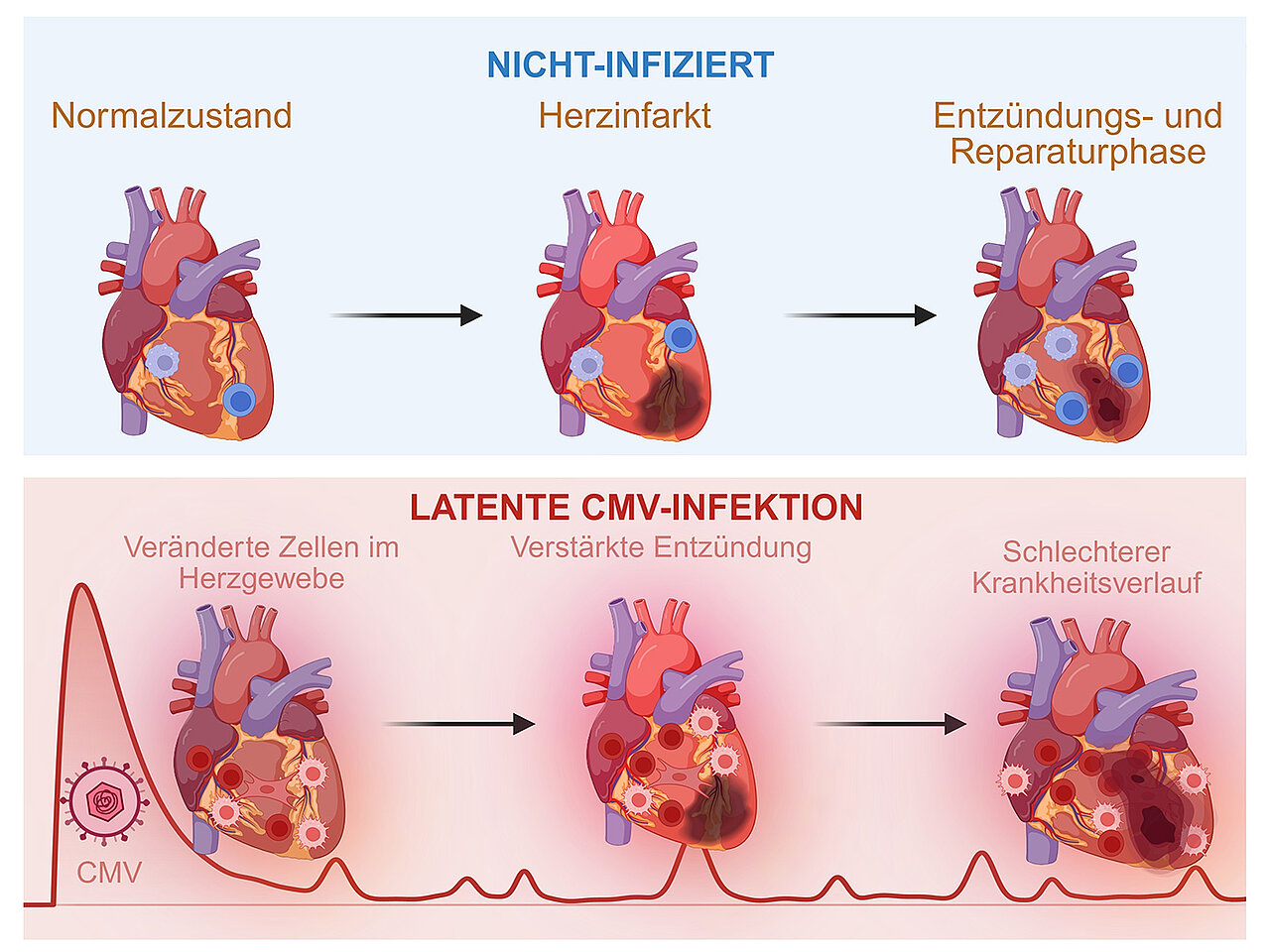
The healing of the heart following a heart attack is not a passive process. It is orchestrated by the immune system. In the first few days, inflammatory cells clear away the dead tissue.
The inflammation must then subside in good time so that a firm and stable scar can form. If the inflammation is too severe or persists for too long, the damage can spread and the heart may undergo adverse remodelling.
The outcome of a heart attack therefore depends not only on how much heart muscle has been lost; it is also influenced by the individual’s immune system.
It is precisely these cardio-immune interfaces that the Collaborative Research Centre SFB 1525 at Würzburg University Hospital (UKW) is investigating. The focus is on the extent to which the immune system influences heart disease and whether these interactions can be exploited therapeutically.
New publication in *Circulation Research*
A particular focus is on infections that a person has had over the course of their life and which shape the immune system, such as infections with the widespread cytomegalovirus (CMV).
In a study recently published in the journal *Circulation Research*, a research group from SFB 1525, in collaboration with researchers from the University of Rijeka (Croatia), found that a CMV infection can alter the immune response and thereby significantly impair the heart’s recovery following a heart attack.
Cytomegalovirus: a silent companion for life
The cytomegalovirus belongs to the herpesvirus family, which also includes the viruses that cause cold sores, chickenpox and glandular fever. A common feature of all herpesviruses is that, following the initial infection, they remain in the body and can persist there for life in a dormant state known as latency.
The immune system must therefore constantly monitor the virus, which leads to chronic, low-grade inflammation in the body. Infection with cytomegalovirus is very common and usually goes unnoticed in healthy people. Many people are therefore completely unaware that they carry the virus.
From mice to humans
As the murine cytomegalovirus behaves in mice in a similar way to the human virus in humans, the mouse model is ideal for investigating these infections in greater detail.
This is where the expertise of the Centre for Proteomics in Rijeka and the Institute of Systems Immunology in Würzburg (WüSI) comes into play. Both institutions are internationally recognised research centres in the field of viral immunology and are investigating the impact of CMV infections on the immune system and tissues.
The Würzburg SFB is also analysing the mechanisms associated with age-related changes in the immune system – known as immunosenescence – which negatively affect the potential for recovery following a heart attack.
“We are investigating how infections with common pathogens such as CMV influence so-called immunosenescence and thus impair the capacity for repair following a heart attack,” explains Professor Gustavo Ramos, corresponding author of the publication.
Together, the researchers were able to demonstrate that the hearts of latently infected mice contain significantly more immune cells and that their tissue shows signs of silent inflammation at the molecular level.
However, this condition alone does not damage the heart or the animals’ general health. If, however, a latently infected mouse suffers a heart attack, the inflammatory environment intensifies and impairs healing, meaning that heart function cannot recover as well as in uninfected mice.
Findings confirmed in humans
Indeed, in two retrospectively analysed patient cohorts from Würzburg and Newcastle, the researchers found a link between CMV-specific cells and antibodies, on the one hand, and the course of the disease following a heart attack, on the other.
“These results initially indicate an association,” explains Professor Stefan Frantz, Director of the Department of Internal Medicine I at the UKW and spokesperson for SFB 1525. “Whether, and to what extent, a stronger immune response to CMV is associated with poorer recovery of heart function must be clarified by further prospective clinical studies. However, our experimental research provides new insights into the mechanisms that may underlie this clinical association.”
From competition to cooperation
“I am delighted that our research groups have found common ground and that we are able to join forces so successfully,” says Gustavo Ramos, the study’s last author.
The groups in Croatia and Germany had initially stumbled upon the same scientific question independently of one another. Whilst the researchers in Rijeka were investigating the impact of a latent CMV infection on the heart, the Würzburg group led by Gustavo Ramos at the German Centre for Heart Failure (DZHI) and Georg Gasteiger at the Würzburg Max Planck Research Group for Systems Immunology (WüSI) were addressing a similar question. Rather than competing to be the first to publish, the teams decided to combine their expertise.
Ramos and Gasteiger subsequently organised a mini-symposium on viral infections and heart muscle diseases at the Würzburg Institute of Systems Immunology in the summer of 2024, at which the researchers pooled their research ideas and further developed their joint work.
Consequently, Eleni Dapergola (WüSI), Marko Šustić (University of Rijeka) and DiyaaElDin Ashour (DZHI, Med I) share first authorship of the publication.
The work was led by Gustavo Ramos (DZHI, MED I) and Georg Gasteiger (WüSI), as well as Ilija Brizić in Rijeka. Ioakim Spyridopoulos and his research team from Newcastle, along with research groups from Paris and Graz, also played a key role in the study.
Three poster awards on CMV and myocardial diseases
“The link between CMV and heart muscle diseases is currently emerging as a key topic at the interface between cardiology and immunology,” says Georg Gasteiger.
The Director of the Würzburg Institute of Systems Immunology refers to three poster awards that were recently presented in this very field at the 3rd Cardioimmunology Conference. The conference took place from 30 September to 2 October 2026 near Madrid.
- Eleni Dapergola, a PhD student at WüSI, received a poster award for the paper published in *Circulation Research *.
- Marko Šustić was honoured for a poster that built on this study.
- Another poster award went to Alexandra Cirnu, a PhD student in Professor Brenda Gerull’s research group at the DZHI. As part of the SFB A4 project, she investigated possible links between CMV and genetic cardiomyopathies. The results were recently published as a preprint (https://doi.org/10.64898/2025.12.11.693827) and are currently undergoing peer review.
Publication
Cytomegalovirus Latency Fuels Inflammation Following Myocardial Infarction. Circ Res. 14 September 2026. https://doi.org/10.1161/CIRCRESAHA.125.327799