
Classicism, sentimental
07/28/2026The Martin von Wagner Museum at the University of Würzburg has now added another work by the Viennese Classicist Füger to its collection. The donation is likely to provoke mixed reactions in the picture gallery.
Heinrich Friedrich Füger, who would later become known as the ‘Art Pope of Vienna’, was, as a young man, part of the growing tide of artists who had been flocking to Italy since the mid-18th century. Their motivation: to perfect their art in the presence of works from antiquity and the modern era that were regarded as ideal.
In July 1777, half a year after arriving in Rome, Füger described his role models in the finest Enlightenment jargon: ‘Just as reason and the finer sensibilities of the soul constitute the true distinction of humankind, so too are the finest works those crafted with these two in mind. The four great names of Raphael, Domenichino, Poussin and Le Sueur are my proof.’
The painter Domenico Zampieri, known as Domenichino and originally from Bologna, was one of the artists in early 17th-century Rome who accorded absolute authority to the classical tradition. Füger drew lasting inspiration from this ‘Baroque classicist’ whilst in Rome; as late as 1802, he had drawings published which he had produced a quarter of a century earlier based on works by Domenichino.
Faith, Love and Hope as female half-figures
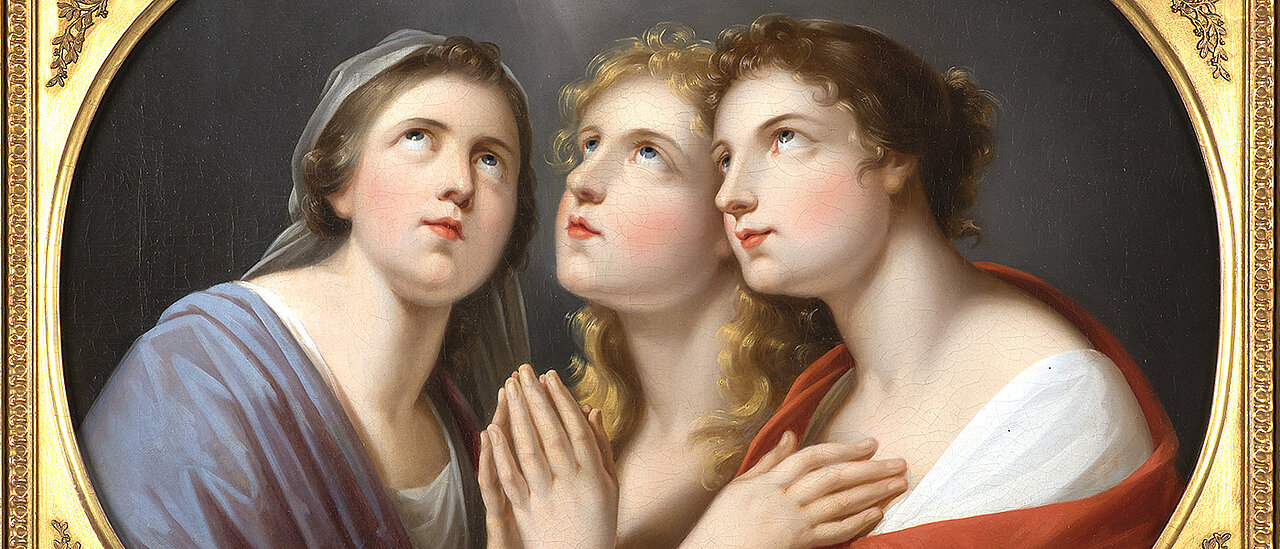
At that time, Füger had been Director of the Vienna Academy of Fine Arts for seven years. Around the same time, shortly after 1800, a painting is thought to have been created which has now been donated to the Martin von Wagner Museum from a private collection. The horizontally oval painting depicts the Christian virtues – Faith, Love and Hope – as female half-figures gazing up towards the divine light.
“These three young women cannot deny their lineage from Domenichino,” says Damian Dombrowski, Director of the Gemäldegalerie and the Graphische Sammlung. “In particular, Domenichino’s series of Sibyls from the 1610s has quite clearly served as the inspiration here.” Significantly, the upward gaze that characterises the virtues first appeared in Füger’s Roman works.
Dombrowski, who is also a professor of art history, has good reason to be delighted with the new acquisition: “It was only last autumn that we were able to secure a large-scale composition by Füger for the collection, partly because the University of Würzburg covered half the costs. This acquisition was particularly important to us because Martin von Wagner studied under Füger at the Vienna Academy.”
Another side of Classicism
Since then, Füger’s *Thetis before Zeus * and Wagner’s *The Council of the Greeks * – two monumental works by teacher and pupil – have hung opposite one another in the Picture Gallery; they are even thematically coordinated, as the subjects of both paintings are drawn from Homer’s *Iliad*. “With the painting acquired through this donation, however, a completely different side of Classicism will soon be on display,” announces Dombrowski.
As Wagner had already stated during his time in Vienna, “Homer and the Bible” were his favourite books. This preference was shared by large sections of the Classicist movement. Alongside figures and historical scenes from antiquity, Christian themes continued to be depicted – and, in the long run, proved even more influential, as they ultimately paved the way for Romanticism.
The triad of Christian virtues dates back to the Apostle Paul’s Epistle to the Corinthians; it expanded upon the ancient canon of the cardinal virtues. As female personifications, Faith, Love and Hope had been depicted countless times in Christian visual art since the early Middle Ages.
Is this kitsch or art?
Yet, as Dombrowski explains, the iconography chosen here is something fundamentally new: ‘Virtues are character traits; even in personified form, they had always retained their status as ultimately abstract attributes. Füger, on the other hand, imbues his virtues with a sense of deep emotion, the sort previously reserved for depictions of pious saints in the presence of a miracle.”
This sentimental charge is conveyed above all by the heavenward gazes of the three figures, which Füger borrowed from Domenichino. It is precisely this feature that will spark controversial commentary, Dombrowski predicts: “There will certainly be talk of ‘kitsch’. Historically speaking, however, such a categorisation is incorrect, for Füger’s virtues reflect the religious visual culture of his time in its purest form.”
And this is achieved with remarkable quality. A single painting entitled *Die Andacht* (*Devotion*), which was auctioned in Munich in 2019, stands on a par with *Die Christlichen Tugenden* (*The Christian Virtues* ), both iconographically and in terms of quality. Other works of similar content, including those in public collections, fall short of this standard in terms of artistic merit.
Delighted donors
At the handover to the Martin von Wagner Museum, the former owners, Marc Stabernack and Heinz-Günther Sowart, were delighted with the location already reserved for the painting from their collection: In the Classicism Gallery of the Gemäldegalerie, it will hang near Thetis and Zeus, yet at a sufficient distance so as not to be overwhelmed by the monumental Füger.
Stabernack and Sowart, from Offenbach, were visiting the Gemäldegalerie for the first time – and were astonished to discover that the destination for their painting was, as they put it, a ‘mini Louvre’. With their donation, the museum has certainly become a little richer once again – and the ‘Sattelzeit’ section a little more complete.