
Mars technology put to the test: Würzburg team tests cave robot
05/19/2026A team from the University of Würzburg has tested new technologies for Mars research on the Zugspitze. The results can serve as a basis for the use of robots on future missions.
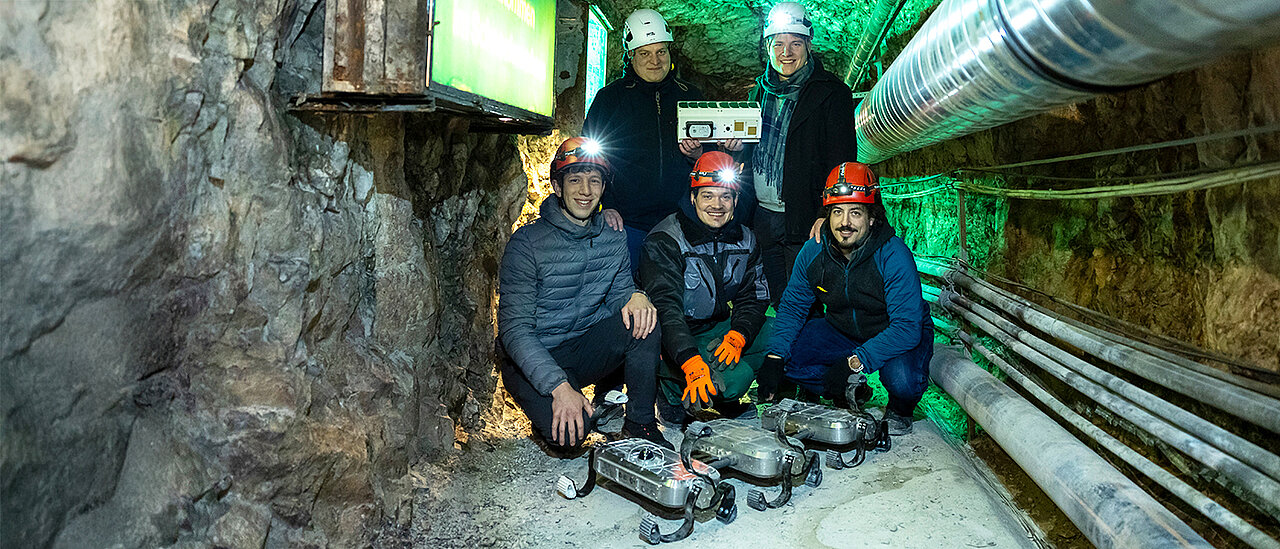
At the end of March, the surroundings of the Schneefernerhaus Environmental Research Station on Germany's highest peak were transformed into a simulated Martian landscape: A team from the Interdisciplinary Research Centre for Extraterrestrials (IFEX) at the University of Würzburg investigated how a technology they had developed would perform under extreme conditions. The aim was to test technologies and procedures for future Mars missions in an environment that was as realistic as possible.
The team therefore used the "Kammstollen" at Schneefernerhaus, which runs along the north side of the Zugspitze, as a test environment. Drilled in 1926 so that skiers could get from the Austrian cable car to the ski area on the German side of the summit, the tunnel now ends on the 7th floor of the Schneefernerhaus.
The building used to serve as a hotel, but is now a globally unique environmental research station. And since January 2024, Julius-Maximilians-Universität Würzburg (JMU) has been one of several institutions that use the Schneefernerhaus for their research. With its shielded environment and good accessibility, the tunnel offers ideal conditions for simulating Mars exploration experiments.
Caves as the key to the search for life on Mars
Why a tunnel of all things? "Researchers assume that possible life on Mars is more likely to be found below the surface. Caves there may provide protection against strong radiation and extreme temperatures," explains Hakan Kayal, Professor of Astronautics and Head of the Interdisciplinary Research Centre for Extraterrestrial Science at the University of Würzburg.
However, such environments are technically challenging: radio communication is severely restricted or not possible at all. New communication solutions must therefore be developed.
Communication like on Mars
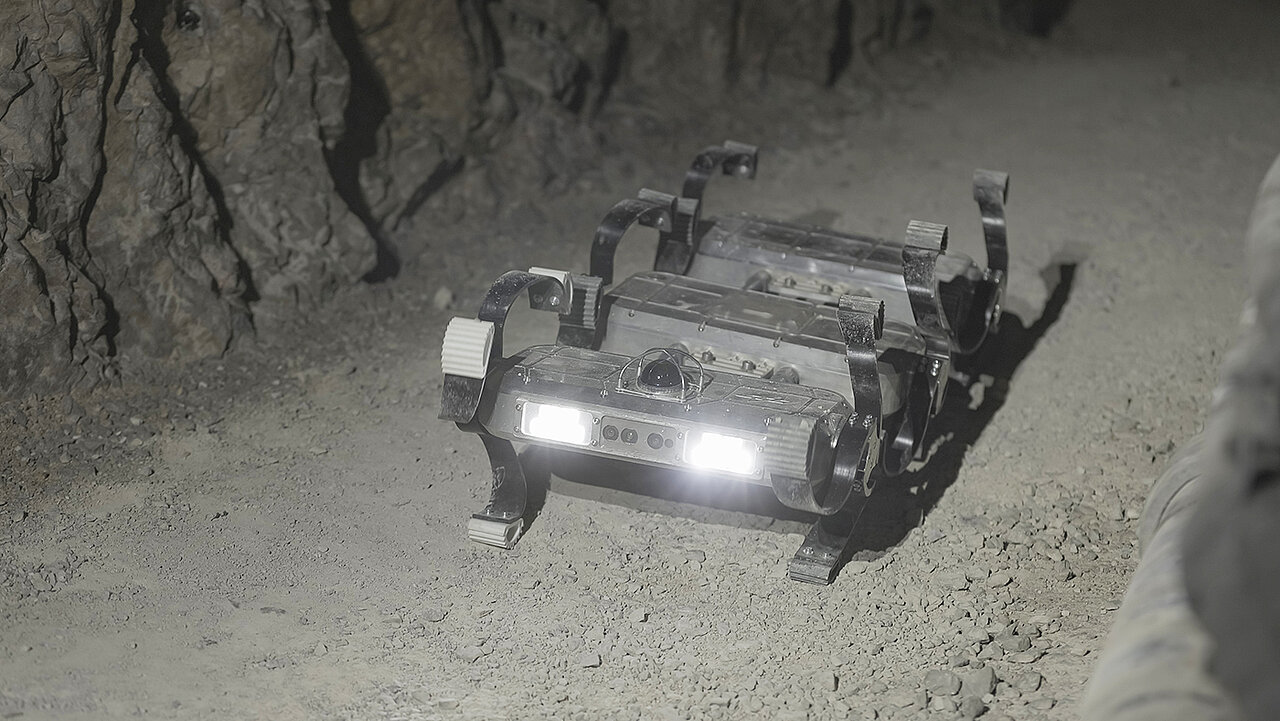
The Würzburg team has trialled a seamless communication chain that could also be used in future Mars missions. The Scout Rover from the German Aerospace Centre (DLR), developed at the Institute of Robotics and Mechatronics in Oberpfaffenhofen, was used.
The signals had to travel a long way: From the control centre on Earth, they first reached a replica of a satellite that simulates a radio station in Mars orbit. From there, the signal was sent to a base station at the entrance to the cave, the so-called gateway.
Inside the tunnel, the connection was then passed on via five individual radio relays, like a bucket brigade. This system made it possible to reliably bridge a distance of over 250 metres and to reach the exploration robot in a stable manner even deep inside the mountain. For the technology, the participants drew on experience gained from the successful SONATE-2 satellite mission in Würzburg as well as hardware from the Berlin-based company IQ spacecom.
Successful test under realistic conditions
"We succeeded in controlling the rover completely remotely," says Hakan Kayal, describing the result. Using so-called telecommands, the team was able to trigger specific actions, such as taking photos of the surroundings, creating laser scans or targeted driving movements through the terrain.
The data collected in the process flowed back to the control centre via the entire radio chain, where the researchers evaluated it directly in order to decide on the robot's next steps. "This process corresponds to the procedure for a real space mission," says Kayal.
After completing the tests, the research team's conclusion is clear: "The Mars analogue test we carried out impressively demonstrates that complex communication and exploration scenarios can be reliably implemented even under extreme conditions." The findings provide important impetus for future robotic missions to explore Mars, especially for operations in difficult-to-access cave environments.
A view into the sky complements Mars research
The project is complemented by the AllSkyCAM, which was installed in September 2025 and is being operated and tested by Hakan Kayal and his team as part of the "VaMEx3 - MarsSymphony" project at the Schneefernerhaus. As part of the gateway, this camera not only enables continuous observation of the sky, but also serves as a platform for testing the communication link to the orbiter, particularly with regard to the transmission of large amounts of data.
The AllSkyCAM thus fulfils a dual function within the gateway: on the one hand, the investigation of atmospheric phenomena such as clouds and meteors as well as the systematic recording of previously unidentified anomalous phenomena (UAP) and, on the other hand, the practical validation of the powerful data communication, which is also of central importance for the connection and operation of the cave robot.
Funding
The VaMEx3-MarsSymphony project is funded by the German Aerospace Centre (DLR) with funds from the Federal Ministry of Economics and Climate Protection (BMWK) on the basis of a decision by the German Bundestag (FKZ 50RK2451A).
Contact
Prof Dr Hakan Kayal, Professorship of Space Technology, hakan.kayal@uni-wuerzburg.de
Links
Additional images