
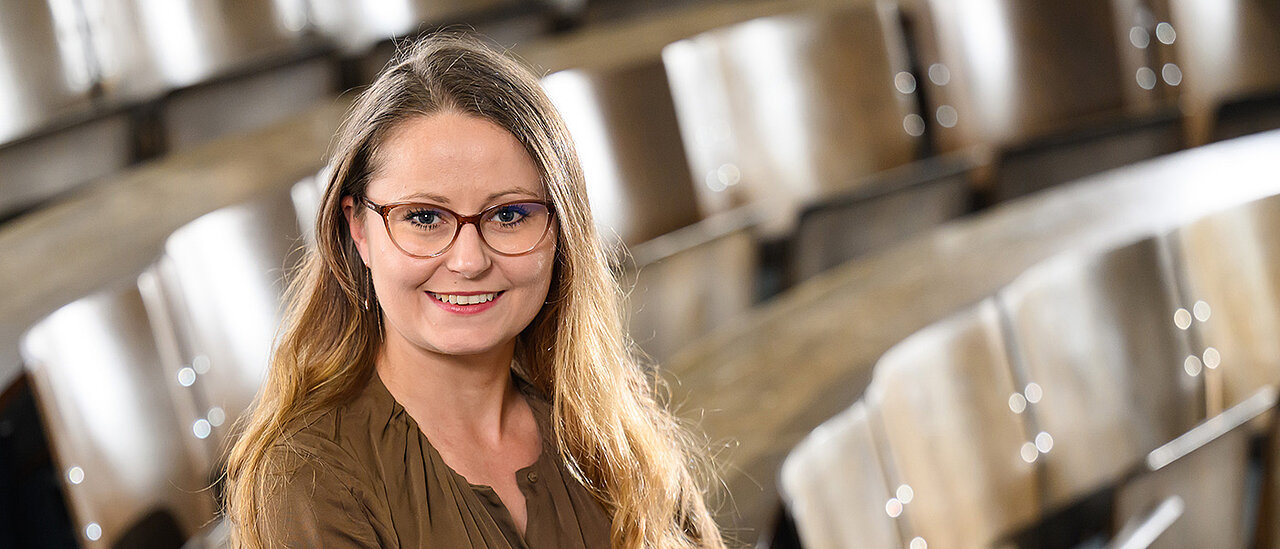
Back to her roots: Camilla Schinner takes up the Chair of Anatomy
07/07/2026Camilla Schinner is a new member of the Department of Anatomy at the University of Würzburg. Her research focuses on genetic heart conditions that can lead to sudden cardiac death in young, fit people.
The heart beats irregularly and too fast, and no longer pumps enough blood into the circulatory system. Those affected suddenly collapse and lose consciousness – often in the middle of a football pitch or whilst playing sport. Arrhythmogenic cardiomyopathy is a genetic heart condition and one of the most common causes of sudden cardiac death in young, athletic people. It is precisely this condition that is the focus of Camilla Schinner’s research.
Schinner is new to Julius-Maximilians-University of Würzburg (JMU); on 1 July 2026, she took up the Chair of Anatomy II. In other words, the anatomist is not really new to JMU. One could also say that, by accepting this appointment, she has come full circle. After all, she began her medical studies here 16 years ago. And even before her preliminary medical examination (Physicum), her passion for anatomy was kindled here.
“Ever since the dissection course, I’ve been absolutely fascinated. Understanding the human body – literally getting to grips with it – combined with hands-on dissection and teaching: that was perfect for me. It quickly became clear to me: this is what I want to do for a living,” says the 36-year-old.
Camilla Schinner’s enthusiasm during the dissection course also led her to the research topic she is still working on today. “Because I wanted to learn more about anatomical research, I asked Jens Waschke, my anatomy professor at the time, if I could write my PhD thesis under his supervision. He agreed, and so I followed him to Munich, where he had just taken up a post at LMU.” And in Jens Waschke’s laboratory, everything revolved around cell-cell adhesion, particularly desmosomal junctions.
New disease mechanisms identified
These have since formed a key focus of Camilla Schinner’s research. They also play a significant role in arrhythmogenic cardiomyopathy. “In these cases, genetic mutations in the adhesion molecules of the heart muscle cells cause the cells to tear apart under stress. This disrupts the electrical connections in the heart and triggers life-threatening cardiac arrhythmias,” says Schinner. In a later stage, this leads to a reduction in the number of heart muscle cells and scarring of the organ.
In her studies, the researcher is investigating the molecular mechanisms of the disease and working on new therapeutic approaches, such as using medication to strengthen cell adhesion. Using mouse models, patient samples and stem cell-based heart muscle models, the research group has identified several promising drug candidates. It is now investigating their precise mechanism of action in order to further develop the therapy in a more targeted manner.
At the University of Würzburg, Schinner has found an ideal interdisciplinary environment for this work. Here, she works closely with the German Centre for Heart Failure (DZHI) and contributes her expertise to two Collaborative Research Centres (SFBs) – the SFB ‘Cardio-immune Interfaces’ led by Professor Stefan Frantz, and the Transregio ‘Desmosomal Dysfunction of Epithelial Barriers’ with the Würzburg site spokesperson, Professor Nicolas Schlegel. This scientific environment alone made it clear to her that she should apply for this post and ultimately accept the university’s offer.
Understanding over rote learning
Anatomy is traditionally regarded as a subject in which students have to memorise vast quantities of terminology. Schinner takes a different approach to training the next generation of doctors. For her, a functional understanding is the clear priority. Rather than testing students on even the smallest foot muscle in isolation, she emphasises the importance of students gaining a thorough understanding of how the body works, its functional relevance and its clinical significance for their future careers. For Schinner, teaching is not a duty but a passion: “Research and teaching are the two central pillars of my work. I wouldn’t want to give up one for the other.”
As a woman holding a professorship, Schinner is also aware of her role as a role model. Women remain under-represented in academic leadership positions. “Whilst parity often still prevails up to postdoc level, women are more likely to hesitate to take the next step in their careers after that,” she says. In her experience, women in particular need to have a little more confidence in their own abilities in order to take the next step in their careers.
Inspiration and role model
Schinner wants to offer encouragement: self-doubt is normal and can make you better by prompting you to question things critically. You just mustn’t let it hold you back. In moments like these, it can help when someone else says: “Yes, of course, go for it! You’ve got a good chance!” She has experienced this kind of support herself.
And role models play an important role in this. She has already noticed this clearly since accepting the appointment to the chair. The response, particularly from other women, shows her that it serves as a role model when a relatively young woman like herself takes up a chair.
About the person
Camilla Schinner (born 1990) studied medicine from 2010 to 2016 at the University of Würzburg, LMU Munich, and in the USA in Cincinnati and New York. She completed her PhD in 2019 at LMU Munich, having conducted research on cell-cell adhesion in the heart for her doctoral thesis between 2012 and 2017.
Following posts as a postdoctoral researcher and junior research group leader at the University of Basel, she became an assistant professor at Hannover Medical School. Most recently, she worked as an assistant professor at the University of Bern and as a professor and deputy director of the institute at the UKE in Hamburg. Since 2023, she has also been a certified specialist in anatomy.
Contact
Prof. Dr med. Camilla Schinner, Institute of Anatomy and Cell Biology, camilla.schinner@uni-wuerzburg.de