

Bumblebees decide efficiently
03/03/2026When searching for food, most insects specifically head for flowers that promise them the best yield. Researchers from the Universities of Konstanz and Würzburg have now shown how bumblebees orientate themselves.
Which strawberries on the supermarket shelf might be the sweetest? Is it better to choose the deep red ones? The ones with the green spots? Or the ones with the most intense flavour?
To make such decisions, we process vast amounts of information every day and use all our senses to do so. In turn, we learn from experience which information to interpret and how.
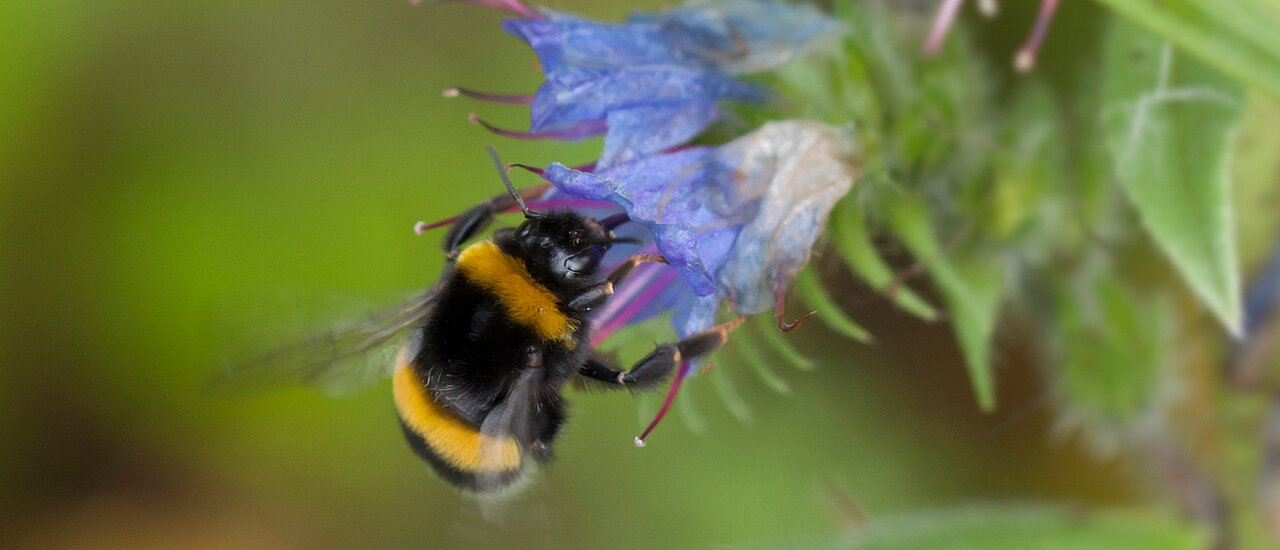
Animals are no different. A recent study by the University of Konstanz in cooperation with the University of Würzburg investigated the decision-making behaviour of bumblebees. The results showed that these insects take a "shortcut" in information processing if it saves them time. They are not so dissimilar to the decision-making behaviour of humans.
The study has been published in the journal Science Advances.
Many flowers require many decisions
When searching for food for their colony, bumblebees fly to hundreds of flowers every day and have to decide each time which ones might be the most rewarding.
"Due to the frequency of these decisions in short periods of time, bumblebees are particularly well suited for investigating decision-making processes," says Anna Stöckl, neuroethologist at the University of Konstanz, alumna of the University of Würzburg and co-author of the study.
To prevent them from wasting too much energy on unpromising flights, it helps the insects to memorise which types of flowers contain nectar or pollen and which are therefore likely to provide food on their next visit. "To remember the good source, they orientate themselves primarily by the colour of the respective flower. However, they are also able to recognise shape, pattern and scent," says Stöckl.
This is very similar to people in front of the supermarket shelf, who know from experience that a certain colour and smell are reliable criteria when choosing strawberries.
Experiments with dummy flowers
But how many characteristics do bumblebees memorise in order to quickly and reliably identify a good food source?
To test this, the researchers first trained the insects to associate a certain combination of characteristics with a reward. This involved combining dummy flowers in different colour constellations with a pattern or a shape.
In one run, for example, the bumblebees were rewarded with a sugar solution for a blue, star-shaped flower, while a yellow, round flower contained only water. In a further experimental set-up, training was also carried out with flowers whose colours were very similar (for example yellow and orange).
After several runs, the researchers observed that the bumblebees increasingly flew to the flowers that offered them a sugar solution. "This was a sign for us that they had memorised the characteristics of the flower and included them in their decision," says Stöckl.
Only what is necessary is memorised
Now the actual research began to find out which of the characteristics the bumblebees are guided by: shape, colour or both equally? To get to the bottom of this question, the researchers mixed the colours and shapes that had already been trained and presented the bumblebees with a choice between the learned characteristics: The star-shaped flower was now yellow, for example, while the round flower was blue.
The clear result: the bumblebees continued to orientate themselves by the colour they had learned - not by the shape - and most of them expected to find their nectar in the blue flower. In a further step, all the flowers were finally uniformly grey and only the shape or pattern indicated the reward.
Here, too, the result was clear: only when the colours were not so easy to distinguish in the training phase did the bumblebees also remember the shape and chose the correct shape of the later uniformly grey flowers significantly more often. The bumblebees adapted their decision-making strategy, i.e. what and how much they memorised, to the uniqueness of the flower characteristics.
The bumblebees' approach saves resources
However, the researchers found it particularly interesting to look at the time taken during the training phase: "Bumblebees that were trained on the flowers with the clear colours needed significantly less time to learn which flowers they had to fly to for the reward. The bumblebees on the flowers with similar colours, on the other hand, needed longer for the learning process," explains biologist and co-author Johannes Spaethe from the University of Würzburg's Biocentre.
According to Anna Stöckl, this approach allows the bumblebees to save valuable resources: "Learning and storing the colour alone probably requires less processing effort than remembering the colour and shape at the same time. Only when the colours were similar did the bumblebees also learn shapes and patterns. However, this in turn meant that learning took longer. In this way, the insects always achieve the best possible result using the principle 'as much as necessary and as little as possible'," she summarises the results of the study.
The bumblebees' decision-making process is not so dissimilar to that of humans: out of many green strawberries, everyone will probably choose the red ones. However, if all the strawberries in the display are deep red, it is also helpful to know what ripe strawberries smell like.
Publication
Johannes Spaethe, Selma Hutzenthaler, Alexander Dietz, Karl Gehrig, James Foster, Anna Stöckl (2026): Bees flexibly adjust decision strategies to information content in a foraging task. Science Advances, 25 February 2026, DOI: 10.1126/sciadv.adw9320
Funding
The project was supported by the Bavarian Academy of Sciences and Humanities, the Zukunftskolleg of the University of Konstanz and the Emmy Noether Programme of the German Research Foundation.