
Awards for young researchers in Würzburg
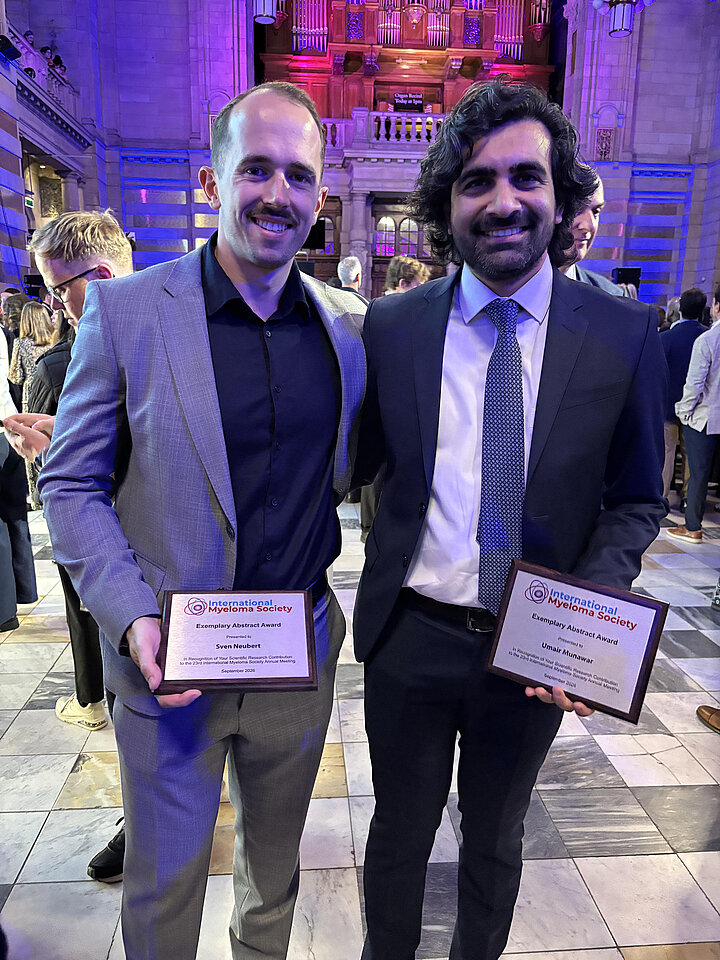
10/06/2026Sven Neubert and Umair Munawar from the University Hospital were presented with the International Myeloma Society’s Young Investigator Awards at the International Myeloma Congress.

How can immunotherapies be used even more effectively to treat multiple myeloma – a malignant disease of the bone marrow? And why do some cancer cells manage to survive the immune system’s attack? Two young researchers from Würzburg are investigating these questions – and were honoured for their work at the 23rd Annual International Congress of the International Myeloma Society (IMS) in Glasgow, Scotland. Dr Sven Neubert and Dr Umair Munawar from the Department of Medicine II at Würzburg University Hospital (UKW) each received an ‘IMS Young Investigator Award for Exemplary Abstract’. Sven Neubert, a junior doctor in the Haematology-Oncology department, was recognised for his outstanding research into CAR-T cells in CNS myelomas. Umair Munawar, a research assistant in Professor Martin Kortüm’s research group, impressed the jury with his discovery of how acquired mutations in the FCRL5 gene help myeloma cells evade the immune system.
Functional effects of FCRL5 mutations on immune evasion under cevostamab in multiple myeloma
Cevostamab is a new immunotherapy currently being investigated in clinical trials. This so-called bispecific antibody links the patients’ own T-cells to their myeloma cells by simultaneously binding to a protein on the T-cells and to a protein on the surface of the cancer cell called FCRL5. The therapy has shown promising results in heavily pre-treated patients; however, the disease recurs in some of them.
To understand why this happens, Umair Munawar from the Kortüm research group analysed bone marrow samples taken from patients during the course of their treatment with cevostamab. In one patient who was no longer responding to cevostamab, the cancer cells had acquired mutations in the FCRL5 gene. The researchers replicated these mutations in myeloma cell models and, in collaboration with Professor Markus Sauer’s research group at the University of Würzburg, used modern high-resolution and live-cell microscopy to observe how the drug interacts with its altered target.
“We identified two different mechanisms by which the myeloma cells were able to evade cevostamab,” explains Umair Munawar. In the first, the mutated protein never reaches the cell surface, so the antibody has no way of binding to it. In the second mechanism, although the protein does reach the cell surface and cevostamab continues to bind to it, the cevostamab-FCRL5 complex is rapidly taken up into the cell. As a result, T cells are not brought into effective contact with the cancer cell and the immune attack fails to materialise.”
These insights into how such resistance arises can help to monitor patients more effectively and develop treatment strategies that remain effective for longer. The next step is to understand the mechanisms by which the drug-target complex is taken up into the cell, in order to determine how resistance can be overcome or prevented altogether. In addition to the Sauer Lab at the Chair of Biotechnology and Biophysics, the Princess Margaret Cancer Centre in Toronto was also involved in the project. The project was supported by the Stifterverband and the German Research Foundation (DFG-TRR387).
CAR-T cells open up new prospects for rare CNS involvement in multiple myeloma
The project led by Sven Neubert, in which Umair Munawar and other researchers from the research groups of Professor Martin Kortüm and Professor Johannes Waldschmidt also collaborated, focused on a different type of immunotherapy – CAR-T cell therapy. The findings offer new prospects for patients in whom the malignant plasma cells have also spread to the central nervous system (CNS), affecting the brain or the meninges. Although this so-called CNS involvement is rare, it is associated with a particularly poor prognosis. As those affected are often excluded from large clinical trials of new therapies, there has been little data to date on how effective modern CAR-T cell therapies are in this situation.
The results of a multicentre study led by the UKW make an important initial contribution towards changing this. The study examined 25 patients with relapsed or progressive multiple myeloma, despite treatment, and CNS involvement. All received a CAR-T cell therapy targeting the BCMA surface protein. This was the first time that the two BCMA-targeted CAR-T cell products approved for multiple myeloma – idecabtagene vicleucel (Ide-cel) and ciltacabtagene autoleucel (Cilta-cel) – had been compared with one another.
Info: In CAR-T cell therapy, the patient’s own T cells are first extracted. These are genetically modified in the laboratory so that they can recognise the B-cell maturation antigen BCMA on myeloma cells and subsequently target and attack it. The modified immune cells are then reintroduced into the body.
CAR-T cells appear to be able to combat tumour cells in the nervous system as well
The real-world data collected from everyday clinical practice under the leadership of Johannes Waldschmidt show that modern immunotherapy can lead to deep and, in some cases, long-lasting remissions even in this high-risk group. “For a long time, it was unclear whether CAR-T cells were sufficiently effective in the central nervous system and whether this form of treatment was sufficiently safe for this particular group of patients. However, our results are encouraging,” says Sven Neubert, lead author of the study. In many patients, the tumour foci regressed completely or to a large extent, both in the bone marrow and in the central nervous system.
Encouraging initial results, but the risk of relapse remains high
The treatment proved to be generally safe. Serious neurological side effects occurred only rarely and were consistent with the known safety profile of CAR-T cell therapy. Despite the high response rates, however, treating this group of patients remains a major challenge. In some patients, the disease progressed again after only a short time. Overall, the prognosis was worse than for people with multiple myeloma without CNS involvement. “To further improve the long-term prognosis for these patients, additional treatment strategies are still needed,” says Sven Neubert.
The trainee haematologist-oncologist shares first authorship of the study with Dr Markus Maulhardt, a junior doctor in the Department of Haematology & Medical Oncology at Göttingen University Medical Centre (UMG). The corresponding author is Professor Johannes Waldschmidt, senior registrar in haematology at Charité – Universitätsmedizin Berlin. Dr Evgenii Shumilov, a lecturer and specialist in internal medicine, haematology and oncology at Münster University Hospital (UKM), also played a key role. Special thanks are also due to Professor Hermann Einsele. As Director of the Medical Clinic and Polyclinic II at the UKW, he established the necessary framework for the project.
According to the researchers, the results suggest that CNS involvement should not be considered a contraindication for BCMA-targeted CAR-T cell therapy. Precisely because these patients have had only very limited treatment options to date, the multicentre real-world data can provide important guidance for treatment decisions in everyday clinical practice. Both BCMA CAR-T cell products were effective; in particular, long-lasting remissions were achieved in some cases with Cilta-cel.
Why some patients respond better
In his next research project, which is funded as part of the Clinician-Scientist Programme at the Interdisciplinary Centre for Clinical Research (IZKF) at the UKW, Sven Neubert intends to build on the study’s findings.
The focus is on the question of why modern immunotherapies, such as CAR-T cell therapy, work particularly well in some patients, whilst others respond not at all or only temporarily. What mechanisms underlie this, and how can they be influenced?
One key area of research is so-called soluble BCMA (sBCMA). This is a soluble component of the BCMA protein, which is also found on the tumour cells of multiple myeloma. Among other things, Neubert wishes to investigate whether sBCMA can provide insights into how effective a treatment is, whether resistance develops, and how the disease progresses. In the long term, this knowledge could help to tailor therapies more precisely to individual patients and increase their chances of success.
In addition, there are plans to examine the cancer cells in the cerebrospinal fluid of patients in whom multiple myeloma has spread to the central nervous system (CNS). Using modern molecular biology techniques, the aim is to investigate what makes these cells particularly aggressive or resistant to treatment. The objective is to identify new targets for future treatments and to expand the treatment options available to these high-risk patients.
Additional images