

Award-winning platelet researcher
02/10/2026Biomedical scientist Sarah Beck from the University Hospital of Würzburg has received the "Frank Misselwitz Memorial Award for Excellence in Thrombosis Research" for her research.
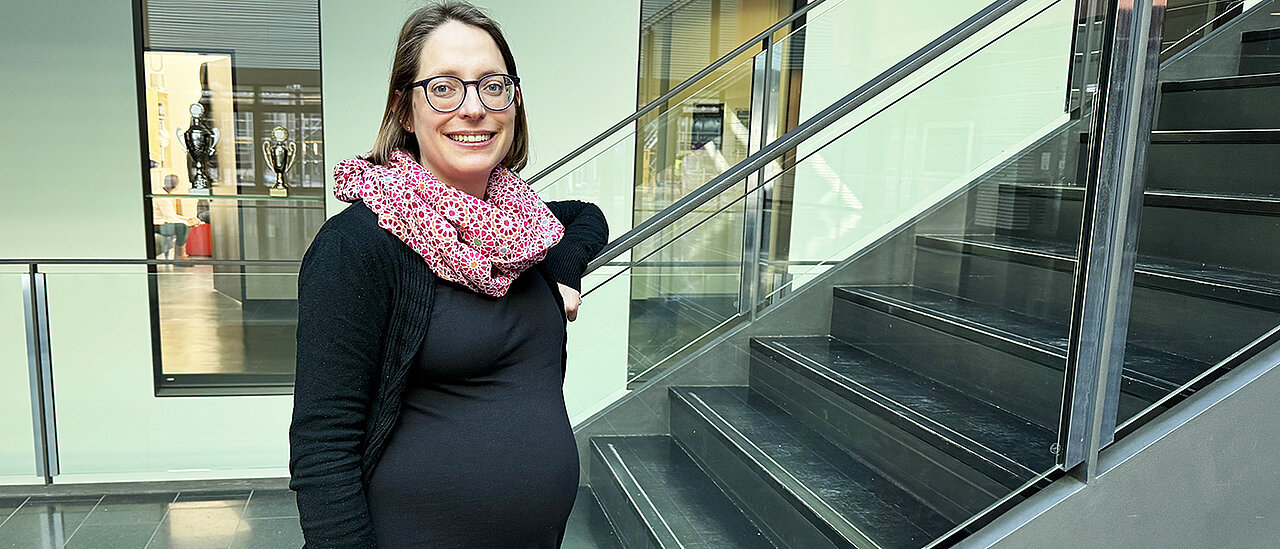
Sarah Beck is a "Würzburg native" through and through: She was born at Würzburg University Hospital (UKW), gained her university entrance qualification at Riemenschneider-Gymnasium and studied biomedicine at Julius-Maximilians-Universität (JMU). Through her Master's thesis, she found her way into the Würzburg Platelet Group, which is known and respected far beyond the state's borders. This is based in Experimental Biomedicine I at the UKW and the Rudolf Virchow Centre (RVZ).
She found research on platelets, as thrombocytes are commonly known, so exciting that she immediately went on to complete her doctorate in the working group of Bernhard Nieswandt, Director of Experimental Biomedicine I. The 37-year-old now has a research project on experimental haemostaseology in the new Research Training Group 3190 "Thrombo-Inflame" and is in the process of setting up her own research group with funding from the German Research Foundation.
She has now been honoured for her platelet research to date with the "Frank Misselwitz Memorial Award for Excellence in Thrombosis Research" from the Bayer Foundation.
Platelets are the main driver of thrombosis
Thrombocytes are the smallest cellular components of the blood. They are formed from megakaryocytes in the bone marrow and have no cell nucleus, which makes them very sensitive. "As platelets lose their quality very quickly, we always need short transport routes and have to complete our experiments within two to three hours," says Beck, describing the special nature of platelets.
In her research, she concentrates on the molecular mechanisms of platelet activation during haemostasis. This process is vital for stopping bleeding and closing wounds. During haemostasis, platelets adhere to the edges of the wound and form a plug that provisionally seals the injury. During blood clotting, long fibres of fibrin are formed which, together with the platelets, seal the wound tightly. However, if too much fibrin is formed, for example in the case of chronic wounds, this can lead to vascular occlusion, i.e. thrombosis.
Revolutionary regulatory mechanism of blood clotting
For a long time, it was not fully understood how coagulation can be limited. Until Sarah Beck, as first author, publisheda revolutionary regulatory mechanism of fibrin formation in the renowned journal Nature Cardiovascular Research.
Together with an international team of authors, she uncovered glycoprotein V (GPV), which is located on the surface of platelets, as a control centre for haemostasis and thrombus formation. They derived new therapeutic approaches from these findings.
Improving haemostasis in people with bleeding problems
"GPV is released by the enzyme thrombin during blood clotting. As the soluble GPV binds to thrombin again, it changes its activity so that less fibrin is formed," says Beck, explaining the mechanism. In various experiments on experimental thrombosis models, the addition of soluble GPV prevented the formation of vaso-occlusive thrombi and provided significant protection against experimental stroke and the associated brain damage.
Interfering with this mechanism may improve haemostasis in people with bleeding problems. "We have developed an antibody against GPV that prevents it from being cut by thrombin - so no soluble GPV is produced. This increases thrombin activity and fibrin formation, which in turn improves haemostasis in cases with impaired haemostasis," explains the biomedical scientist. Anti-GPV treatment has great clinical potential - a starting point that she is currently investigating in more detail in a mouse model.
"This research project is exciting from a translational perspective. Because depending on how I target the platelet receptor and modulate its function, I can reduce the risk of bleeding or thrombosis - or even both in the best-case scenario: prevent thrombosis without impairing haemostasis," enthuses Sarah Beck.
Further projects
In the new Research Training Group 3190 "Thrombo-Inflame", she is also investigating the surface receptor GPV and its involvement in the loss of so-called vascular integrity. This involves the process in which blood vessels become more permeable due to inflammatory reactions.
Finally, she and her colleagues from the Department of Chemistry are working on their new project, which is funded by the German Research Foundation. This involves active substances whose inhibitory effect can be switched on and off with light. Beck gives an example: "If someone has to take anticoagulants permanently - these are drugs that prevent the blood from clotting and coagulating too quickly or in an uncontrolled manner - this person would have a high risk of bleeding during a spontaneous operation. We are trying out a new approach in basic research to switch light on or off for a short time and thus reduce the risk of bleeding."
Würzburg offers the best conditions
In Würzburg, she has the best conditions and an ideal environment. "Everything is there: good questions, excellent collaboration with great colleagues with outstanding expertise, equipment that is unrivalled worldwide, a wide variety of methods and, finally, good and flexible childcare at the university hospital with the Grombühl Dwarfs," says Beck.
Bernhard Nieswandt represented Sarah Beck at the award ceremony
As she is expecting her second child in a few days, Sarah Beck was unable to accept the "Frank Misselwitz Memorial Award for Excellence in Thrombosis Research" in person. But she could not have imagined anyone better to represent her at the award ceremony on 5 February 2026 in Leverkusen: Bernhard Nieswandt, Beck's mentor, doctoral supervisor and scientific role model. "His support, his trust and his intellectual generosity have significantly shaped my scientific path and my understanding of what it means to conduct research with care, integrity and passion," said the biomedical scientist in a video message.
The Frank Misselwitz Memorial Award gives her additional motivation to continue her research with dedication, curiosity and ambition. "The award is an extraordinary honour and a strong recognition that my research resonates not only for me personally, but also for others," says Sarah Beck. For her, research is not just a scientific endeavour, but also a responsibility: "To create knowledge that has the potential to improve patient care and ultimately quality of life. By investigating fundamental biological processes, I want to help close the gap between basic research and clinical application."
About the award
The Frank Misselwitz Memorial Award for Excellence in Thrombosis Research is a one-time award to honour the scientific legacy of Dr Frank Misselwitz, who passed away in the summer of 2025 at the age of 68. Misselwitz was known for his significant contributions to thrombosis and haemostasis research and played a central role in the development and approval of rivaroxaban (Xarelto).
Together with his colleagues Dr Dagmar Kubitza and Dr Elisabeth Perzborn, he received the German President's Future Prize in 2009 for this ground-breaking work. The team donated the prize money to the Bayer Foundation, which enabled the Bayer Thrombosis Research Award to be created. The award, which is endowed with 30,000 euros, is presented every two years for exceptional early-career achievements in basic or clinical thrombosis research.
This prize has already gone to the Würzburg Platelet Group: in February 2015, Prof. Dr Markus Bender was honoured with the Bayer Thrombosis Research Award. The Frank Misselwitz Memorial Award honours two young researchers whose work reflects the translational ambition and curiosity that shaped Misselwitz's career. The second person honoured was the physician Gerrit M. Grosse from the University Hospital Basel. Beck shares the 20,000 euro prize with him.