
Research project in legal history approved
11/03/2026How did the supreme courts operate in the Old Empire? This is the subject of a new AI project involving Anja Amend-Traut, a legal scholar from Würzburg. The DFG is providing 1.3 million euros in funding for the project.
Whenever two imperial princes in the Holy Roman Empire of the German Nation were in dispute over borders, an abbot feared for his privileges, or an inventor applied for an imperial patent, their petitions were usually addressed to the Reichshofrat (Imperial Court Council), or a dispute was settled before it.
The Imperial Court Council, based in Vienna (or, at times, Prague), was one of the two highest courts in the Empire alongside the Reichskammergericht (Imperial Chamber Court), and also served as an imperial administrative authority at that time. It was directly subordinate to the Emperor and was responsible not only for legal disputes but also for feudal matters, elevations in rank – such as appointments to the rank of count or prince – the granting of imperial privileges, and political advice.
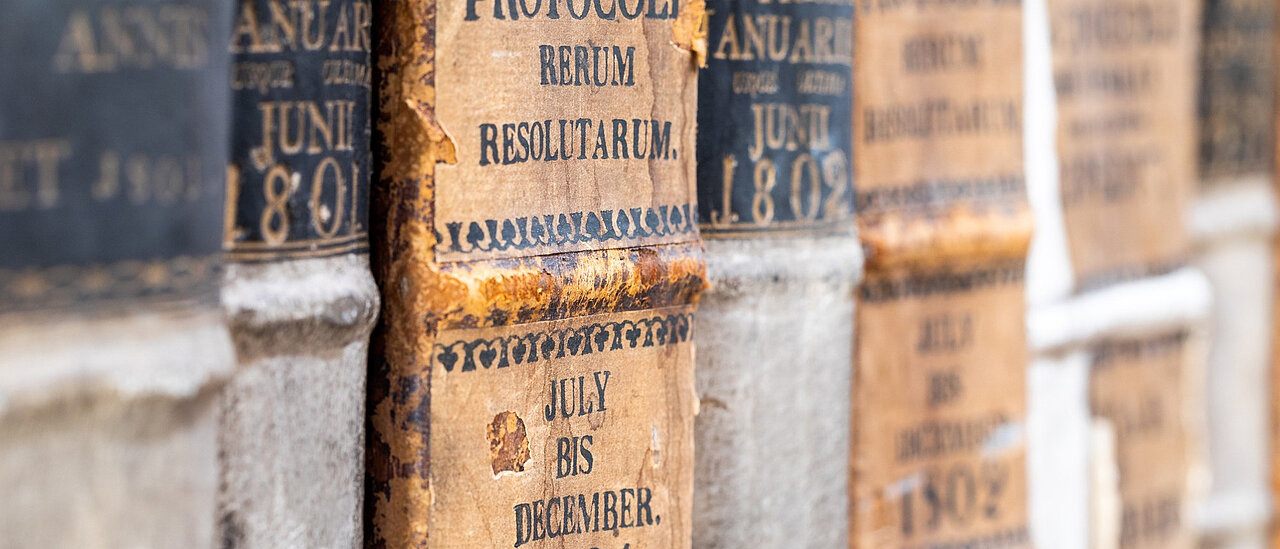
So-called ‘protocol books’ documented in minute detail what happened to each petition – for instance, when the matter was heard, who acted as rapporteur, what arguments were put forward, and whether a decision was reached and, if so, what it was.
Participants from Würzburg, Münster and Eichstätt
Such minutes books are the focus of a new research project at Julius-Maximilians-Universität Würzburg (JMU). Professor Anja Amend-Traut, holder of the Chair of German and European History of Law, Canon Law and Civil Law, is jointly responsible for the project.
The German Research Foundation (DFG) is providing a total of 1.3 million euros for the project ‘AI-assisted digitisation of Imperial Court Council minute books (1700–1805). A Key to the (Legal) History of the Early Modern Period’. Anja Amend-Traut submitted the application jointly with Professor Peter Oestmann (University of Münster) and Professor Sabine Ullmann (University of Eichstätt-Ingolstadt).
“The project will involve the structural cataloguing of the Imperial Court Council’s minutes following their digitisation and text recognition,” says Amend-Traut, explaining the project’s aim. This methodological, AI-supported approach will replace traditional file cataloguing.
Among other things, the minutes provide information on the social status, gender, religious denomination and origin of the applicants or parties, as well as other participants in the proceedings and the facts of the case; through their references to existing meeting minutes, they also provide access to the relevant case files.
Deeper academic insights thanks to AI
The data obtained in this way thus allows for in-depth analysis and enables research into early modern justice to investigate previously unanswered questions in history and legal history concerning the workings and functioning of the highest courts in the Old Empire.
The project can be described as a European endeavour in terms of both content and organisation: the information derived from the minute books covers around 20 present-day European states, with a focus on Germany.
The Austrian State Archives in Vienna, where the records are held, are acting as a cooperation partner for the project. The technical implementation is being overseen by Professor Georg Vogeler of the Institute for Digital Humanities at the University of Graz.
Anja Amend-Traut and her co-applicants are certain: “This funding sends an important signal for research in the humanities, particularly for legal studies in general and research into the highest courts in particular.”
Contact
Prof. Dr Anja Amend-Traut, Chair of German and European History of Law, Canon Law and Civil Law, University of Würzburg, T +49 931 31-88689, anja.amend-traut@uni-wuerzburg.de
Prof. Dr Peter Oestmann, Chair of Civil Law and German Legal History, University of Münster, T: +49 251 83-28641, LS.oestmann@uni-muenster.de
Prof. Dr Sabine Ullmann, Chair of Early Modern History and Comparative Regional History, Catholic University of Eichstätt, +49 8421 93-21666, sabine.ullmann@ku.de