
Anniversary celebration: Building bonds in turbulent times
10/27/2026Numerous alumni returned to the university at the weekend to celebrate the anniversary of their graduation. For many, this was not only where they sat their exams, but also where they set the course for their lives.
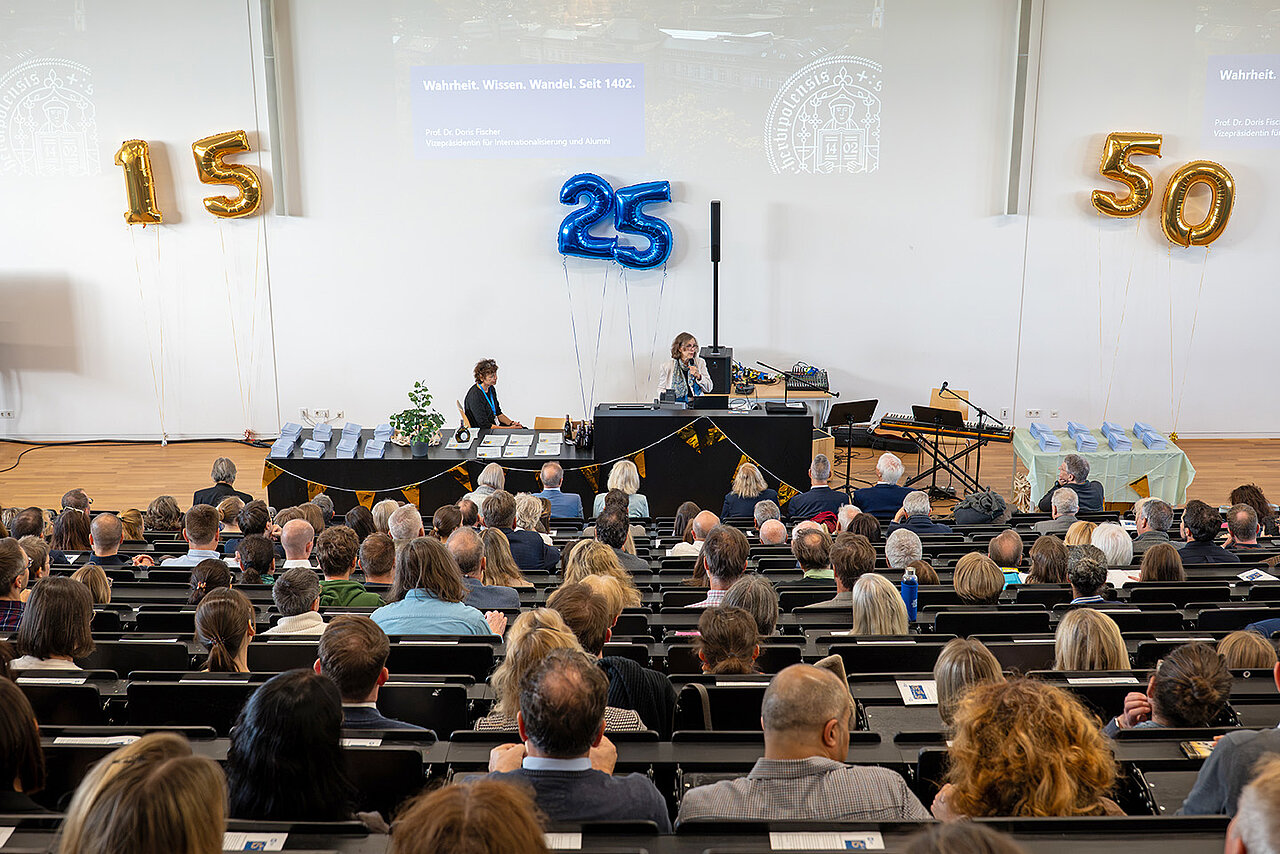
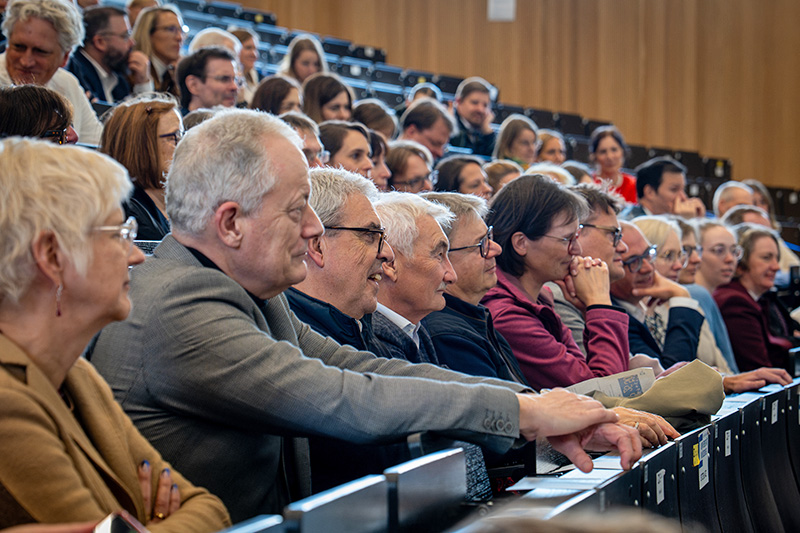
From 15 to 60 years since graduation: alumni from several decades gathered in Würzburg on 24 October 2026. Around 350 graduates accepted the invitation and returned to their former university with friends and family for the anniversary celebrations. Here, they were greeted by familiar paths through the faculties and a celebration in the Z6 lecture theatre building. They were also amazed at how the campus had developed since their own student days.
Even before the first speeches, ‘Just in Time’, featuring Timo Rach and Jennifer Böhm, set the mood for those present with their music. The duo from the Department of Music Education provided the musical backdrop for the afternoon with songs such as ‘I’m Still Standing’, ‘Unwritten’ and ‘Ich liebe das Leben’. They provided a harmonious and much-applauded musical backdrop to the ceremony, which featured welcoming addresses, reflections and the presentation of anniversary certificates.
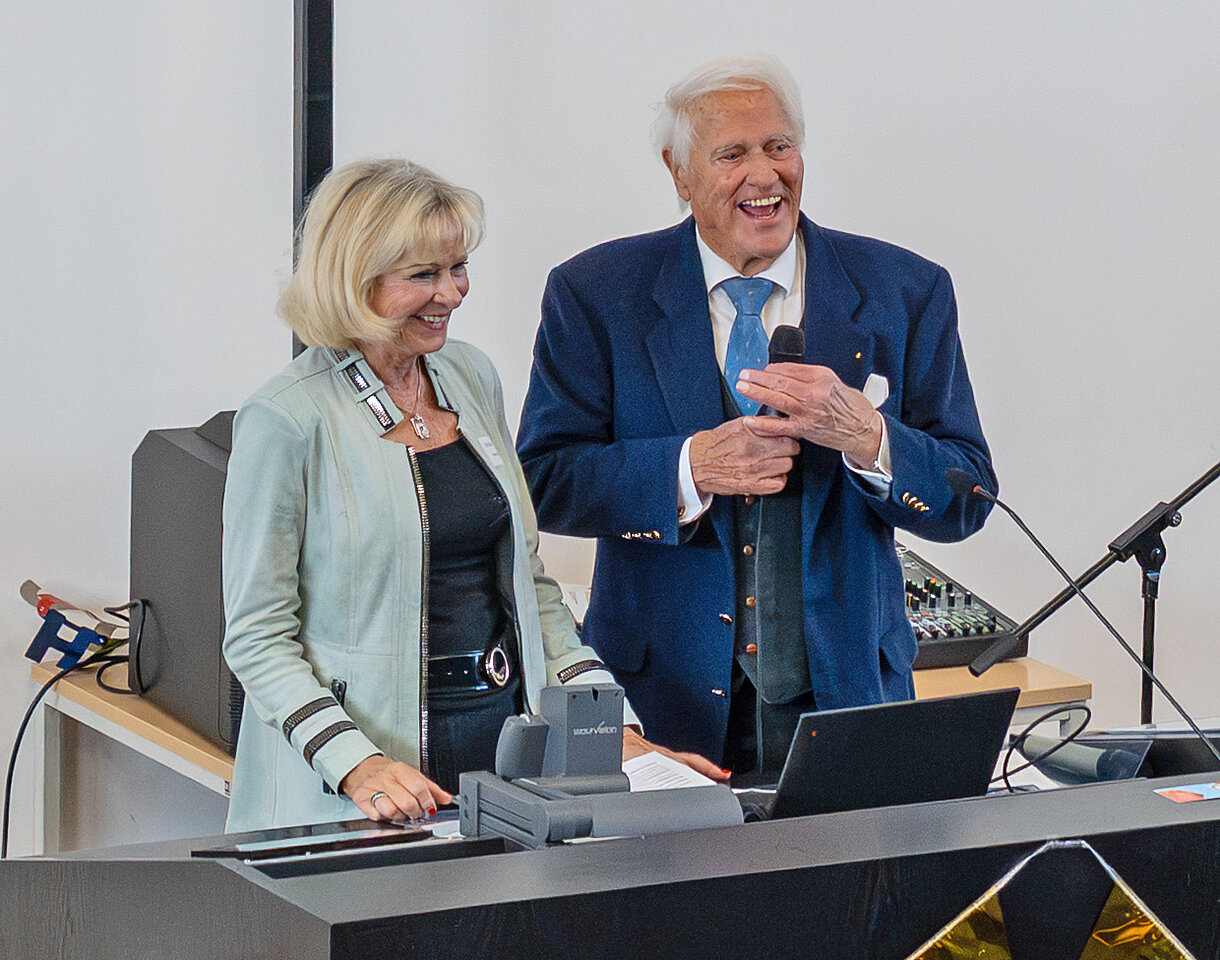
In her welcoming address, JMU Vice-President Doris Fischer thanked the guests for their commitment: “As ambassadors, mentors, networkers and supporters, you play a vital role in the fruitful exchange of knowledge and in our national and international networking.” The close ties between alumni and the university create space for new ideas, joint projects and the sharing of diverse experiences.
The first major turning points in life
In her welcoming address, Würzburg’s Deputy Mayor and JMU alumna Sandra Vorlová reflected on the transformation of the Hubland Campus, which many former students still remember as a US military barracks or a major construction site.
She was delighted by the guests’ keen interest and close connection to their former university: “For many, it was here that the first major turning points in their life’s journey took place,” said the deputy mayor, who conducted research in biomedicine at the University Hospital before moving to the town hall. “The fact that some of you have travelled from far afield to return to Mainfranken today highlights the bond that Julius-Maximilians-Universität forges between us all. And next time,” she told those present, offering a glimmer of hope, “we’ll be taking the tram to Hubland!”
A point of reference in turbulent times
“We are living in turbulent times,” noted Professor Peter Bofinger, Chair of JMU Alumni & Friends e.V., in his presentation. Among other things, he cited the war in Ukraine and the current upheavals in the political party landscape. “This makes stable points of reference all the more important!”
The fact that the honourees had accepted the invitation showed that the University of Würzburg had remained such a point of reference. JMU, too, had experienced a few eventful weeks: having narrowly missed out on the ‘Excellence’ title, the Würzburg-based researcher Georg Nagel was awarded the Nobel Prize in Medicine shortly afterwards.
In his speech, Peter Bofinger referred to the alumni not as “former students”, but as an active part of the university community: “You carry the Alma Julia out into the world of science, medicine, law, education, the arts and many other fields. And for that, we are grateful to you!”
A look back at an analogue world
The emotional highlight of the afternoon was provided by the reflections of two graduates.
Ruth Bley, who studied chemistry and biology to become a teacher in the 1970s and passed her state examination 50 years ago, took the audience back to a time before email and digital course catalogues: To institutes scattered across the city, or to the infamous ‘stinking room’ of the Institute of Inorganic Chemistry on Röntgenring, where the air was said to be thick with hydrogen sulphide, bromine and chlorine. And to the ‘positive culture shock’ of her move to the state-of-the-art laboratories in the then newly opened research buildings at Hubland. She reflected on her time as a student, which she remembers very fondly despite the occasional stench.
Dr Hubert Scheuer, who studied medicine in Würzburg in the 1960s, was from an even earlier cohort. Back then, with a 12-PS 2CV and a friend in tow, he drove twelve hours from Hamburg to Würzburg to enrol. His summary of the changes in the student body drew applause in the ballroom: whilst only a very small proportion of medical students were female back then, women now often make up the majority in the subject: “Women are simply smarter,” the doctor remarked with a wink in his closing remarks.
Exploring the new, rediscovering the old
Afterwards, Michaela Thiel, JMU’s alumni officer, put the guests to the test with a short quiz about JMU. Following the presentation of the anniversary certificates, the guests dispersed to the faculty tables for coffee, cake and snacks.
There, deans and representatives from the faculties were on hand to chat – including Matthias Frosch, Dean of the Faculty of Medicine; Georg Ertl, former Medical Director of the University Hospital; the Dean of the Faculty of Biology, Martin Müller, and Andrea Kübler, Dean of the Faculty of Human Sciences.
To round off the day, guided tours of the faculties gave guests the opportunity to explore new things and rediscover old ones.
Studying in Würzburg: More than just years of education
Wherever the alumni came from – whether from the local region, other parts of Germany or further afield – they all shared the experience that their own student years were not merely about academic education: “It was a very intense time,” recalls Katja Kleideiter, who once studied psychology in Würzburg. “Student jobs, partying, making music – and, of course, managing to get through my degree at the same time!”
“The wide-ranging knowledge, the good wine, the countryside and the friendly people,” says Jochen Krenz, reflecting on his time as a student in Würzburg, where he completed his teacher training for secondary school in 2001. “All that, plus the rich history that has shaped the city!”
Jochen Krenz has a piece of advice for those studying today and in the future: “Trust your own intelligence, not just the increasingly artificial kind. Even if the path of thinking, reading and critical reflection isn’t always easy, it’s worth it.”
Many of those present emphasised that studying does more than just stimulate the mind. Some friendships have lasted to this day, and some couples met at university: as was the case with Katja Wolfrum, who completed a teacher training degree and a Master’s degree at the University of Würzburg: “I made some very good friends during my student days; we still meet up regularly! And I also met my husband here in Würzburg.”
Devrim Can, who graduated with a degree in dentistry in 2001, also found more than just professional fulfilment whilst studying in Würzburg: “On my first day in the lab, a fellow student walked through the door and I fell in love with her at first sight. And today she’s my wife!”
More than just nostalgia
A total of more than 400 guests who, after 15, 25, 50 or even 60 years, found their way back to their former university – there’s more to this than mere nostalgia. It is an invitation and a promise to remain connected to the University of Würzburg in the future: through the ‘University of Würzburg Community’ alumni network, as a driving force for science and society, and as part of a vibrant university community.
Web link
Additional images