
AI patients for training in psychotherapy
02/10/2026The Chair of Clinical Psychology and Psychotherapy is creating a virtual room in which students can practise therapeutic conversations with an AI-generated counterpart.
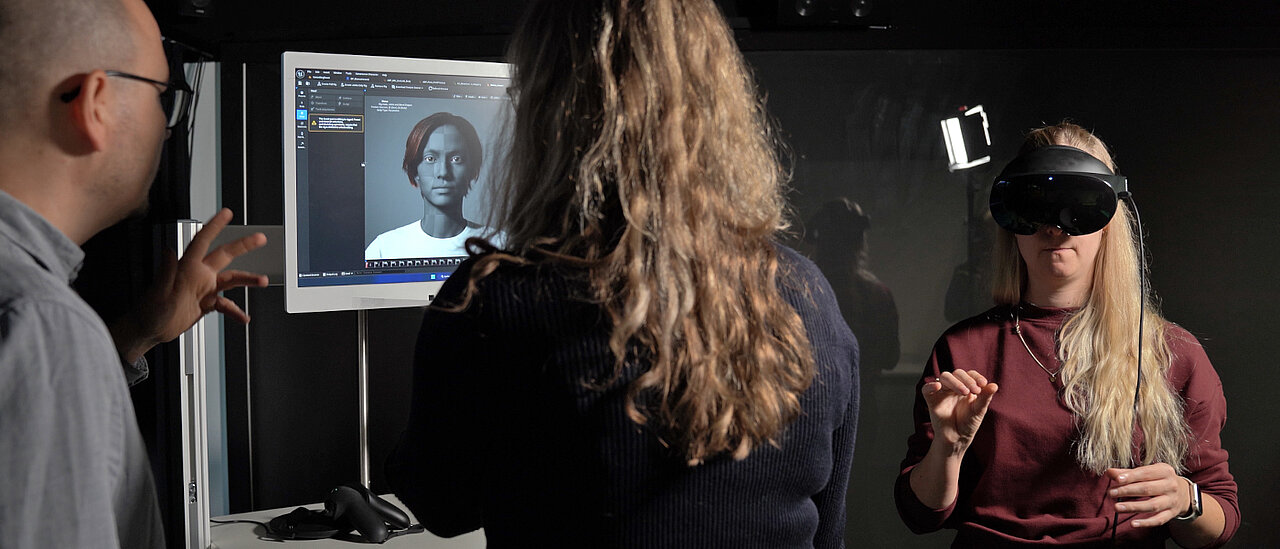
A room, a chair, a person opposite. The voice sounds determined, perhaps even a little worried: "I don't want to go back to old patterns," says the patient. Sitting opposite her is a trainee psychotherapist. But the woman in front of him does not really exist; she is a simulation of artificial intelligence and virtual reality.
New Master's programme brings new requirements for teaching
As part of the reform of psychotherapy training, a new Master's degree programme has been created at the University of Würzburg, which - after successful completion - can be directly followed by the licensing examination for psychotherapists. This change has meant that teaching, such as the training of psychotherapeutic interactions, must be much more practice-orientated.
Up to now, this has mainly involved role-playing with actors or fellow students. However, both variants are associated with challenges: They are either costly and require intensive supervision or reach their limits when it comes to authentically portraying stressful situations or certain groups of people.
AI patients for authentic interactions
A teaching project at the Chair of Clinical Psychology and Psychotherapy is experimenting with a creative solution to this challenge: "The students are given VR glasses that place them in a virtual therapy room. A virtual person sits opposite them. They are then given a specific task for the therapeutic conversation. For example, they are asked to clarify what kind of problem the person has," explains Dr Daniel Gromer, one of the project managers.
The special thing: The patients' answers do not follow a pre-programmed response chain, but react to what the students bring to the conversation based on a detailed prompt. "The idea is to present credible, authentic social interactions," says Dr Sabrina Gado, who is in charge of the technical part of the project.
Interaction of hardware and software is technically complex
What the students say is recorded via a microphone, converted into text and sent to an AI language model. The generated text response is then translated into speech and played back in the VR environment together with a matching animation of the person speaking.
The project is technically complex, as the various hardware and software components interact seamlessly and have to be constantly adapted to the latest technology. The project was financially supported by WueDive at the Centre for Teaching and Learning (ZBL).
A playful approach can take away the fear of failure
From a psychotherapeutic perspective, the advantages are obvious for project manager Dr Isabel Neumann: students can play through the same case several times and try out different conversation strategies. They also feel freer to try out dialogue strategies outside their comfort zone with generated counterparts. "VR allows a playful approach," emphasises Sabrina Gado, "and that can take away the fear of failure."
The system also offers the option of recording interactions and thus analysing eye movements, voice pitch and even physiological reactions such as the students' heart rate. Isabel Neumann explains: "The recording allows me to reflect afterwards on whether there are any topics that are uncomfortable for me, for example where I don't maintain eye contact. This allows me to slowly approach my own personality as a therapist."
Prospects for other professional groups too
In the long term, the development team is asking itself how the system can be made more accessible: Can the simulation be realised as a web-based version in addition to the VR version? According to Daniel Gromer, a screen version would be less immersive and without physiological measurements, but would be accessible from home at any time. In addition, the underlying AI model could also be transferred to other contexts, such as medical anamnesis interviews or challenging dialogue situations in the teaching profession.
Whether virtual patients will change education in the long term remains to be seen. What is clear, however, is that they expand the scope of possibilities. They allow intensive practice on extremely diverse scenarios and new forms of reflection. The technology is not intended to be a substitute, but rather to supplement the discussions and seminars that otherwise take place during therapy training. A test phase with students is currently underway.
Weblink
Project "Simulation of psychotherapeutic interactions in VR using AI"
Contact
Dr Sabrina Gado, Dr Daniel Gromer and Dr Isabel Neumann at the Chair of Psychology I
Supervision of the project: Dr Lea Hildebrandt, Prof Dr Matthias Gamer and Prof Dr Katja Bertsch