
AI ideas from Würzburg impress at the 3rd Healthcare Hackathon
04/07/2026At the annual Healthcare Hackathon Würzburg, the aim is to develop digital solutions for everyday medical problems as a team within 48 hours. This year, AI solutions took first and second place.
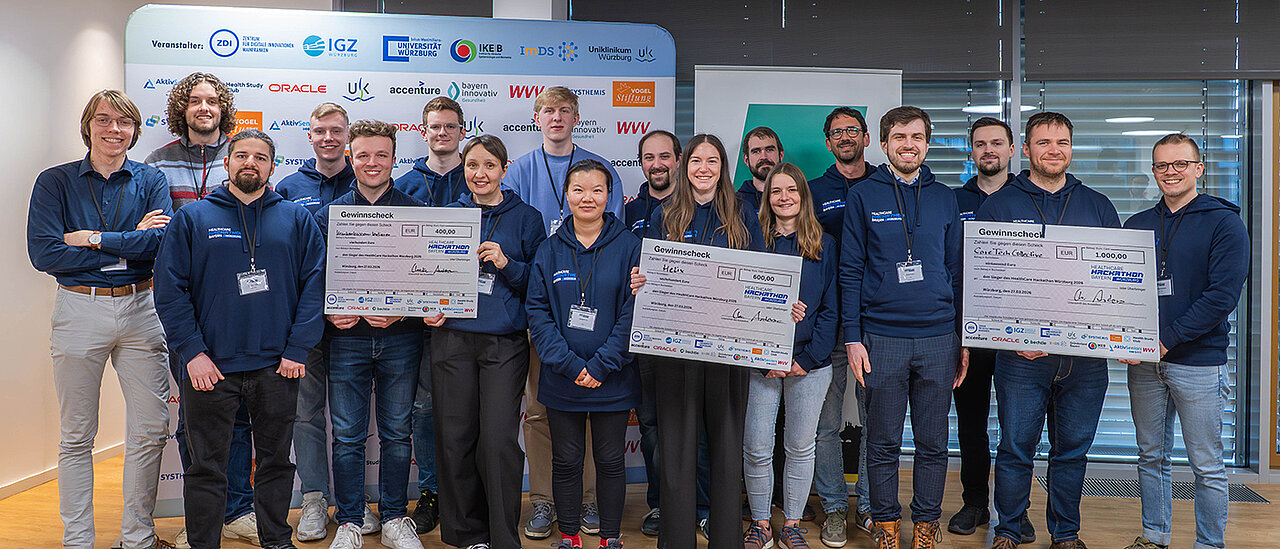
How can medical fax findings be analysed more quickly? How can skin tumours be assessed more objectively? And how can impending malnutrition in children with cancer be recognised at an early stage? At the 3rd Healthcare Hackathon Würzburg, more than 40 participants worked on ways to facilitate medical care and research at the University Hospital of Würzburg (UKW). They developed concrete solutions within just 48 hours.
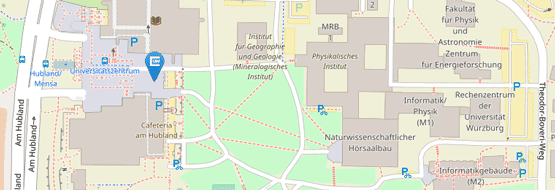
On 26 and 27 March, the Skyline Hill Center on Hubland became a meeting place for doctors, IT specialists, numerous students and doctoral candidates from all over Germany, Julius-Maximilians-Universität Würzburg (JMU) and the UKW. In a total of eleven challenges, they jointly investigated digital solutions for real problems from everyday medical life.
The trend was clear: artificial intelligence played a central role in many projects. The Healthcare Hackathon has long been more than just a competition: rather, it creates a space in which different disciplines come together and benefit from each other. Ideas are discussed, rejected, further developed - and often directly implemented as prototypes.
When data makes everyday clinical practice easier
The CareTechCollective team from Würzburg-based IT company Systhemis particularly impressed the jury of scientific experts this year. With its "LabEfficient" project, it won the first prize of 1,000 euros. The question was posed by Dr. Simon Goller from the UKW Dermatology Clinic - as was the challenge of the second-placed team.
It was aimed at facilitating the evaluation of external laboratory findings: "An everyday problem for us in the clinic is that we receive a lot of laboratory findings from medical practices as faxes and then have to analyse these findings manually. This takes up a lot of time in our day-to-day work," explains Dr. Goller. The award-winning solution uses artificial intelligence to automatically read such documents, structure the content and visualise relevant anomalies. This reduces the workload for doctors and improves the evaluation of findings.
New image analysis system
The Helix team also focussed on making everyday clinical work easier: With "SkinStager", it developed a system that analyses photos of skin tumours and makes them comparable. Until now, the assessment has been heavily dependent on subjective impressions - different perspectives or image sections make evaluation difficult.
The solution relies on AI-supported image processing: photos are automatically aligned, conspicuous areas of skin are recognised and their size is measured. This creates a more objective basis for assessing the course of therapy. "Despite initial hurdles, the team quickly developed a convincing and pragmatic solution that can help doctors and patients alike in the future," said Vanessa Borst, PhD student at the JMU Chair of Software Engineering, who was delighted with the team's second place, which she mentored.
Early detection, better treatment
Third place went to the Krankenkassen-Codierer team of JMU students with their "NutriCare Paediatric Oncology" project. The focus here was on the care of children with cancer. An app is designed to help recognise malnutrition at an early stage.
Parents can regularly enter data into the app, which is automatically analysed. Critical developments are recognised at an early stage and clearly displayed so that medical staff can react more quickly.
Ideas with a future
The results of the hackathon show how great the potential of digital solutions in the healthcare sector is - especially when medical expertise and technical know-how come together. An important basis for this is the dynamic start-up scene in the Würzburg region. Interdisciplinary collaboration, close networking and competent contacts from science, IT and business create fertile ground for new start-up ideas.
This also increases the chances that projects from the hackathon will be further developed and transferred to medical practice in the long term. The Healthcare Hackathon Würzburg is thus increasingly developing into a place where not only ideas are created, but also concrete approaches for the medicine of tomorrow.
Hacking for a good cause
The Healthcare Hackathon Würzburg is a collaboration between the JMU Chair of Clinical Epidemiology and Biometry, the UKW Institute for Medical Data Sciences, the Innovations- und Gründerzentrum Würzburg (IGZ) and the Zentrum für digitale Innovationen (ZDI) Mainfranken.
Contrary to what the name might suggest, the event is not about penetrating computer systems. Instead, interdisciplinary teams work together to find innovative digital solutions to common medical issues and develop initial prototypes within a short space of time. The event was organised by Miriam Schlüter and Professor Rüdiger Pryss (University of Würzburg and UKW), Denise Hiebl and Dr. Christian Andersen (ZDI) and Dr. Gerhard Frank (IGZ).
The jury consisted of Professor Johannes Schobel (Neu-Ulm University of Applied Sciences), PD Dr. Patrick-Pascal Strunz (UKW), Dr. Andrea Thelen-Frölich (IZKF Würzburg), Maximilian Ertl (Data Integration Centre Würzburg, UKW) and Professor Anke Bergmann (UKW).