2026
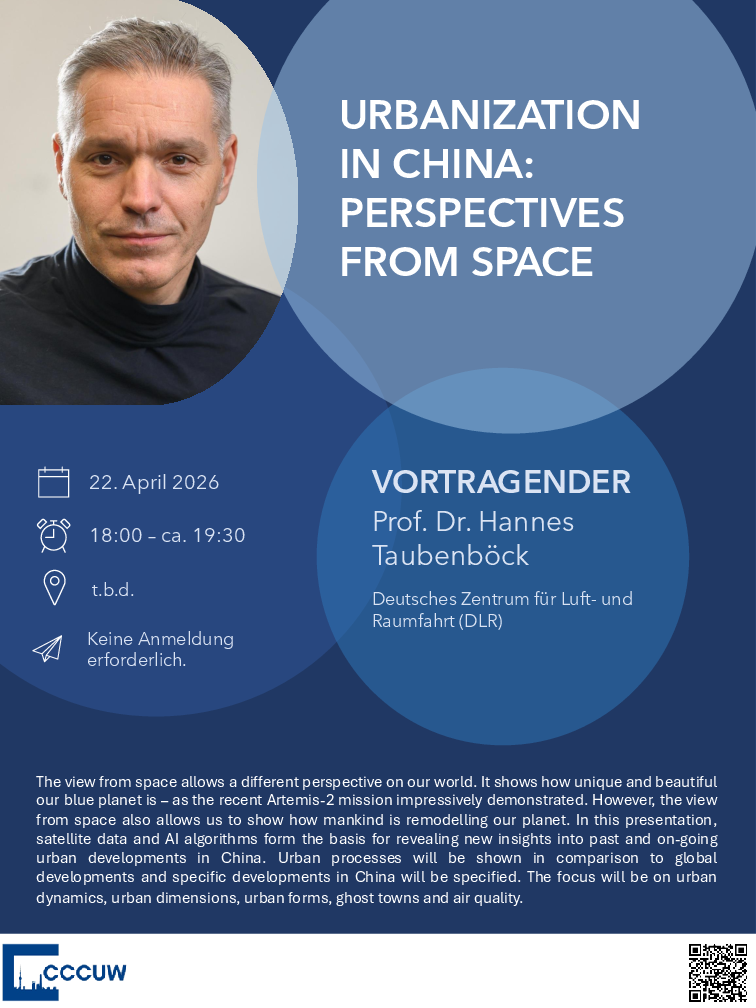
Vortrag von Prof. Dr. Hannes Taubenböck (Deutsches Zentrum für Luft- und Raumfahrt)
The view from space allows a different perspective on our world. It shows how unique and beautiful our blue planet is – as the recent Artemis-2 mission impressively demonstrated once again. However, the view from space also allows us to show how mankind is remodelling our planet according to its needs and ideas. In this presentation, satellite data and AI algorithms form the basis for revealing new insights into past and on-going urban developments in China. On the one hand, urban processes will be shown in comparison to global developments and, on the other hand, specific developments in China will be specified. The focus will be on urban dynamics, urban dimensions, urban forms, ghost towns and air quality.
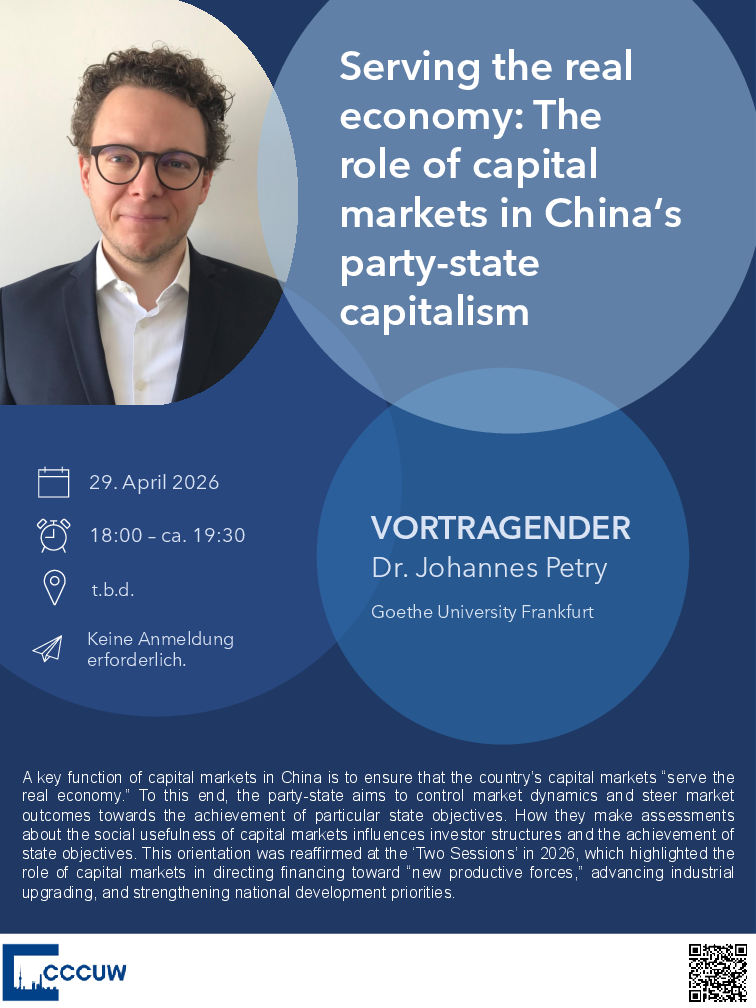
Dr. Johannes Petry (Goethe University Frankfurt)
What is the role of capital markets in China? A key function of is to ensure that China’s capital markets “serve the real economy.” To this end, the party-state aims to control market dynamics and steer market outcomes towards the achievement of particular state objectives. How they make assessments about the social usefulness of capital markets shapes the infrastructural arrangements in these markets, influences investor structures to facilitate the achievement of specific state objectives such as poverty alleviation and the capital market-based economic reform of Chinese companies. This orientation was reaffirmed at the ‘Two Sessions’ in 2026, which highlighted the role of capital markets in directing financing toward “new productive forces,” advancing industrial upgrading, and strengthening national development priorities.
Bernd Riedel (BMW)
Bernd Riedel ist Diplom-Ingenieur und verfügt über langjährige Führungserfahrung in der Automobilindustrie. Als Projektleiter für strategische China-Themen der BMW Group prägte Bernd Riedel maßgeblich die Zusammenarbeit mit chinesischen Partnern, unterstützte den erfolgreichen Ausbau des Joint Ventures BMW Brilliance und war einer der Architekten für die Entwicklung und Produktion ein neues Elektrofahrzeug zusammen mit dem chinesischen Partner Great Wall Motor. Sein inter-kulturelles Verständnis, technische Expertise und klare Führung setzte er für die langfristige, nachhaltige Positionierung von BMW in China ein.
Heute bringt er seine Erfahrungen als Berater, Autor und Redner in den Bereichen internationale Zusammenarbeit, Mobilitätsstrategien und deutsch-chinesische Wirtschaftsbeziehungen ein.
Vortrag
Es werden die Hintergründe der chines. Industriepolitik erläutert, die zu der Gründung von Joint Ventures zwischen westlichen und chines. Staatsunternehmen geführt haben. Welche Aspekte haben dabei eine entscheidende Rolle gespielt und wie konnte man dabei erfolgreich tätig sein?
Die Chancen und Risiken durch die „Made in China 2025“ Strategie und weitere Pläne der chinesischen Regierung, seit 2015, werden beleuchtet und wie man darauf als westliches Unternehmen reagierte. Wie war es beispielsweise möglich, dass BMW die Mehrheit bei dem Joint Venture BMW Brilliance Automotive Ltd. übernehmen konnte?
Als Ausblick soll ein neues Kooperationsmodell beschrieben werden, welches bei der Entwicklung und Produktion der neuen Elektrofahrzeuge der Marke MINI zum Einsatz kommt.
Welche Rolle spielt dabei die Führung in China und Deutschland bei der Umsetzung?
Dr. Daniel Fuchs (HU Berlin)
Technical standards—ranging from the DIN A4 paper size to the dimensions of shipping containers and the network architecture of 5G mobile technology—serve to ensure interoperability and quality assurance. The negotiation of standards is shaped both by the profit motives of transnational corporations and by the strategic calculations of government actors. Against this backdrop, international standardization has become a key arena for geopolitical rivalry: As the conflicts surrounding 5G technology illustrate, China’s growing influence in international standardization organizations is meeting with increasing resistance from actors in the Global North. The lecture provides an introduction to the political-economic significance of technical standards, explains the reasons behind China’s influence in standardization, and discusses the geopolitical implications of the global competition over standards for future technologies.

Erster China-Tag für unterfränkische Schüler:innen
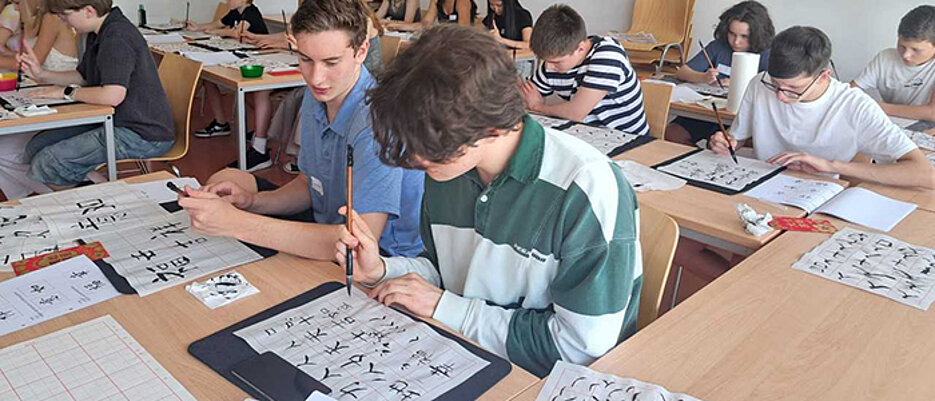
Maultaschen füllen, Kung Fu üben und Schriftzeichen malen: 17 Schülerinnen und Schüler schnupperten beim China-Tag an der Uni Würzburg Campus-Luft.
Vorurteile über China abbauen, Zugänge zur Sprache bieten, einen differenzierten Blick hinter die Kulissen des Landes ermöglichen: Diese Ziele verfolgt die Würzburger Sinologie mit dem 2023 gestarteten Projekt „Campus trifft Schule Unterfranken“. Dabei bieten die Lehrenden regelmäßig China-Arbeitsgruppen an Gymnasien in Würzburg, Schweinfurt, Aschaffenburg und Erlenbach am Main sowie eine Online-AG an.
Campus trifft Schule Unterfranken
Das Projekt der Sinologie hat ein dreiteiliges Angebot für Gymnasien in Unterfranken: China-AGs, Vorträge und Fortbildungen für Lehrkräfte. Vorrangig geben die Dozierenden der Uni dabei erste Einblicke in die hochchinesische Sprache. Sie verschaffen den Schülerinnen, Schülern und Lehrkräften einen vielseitigen Blick auf China. Das Projekt ist offen für weitere Partnerschulen.
Als Teil der Kooperation fand am 19. Juni 2026 erstmals ein China-Tag an der Universität statt. Er sollte es insbesondere den Teilnehmenden der Online-AG ermöglichen, sich live kennenzulernen und in die Universität hineinzuschnuppern. 17 Schülerinnen und Schüler im Alter von 12 bis 17 Jahren waren dabei.
Rallye durch Mitmachstationen
Die Gäste verbrachten an der Uni einen Nachmittag mit einer abwechslungsreichen Rallye. Sie konnten Kalligraphie und die Kampfkunst Kung Fu ausprobieren, Tee verkosten und eigenhändig chinesische Maultaschen füllen. Sie erhielten auch Einblicke in die Kunst des Scherenschnitts und des Knüpfens traditioneller chinesischer Knoten. Eine Stäbchenchallenge und ein Besuch in der Institutsbibliothek standen ebenfalls auf dem Programm.
Natürlich bot der China-Tag auch Gelegenheiten für Gespräche, bei denen die Interessen der Schülerinnen und Schüler und zum Teil auch die ihrer Eltern im Mittelpunkt standen.
Die Mutter zweier Teilnehmer schickte der Sinologie dieses Feedback: „Ich wollte Ihnen noch einmal ausdrücklich zurückmelden, wie begeistert unsere Jungs vom China-Tag waren. Besonders gefallen hat ihnen die Vielfalt der Stationen und Angebote. Unser Sohn hat mir zu Hause voller Freude und auch ein bisschen stolz die Schriftzeichen aus der Schreibwerkstatt gezeigt und begeistert von seinen Erlebnissen erzählt.“
Das Team der Sinologie hat den China-Tag in Zusammenarbeit mit dem China-Kompetenz-Zentrum der Universität (CCCUW) und der Fachschaftsinitiative Sinologie durchgeführt.
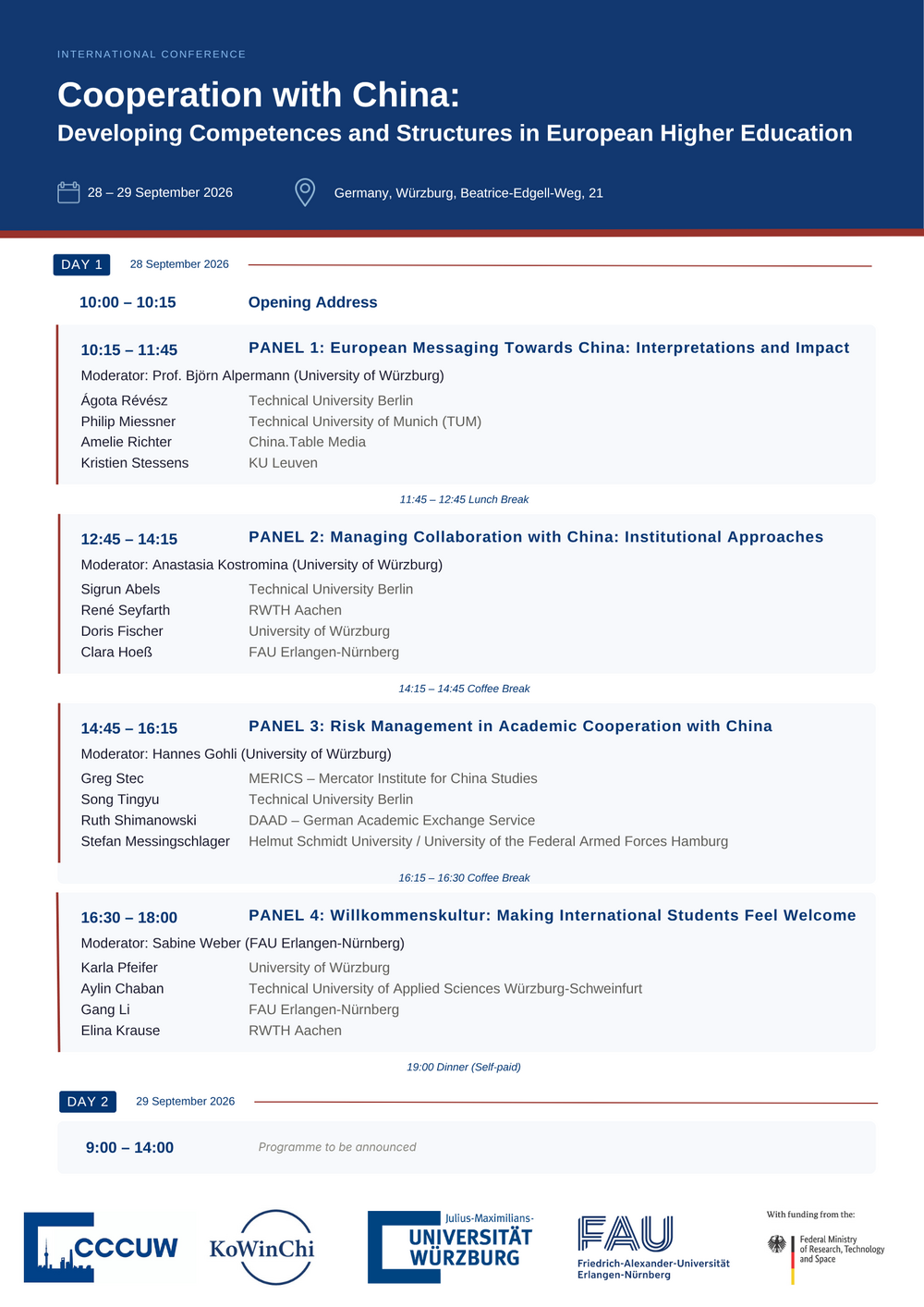
Join us discuss academic freedom, research security and other exciting topics related to cooperations with China
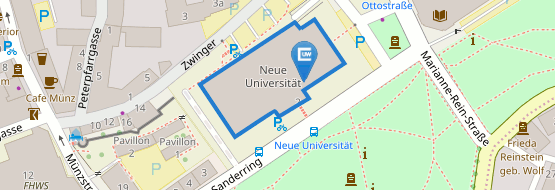
University of Würzburg, Germany
Scientific cooperation between European universities and partners in the People’s Republic of China continues to play an important role across disciplines. At the same time, academic collaboration increasingly unfolds within a complex geopolitical and regulatory environment. Universities are expected to navigate evolving policy frameworks, heightened public scrutiny, and questions of institutional responsibility, while safeguarding academic freedom, research integrity and international openness.
Against this backdrop, the China Competence Centre of the University of Würzburg and the KoWinChi project (Interacting Competently with China in Science) — a joint programme of the University of Würzburg and FAU Erlangen-Nürnberg, funded by the German Federal Ministry of Research, Technology and Space — invite participants from across Europe to exchange experiences and reflect together on institutional approaches to cooperation with China.
Over the past two years, the KoWinChi project has worked closely with researchers and administrative staff at German universities to strengthen awareness, institutional sensitivity and informed engagement in academic cooperation with China. With this conference, we would like to continue the discussion within the broader European context, creating space for comparative perspectives and shared reflection on institutional approaches, governance practices, and academic engagement.
Register Now
Registration includes access to this exclusive round of discussions, as well as nutrition and refreshments throughout the conference. Participation is free of charge. Secure your spot by completing the registration form available here.
We look forward to welcoming you to Germany in September 2026!