
Overview: Processes and process management
What is a business process?
A business process is a structured procedure which contains all the activities that are necessary for the achievement of the process objectives. Furthermore, the responsibilities, competences and actions of all those involved are documented in order to show what has to be done when and by whom. A business process is triggered by an event and delivers a result. A business process combines several tasks and usually involves several people. However, not all tasks and procedures are considered business processes - only those that contribute to achieving the university mission.
The following characteristics can be found in most or all business processes:
- There is a start event and an end event.
- There are inputs and outputs. (e.g. in the form of information or documents)
- The business process takes place repeatedly/continuously.
- It is customer-orientated. (Customers can be, for example: students, employees, academics)
- There is person who is responsible for the business process.
- There is a regular review procedure.
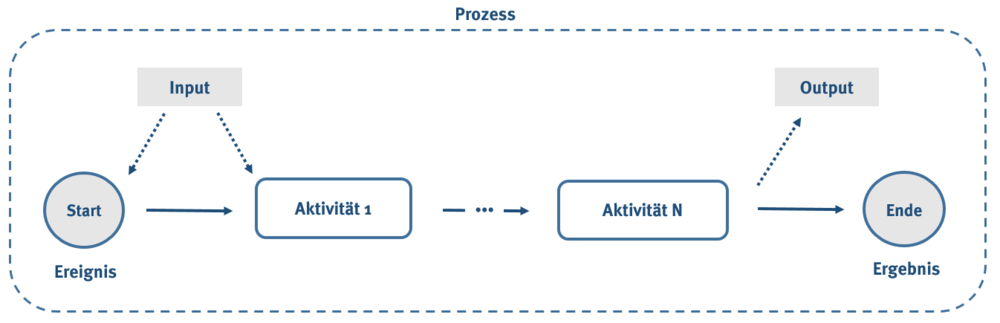
Example: business trip accounting (Dienstreiseabrechnung)
This business process is considered a support process for the employees of the University of Würzburg so that they can fulfil their tasks in research and teaching or administration in a fair and legal way. It has the characteristics mentioned above:
- Start event: The business trip expense report is received by the responsible department.
- End event: The trip is settled.
- Input: business trip expense report (form), business trip authorisation (from the upstream process "Business trip authorisation")
- Output: e.g. completed business trip expense report, payment instruction for business trip (for a downstream process "Payment").
- The business process takes place continuously and repeatedly - there are thousands of business trips every year.
- The customers of the process are the applicants, i.e. academics, employees in the faculties or the administration.
- The person responsible for the business process must be appointed in the department in charge, the Human Resources Service Centre.
- The process is included in the regular process reviews in the central administration.
Business process management (BPM) refers to the conscious planning, implementation, control and improvement of business processes. In the introductory phase, the focus is initially on recording and improving processes. Subsequently, the processes of the ZV are to be reviewed in regular cycles and - where necessary - optimised or quickly adapted to changed framework conditions.
Background
The transparency about and the documentation of processes has become increasingly important in recent years. Audit authorities regularly ask for business process descriptions, and in the accreditation of study programmes or when applying for projects, the existing and planned processes must be presented in a comprehensible and standardised form. It is now taken for granted that all management levels can report on the business processes for which they are responsible within a very short space of time. Targeted process control and improvement is also perceived as a self-evident management task.
Objective
Business process management serves to efficiently organise all workflows in the central administration. In particular, business process management is aimed at processes that are cross-departmental and include contact points with students and academics .
Business process management is a central component of quality assurance and organisational development at the University of Würzburg. Looking at the specific business processes in the administration offers the decisive advantage of focussing on the overall process and their results beyond the respective departmental boundaries. The change in perspective is completed by analysing processes with a focus on the value-adding activities and the requirements of the stakeholders (customers). This enables us to define clear procedures, responsibilities and requirements and to permanently ensure that cross-departmental tasks are carried out effectively and with regard to preserving resources. Process management should improve cross-departmental collaboration and help to avoid duplication of work and reduce errors. It also aims to make administrative processes and decision-making channels transparent and reliable with the involvement of those affected, ultimately creating trust not only among our own employees, but also among students, partners and the public.
Business process management standards
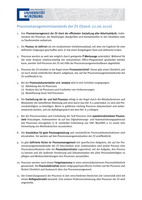
We have published the concept of business process management for the central administration at the University of Würzburg in the form of a handout on the website. For a better overview, we have selected a few specifications that are intended to serve as standards with a corresponding keyword in the handout and have summarised all standards in an overview on one page (in German only; see download box on the right). These standards are binding and must be observed. The maturity model, the process review and the approval process for the process portal are currently being further developed and will be published here once they have been finalised.
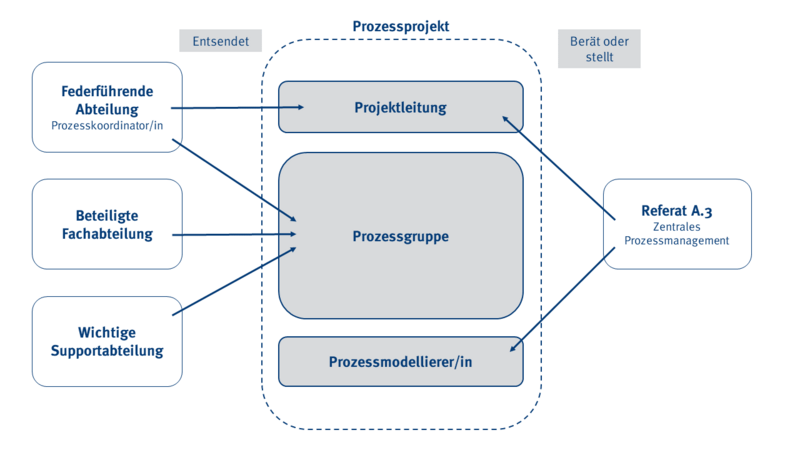
Business process management requires a number of tasks and roles that are not yet provided for in the traditional line organisation of the administration. Even though business process management is supported by Unit A.3, the responsibility and organisation of the business processes remains in the hands of the departments. The roles in business process management and their tasks are described below.
A process coordinator is responsible for one or more business processes within an organisation. Their tasks include knowledge and constant monitoring of the process as well as communication relating to the process. Specifically:
- Knowledge of the framework conditions, specifications and guidelines for the process
- Coordinating with others involved in the business process (especially those from other departments)
- Monitoring and ongoing documentation of the process (E. g. Are the target and actual processes different? Are the framework conditions of the process changing? Is the process achieving the agreed results - measured in agreed criteria/key figures?)
- Seek communication about the process with the relevant departments (especially if uncoordinated deviations occur or problems arise)
- Initiate the further development of the process (introduce suggestions for improvement and own observations)
As part of a process documentation and analysis, a group of process participants is formed with whom the process is revised. This group can include all process participants or a representative selection. The process group analyses the previous processes based on the process documentation, uncovers weaknesses, problems or ambiguities and develops proposals for the future process. It can thus actively influence the future procedure and should cover all perspectives on the process. The process group needs a specific mandate - similar to the project profile for the project group - and should consider all aspects necessary for the process, e.g. also the harmonisation of templates or forms and the use of software such as SAP ERP.
Each business process has a responsible and most relevant department. This is the department in which the process is anchored. This department is responsible for the majority of the process and its control (the "smooth running"). The process coordinator is also located in the lead department. The lead department coordinates the cooperation between those involved in the process on a day-to-day basis and generally acts as a point of contact for users.
Central business process management is located in Unit A.3 Quality Management and Organisational Development. This is where the process management concept is developed and updated, the JMU process map and the process portal are managed, and the process management tools and websites as well as the process management guidelines and directives are maintained. Central Business Process Management coordinates the introduction of process management at JMU and advises and supports the various departments at JMU.
In the first step, the business processes can be visualised graphically as part of a process documentation and analysis simply using post-it notes in the process group or in preparation for a workshop by the head of a process project. In particular, there are few guidelines for documenting the actual process so that everyone can visualise it.
For the modelling of a target process, on the other hand, there are some guidelines that must be observed. A process modeller must therefore be appointed for this purpose, who can be supported by Unit A.3 in order to ensure standards and correct mapping. For projects of a pioneering nature or in projects managed by Unit A.3, process modelling can also be carried out centrally. In large-scale projects (e.g. introduction of campus management) and in departments with responsibility for a large number of comprehensive processes, there may also be process modellers who are trained in the specifications and guidelines for process modelling.
The process participants are all the persons and departments whose functions are relevant to a process. They are either actively involved in the process flow or contribute to it (e.g. by providing the necessary information or infrastructure). The persons or departments concerned are responsible for the further development of the content of processes. When new or further developing processes, representatives of the departments involved in the process must be included in the process group.