

German-Indian International Research Training Group in Chemistry
03.11.2025The International Research Training Group 2991 is a German-Indian collaboration project, jointly funded by the German Research Foundation (DFG) and the Indian Department of Science and Technology (DST). Researchers of the University of Würzburg and the Indian Institute of Science Education and Research Thiruvananthapuram are working together to explore “Photoluminescence in Supramolecular Matrices”.
Research Training Groups offer a structured training program for doctoral students, with emphasis on exchange and collaboration between researchers from different fields and, in the case of an International Research Training Group, also different countries. In May 2024, the German Research Foundation (DFG) announced funding of the German-Indian International Research Training Group (IRTG) 2991 in Chemistry for an initial period of five years (2024 to 2029) with 7.4 million euros. On the Indian side funding is provided by the Indian Department of Science and Technology (DST).
The spokespersons of the IRTG 2991 are Prof. Frank Würthner, Head of the Center for Nanosystems Chemistry at the University of Würzburg, and Prof. Mahesh Hariharan from the Indian Institute of Science Education and Research Thiruvananthapuram (IISER TVM).
Twelve research groups from the University of Würzburg and eight research groups from IISER Thiruvananthapuram will combine their expertise to address the question of how organic light-emitting materials are influenced by their surroundings. The topic finds applications in, e.g., bioimaging and OLED (organic light emitting diode) devices, like TV screens or mobile phones.
Photoluminescence and the Importance of the Supramolecular Matrix
The ability of some organic molecules to release energy in the form of light is called “photoluminescence”. An illustrative example for the technical relevance of this process are OLEDs: the organic molecules implemented in the devices are excited with electrical energy and subsequently release this energy in the form of light. The colour of the emitted light and the efficiency of this process are important for the applications and determined by the properties of the light-emitting molecules.
For many years, the search for efficient emitter molecules (luminophores) was mainly focused on varying the chemical structure of molecules. However, the chemical structure of a molecule is not sufficient. In real-life, the functional molecules are surrounded by other molecules, the so-called matrix, with which they interact. These interactions can strongly influence the emission of light.
The nature of these supramolecular (= “beyond a single molecule”) interactions between functional molecules and the surrounding matrix and the influence on the properties can be very complex. Molecules, which under some conditions shine very bright, might in a different environment not emit light at all. To better understand these relationships and utilize them in real applications, well defined molecule-matrix systems must be investigated, taking aspects from all areas of chemistry into account. Therefore, in the IRTG 2991, experts in the fields of luminophore and matrix design, characterization and theory will work together with the aim to better understand and develop novel photoluminescence materials based on innovative design concepts.
The International Research Training Group
A total of 32 PhD student positions are associated with the IRTG 2991 program, 16 at the University of Würzburg and 16 at the IISER Thiruvananthapuram, as well as two postdoc positions. Besides the scientific relevance, the education and promotion of young researchers is an important part of the project. A special opportunity for the IRTG2991 in this regard is the close exchange between researchers and PhD students from different countries. During their PhD studies, all students from India and Germany will spend an extended research stay at the partner institution, where they can benefit and learn from the scientific expertise of their collaboration partners as well as from the cultural exchange.
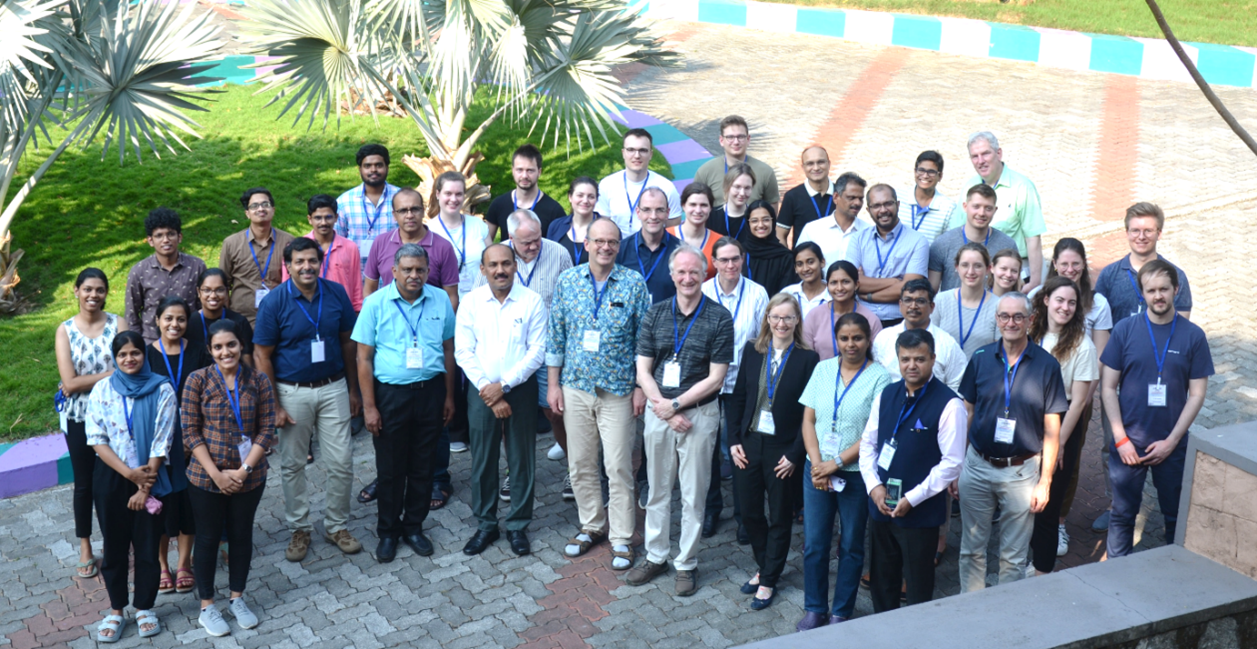
Additionally, joint events like the Start-up Meeting at the IISER Thiruvananthapuram in February 2025 and a series of scientific as well as transferable skill workshops are part of the IRTG 2991 program, with the goal to establish fruitful German-Indian collaborations to advance a highly relevant field of research.
Link to website: https://www.uni-wuerzburg.de/irtg2991