Dmitry Fedosov
Theoretical Physics of Living Matter
Institute for Advanced Simulation
Forschungszentrum Jülich
52425 Jülich
Germany
Dmitry Fedosov
...received his Bachelor’s degree in mathematics from Novosibirsk State University, Russia in 2002. After earning a MS degree in aerospace engineering from the Pennsylvania State University in 2004, he moved to Brown University, where he pursued a PhD degree in applied mathematics. Dmitry received a MS degree in applied mathematics in 2007 and his PhD in 2010. His thesis work was recognized with the 2011 Nicholas Metropolis Award for outstanding doctoral thesis work in computational physics from the American Physical Society.
After completing his PhD, Dmitry moved to Forschungszentrum Jülich, Germany for a postdoctoral position. In 2012, Dmitry was awarded the Sofja Kovalevskaja Award from the Humboldt foundation to build up an independent research group at the Forschungszentrum Jülich. In 2016, he obtained a Habilitation in Theoretical Physics from the University of Cologne. Dmitry continues to work as a group leader at the Institute for Advanced Simulation, Forschungszentrum Jülich with a research focus on non-equilibrium physics, including various complex systems in biophysics, and soft and active matter. He is also an acting director of the Theoretical Physics of Living Matter group at the Institute for Advanced Simulation.
Research synopsis
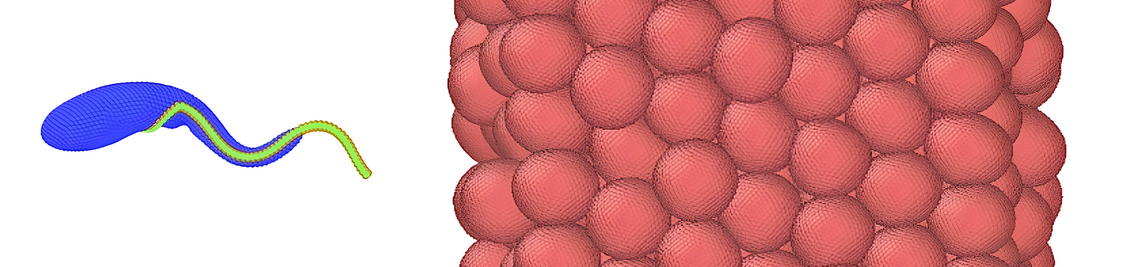
We employ theory, modeling, and simulation to study and understand the structure, self-assembly, and dynamics of complex fluids, active soft matter, and living matter -- on the basis of physical principles. Most of these systems operate out of equilibrium and exhibit incredibly complex structures, interactions, and dynamics. In particular, we are interested in the behavior of active matter systems, blood flow in health and disease (e.g., malaria), microswimmer motility, microfluidics, and collective behavior of many active units.
In Project 6 of the SPP 2332 PoP, we focus on modeling trypanosome motility in complex environments, such as tissues.