Lecture series: Perspectives for humanities and social studies
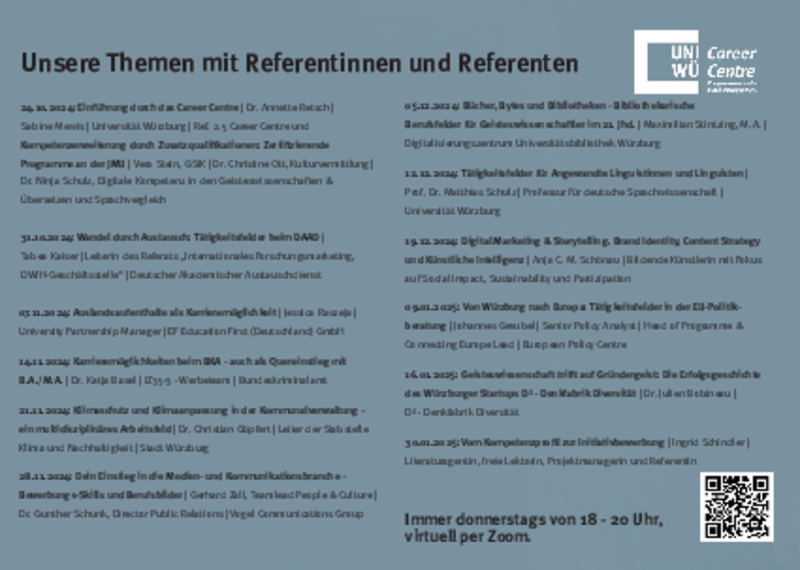
We would like to run the lecture series ‘Prospects for the Humanities and Social Sciences’ again in the 2026/27 winter semester. In this series, former students of the humanities and social sciences talk about their own career paths and exciting career prospects.
Further information and registration can be found on WueStudy.
Programme
And what will you do with it? This question is asked repeatedly to students of humanities subjects. To avoid responding with a helpless shrug and saying ‘something to do with media or culture,’ it is important to know your own skills and goals early on. Most jobs for humanities graduates are not advertised. However, there are still many opportunities to find jobs through personal contacts or unsolicited applications.
The lecture series introduces people who have taken this path themselves, some of whom now work in traditional fields for humanities scholars, while others are engaged in exciting activities in completely unexpected areas.
As a result of advancing globalisation and digitalisation, the labour market is not only undergoing ever-faster change but is also being affected by diverse and unpredictable crises.
The importance of interdisciplinary, cross-cutting skills is steadily increasing in the labour market. It is therefore a particular priority for the Career Centre, as part of this series of events, not only to present future-proof and interesting career fields and pathways, but also to highlight the programmes through which students can and should develop their skills with a view to the various career fields. As part of this, the event will also take a look at the new certificate programmes.
At the local level, climate protection is implemented in a tangible and concrete manner. Furthermore, the consequences of advancing climate change are already clearly noticeable at the local level. These changing realities of life generate motivation and a sense of urgency to take action on adaptation measures.
The local authority – the City of Würzburg – plays a central role here, or rather several roles: as a role model, it ensures the energy efficiency of its own properties; as a planner and regulator, it sets specific guidelines for climate-optimised construction; it also supplies renewable energy through local municipal utilities; and it advises local residents, for example on energy-efficient refurbishment, adapting to heatwaves or adopting climate-friendly behaviour – and much more.
The aim is to strategically manage and coordinate these areas, harness synergies and, more generally, integrate climate protection and climate adaptation into all areas of life and work (‘mainstreaming’). This is a multidisciplinary task. It is a task that requires collaboration between people from different professional backgrounds – and can also offer exciting opportunities for scholars in the humanities.
Company presentation, programme presentation, benefits of a stay abroad, career opportunities at EF
A career change into the civil service opens up a wide range of opportunities to make a fresh start professionally and take on social responsibility. In this workshop, you will learn what opportunities and prospects are available to you as a career changer in the public sector and how you can best prepare for this career move.
- The significance of a PhD and its impact on leadership roles in the civil service
- Overqualification due to a PhD: myths and realities
- Classification of relevant professional experience into pay grades and levels
- Opportunities for career changers from the private sector and academia
- Changing careers after many years in the workforce: pathways and challenges
- Transition from teaching to senior administrative roles
Practical tips and strategies
- Transferring values, motivations and skills to roles in the civil service
- Moving to a higher pay grade: requirements and procedure
- Crediting social security contributions when changing careers and becoming a civil servant (where applicable)
Political education is a career field of interest to humanities graduates. What is it like to work as a political education officer at the Federal Agency for Civic Education? What does a traineeship at the bpb involve? What responsibilities do you take on as a programme officer, and what qualities should you bring to the role? A look at the various pathways into journalism – through work placements, running your own podcast, freelance work, a traineeship or a journalism school – shows how these can be combined with (freelance) journalistic activities. What can you do whilst still studying to help you break into journalism after graduation? What are the requirements, and which skills are important? What is useful to know about the industry and working as a freelance journalist? As a former student of European Ethnology and History at the University of Würzburg, I would like to use my own career path to show how one can gain a foothold in the fields of political education and journalism.
In our talent development programmes, you will experience a working environment that is as varied as it is challenging and exciting. Given the wide range of topics that GIZ deals with, you will acquire extensive specialist knowledge, whilst also constantly being encouraged to think outside the box. After all, dealing with different people and cultures also requires interpersonal sensitivity, openness, a willingness to take the initiative and flexibility.
Choose the programme that suits you best. Practical experience in Germany or in one of the more than 130 countries worldwide where GIZ operates will add variety to your studies and enrich your CV. Find out about GIZ’s work in Germany and abroad through student placements, a legal traineeship, trainee programmes or a junior role. You will learn more about GIZ, application deadlines and requirements, fields of work and so on during the talk.
Speaker: Lisa Becker, HR Officer in the Young Talent Development department at the German Society for International Cooperation (GIZ) in Eschborn. Lisa Becker has been with GIZ for around 15 years. For many years, she worked in procurement and contract management. Prior to that, she was herself a dual-study student (BA in Business Administration) at GIZ and completed one of the young talent programmes. For several years now, she has been responsible for managing internships within the HR department.
Being a teacher – would that be something for me? Dr Weier will talk about her experiences as a primary school teacher and in other educational institutions. She will discuss the responsibilities, positive aspects and challenges of the teaching profession, be open to answering any questions, and will be happy to offer a few tips on how you might find the right career choice for you.
Artificial intelligence is no longer just a topic for computer scientists – it is fundamentally transforming our society, our culture and our working world. Texts, images, translations, analyses or even entire decision-making processes: much of what used to be the preserve of humans can now be handled by algorithms. But what does this mean for students of the humanities and social sciences?
In this 90-minute talk, we will take a look at how AI is already shaping our world and what opportunities and challenges this presents. Above all, however, the focus is on your role in this development: why humanities scholars, in particular, are needed to scrutinise, shape and imbue AI systems with meaning. For whilst machines operate on probabilities, humans live by meaning. You will discover which skills you can start building today to be professionally successful and socially effective in an AI-driven world.
A talk that offers guidance, provides food for thought – and demonstrates why the future of AI is inconceivable without the humanities.
For a successful speculative application, it is essential not only to research the prospective employer and potential areas of work, but also, in particular, to analyse your own skills profile. The skills profile captures the current status of the skills you have acquired. It highlights the knowledge, skills and abilities you have gained, whether formally or informally. These skills may have been acquired as part of your (academic) education, but also outside school and university, and encompass both theoretical knowledge and practical experience.
Requests for further lecture topics and cooperation requests for the coming semesters can be addressed to Dr Annette Retsch at any time:
annette.retsch@uni-wuerzburg.de, 0931/31-82420
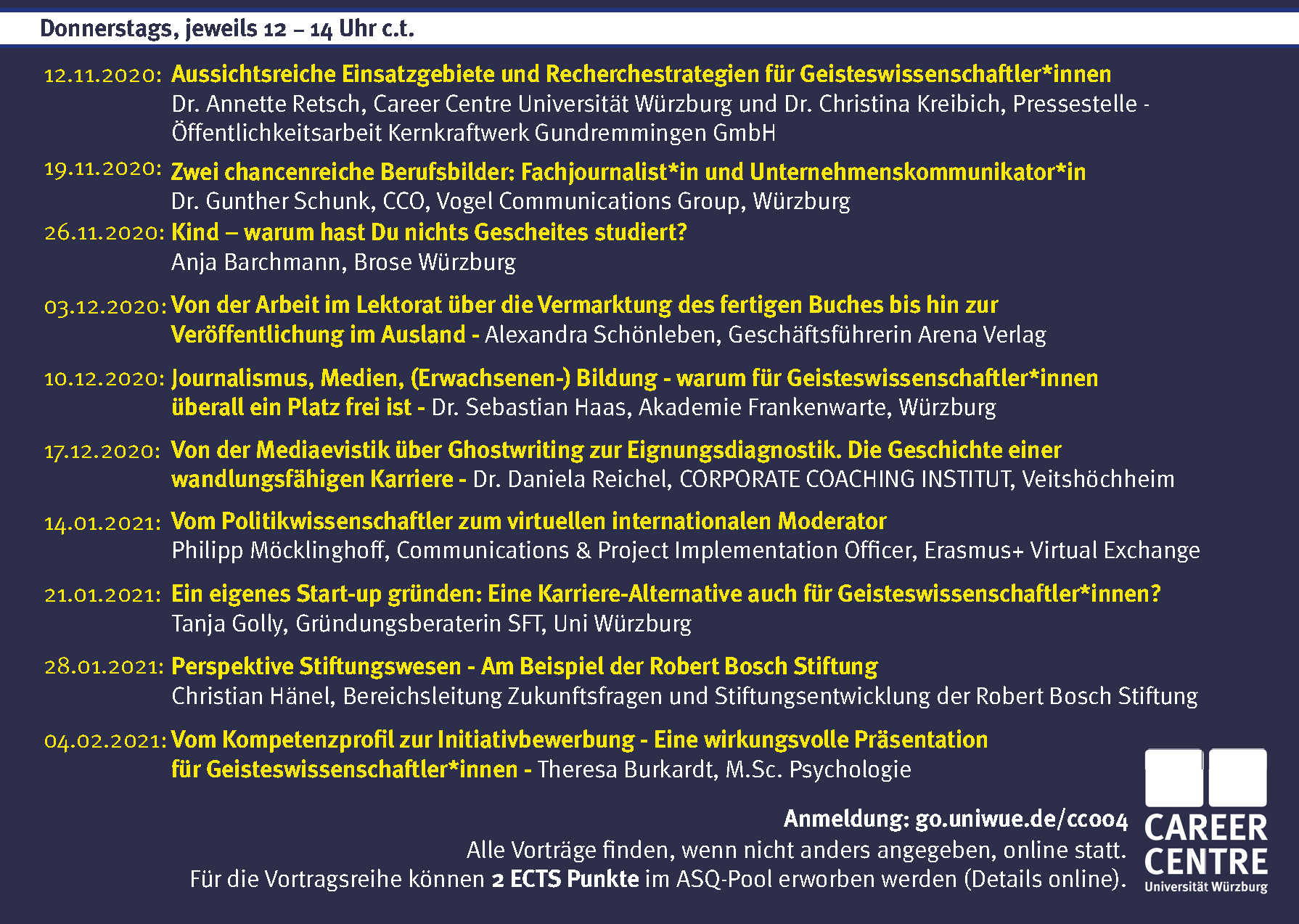
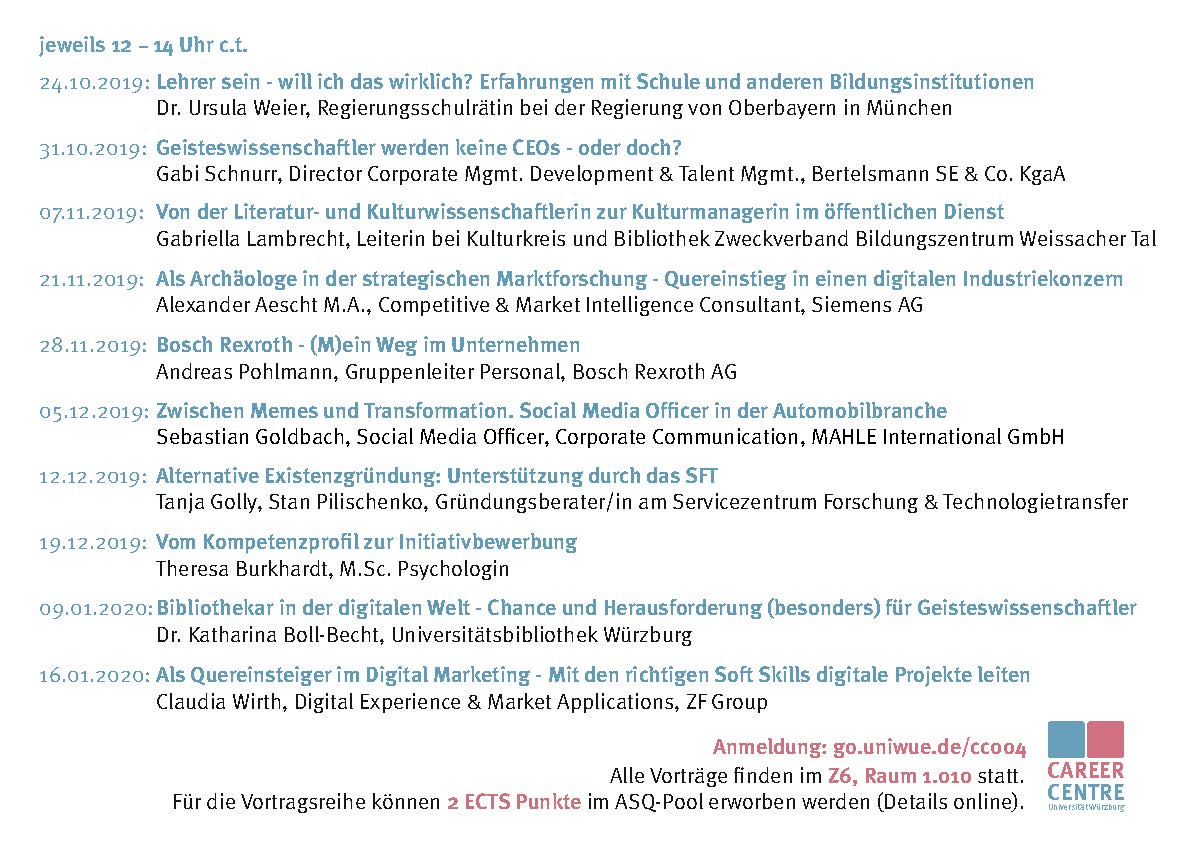
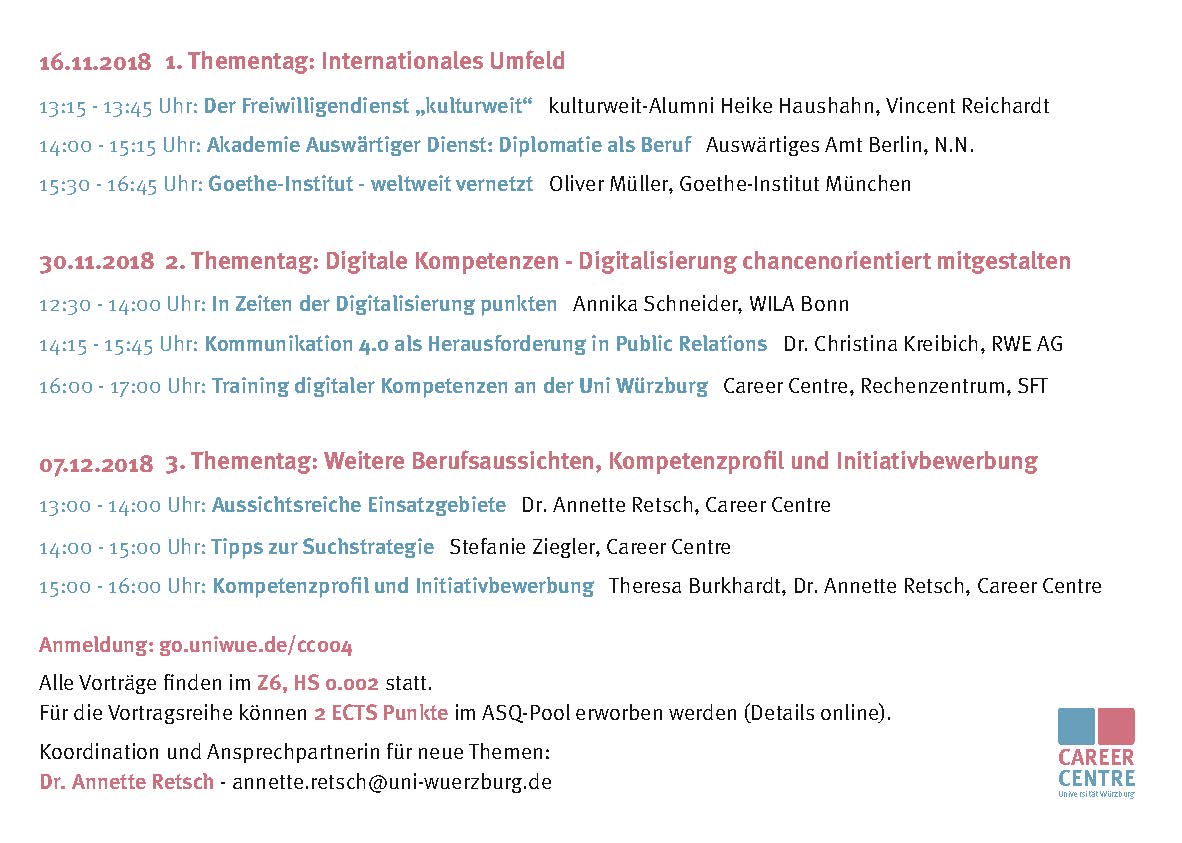
Past Events