Citizen Science
#Observe bees
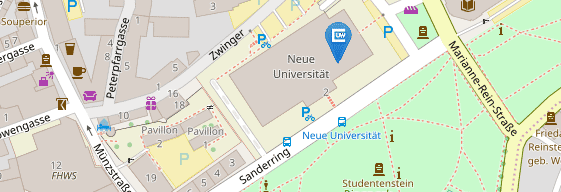
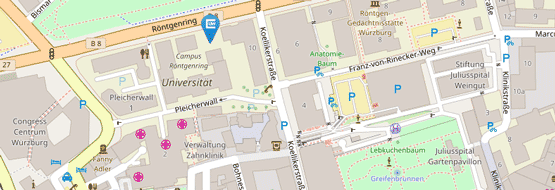
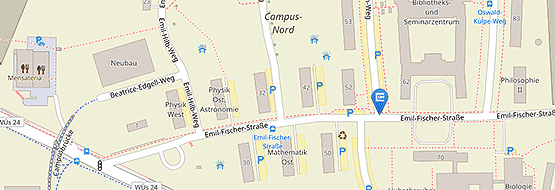
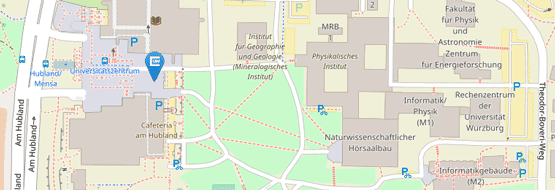
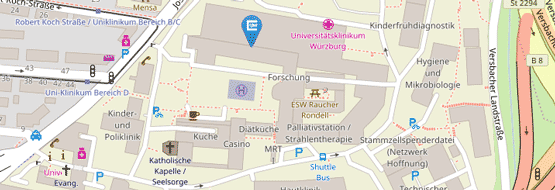
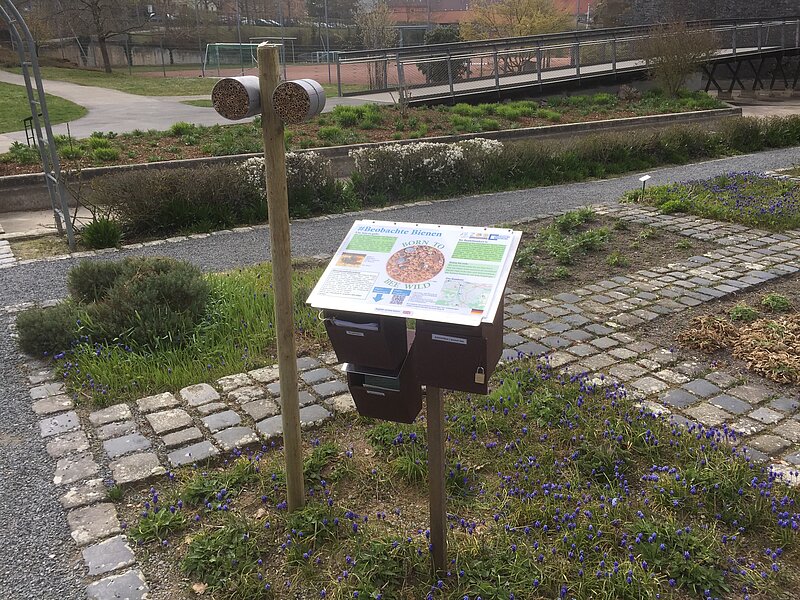
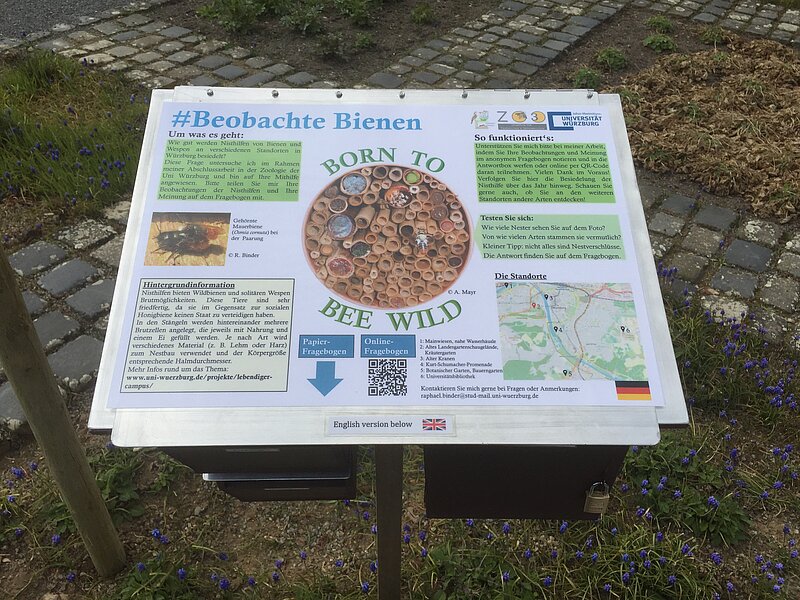
As part of this citizen science project, nesting aids will be set up at six public locations in Würzburg (see map) from April to September 2021, allowing interested citizens to track their colonization. In addition to the nesting aids, information boards will be installed to provide information about the project, the nesting aids, and their inhabitants. Questionnaires below the information boards will be used to collect citizens' observations of the nesting aids, thus gathering important data on the occurrence of stem-nesting bees and wasps in Würzburg. Digital participation via QR code is also possible. By visiting the various locations, it is possible to discover different types of nest closures and thus deduce that different species occur depending on the location and its characteristics.
On this website, you will find further information on nesting aids and wild bee protection (see below) as well as the latest observations from the population (see right) throughout the bee season.
Organizer: Anna Hofmann & Raphael Binder, Betreuerin: Antonia Mayr
Contact: Sarah Redlich
sarah.redlich@uni-wuerzburg.de
#Observe bees
Nesting aids and so-called insect hotels are becoming increasingly popular with the general public, but very few people know much about them and their inhabitants. For example, in addition to the well-known honeybee, there are 585 species of wild bees in Germany. Most of them live solitarily, meaning they do not form colonies; instead, the females take care of building their nests and feeding their brood on their own. Without a colony to defend, wild bees are very peaceful—so don't be afraid of them!
Some of these wild bees, as well as solitary wasps and their natural enemies such as flies, beetles, parasitic wasps, and gold wasps, can be provided with nesting aids for breeding and hibernation, thereby promoting biodiversity.
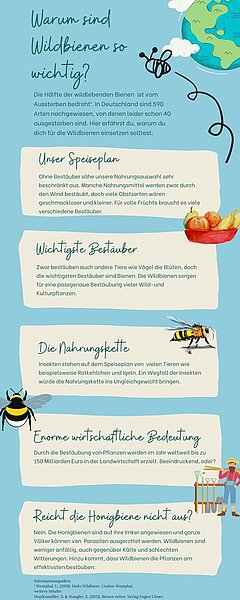
In short: food, building materials for nests and nesting sites. Depending on their size, bees fly a few hundred meters, so these needs must be met in close proximity.
Nectar and pollen serve as food for bees and their offspring. Depending on the species, this comes from very specific plants, such as bellflowers, or, in the case of generalist species, from many different plant families. The main thing is that they are native and regional plants.
The species are just as diverse when it comes to nesting sites. Around two-thirds of our native species nest in the ground. Others only nest in dead wood or plant stems.
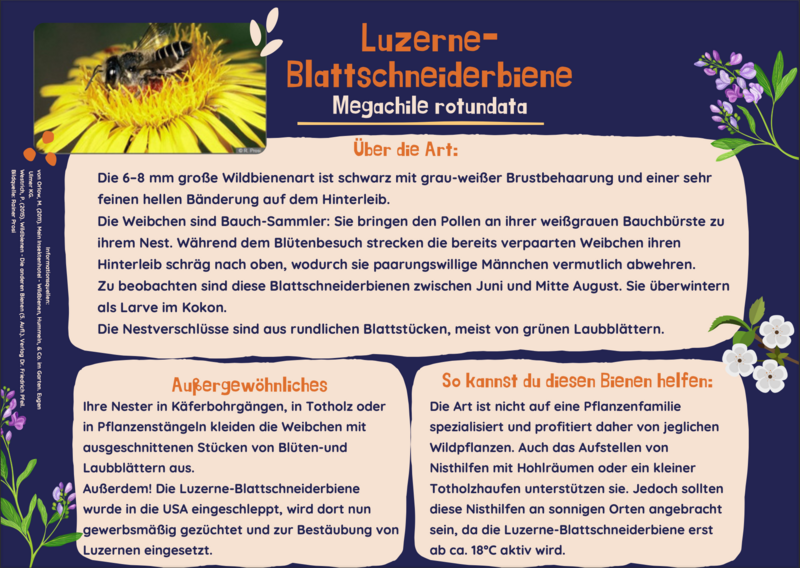
To make a nesting site perfect for their offspring, they need a wide variety of materials. For example, leafcutter bees cut pieces from leaves and use them to build their nests. Other species need plant hairs, resin, or even small stones.
To ensure the survival of wild bees, these three aspects must be fulfilled in their habitat.
Source:
Hopfenmüller, S. & Stangler, E. (2021). Bienen retten. Verlag Eugen Ulmer.
You have….
|
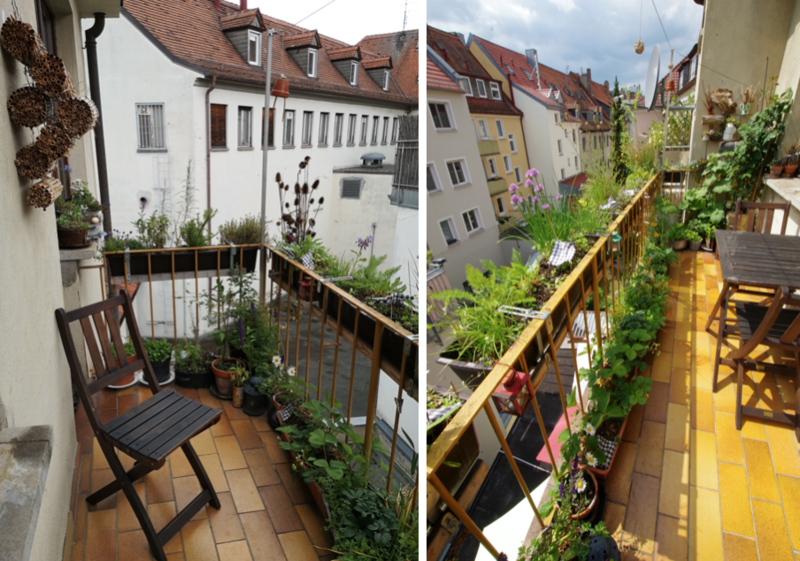
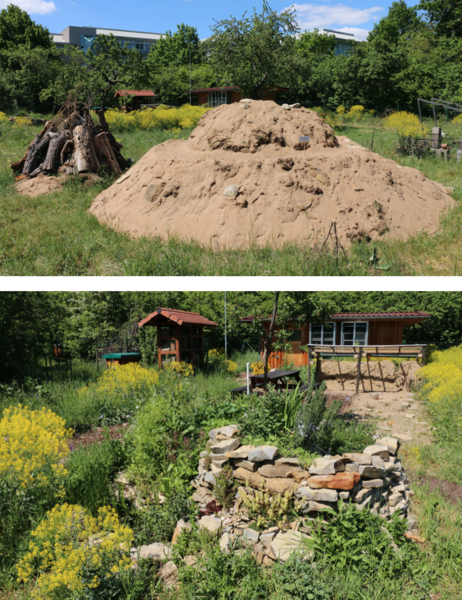
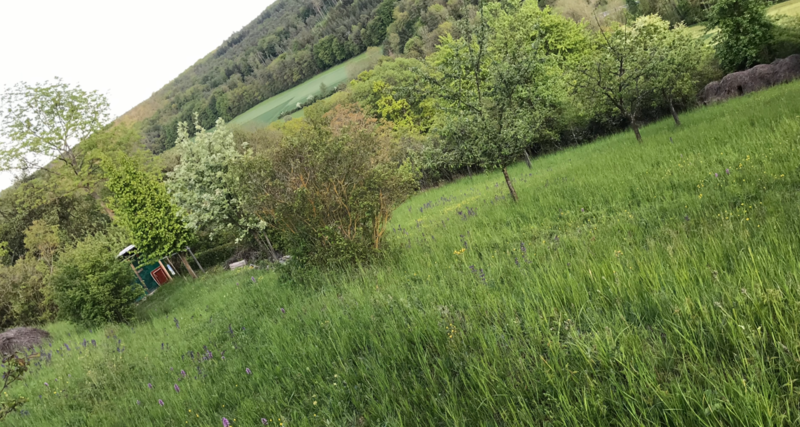
In addition to regional nurseries, many online retailers also offer certified seeds and perennials. The following sources are available online, for example:
https://www.stauden-spatzundfrank.de/?language=de
https://www.gaissmayer.de/web/gaertnerei/
https://www.rieger-hofmann.de/alles-ueber-rieger-hofmann.html
Source:
Hopfenmüller, S. & Stangler, E. (2021). Bienen retten. Verlag Eugen Ulmer.
Wild bees that nest in stems, such as the horned mason bee, create up to twelve brood cells in a row in a small tube. These are separated by cross walls made of clay, and the tube is sealed at the end with a clay plug (see below). This is then clearly visible on the nesting aids.
In spring, the mother bee transports sufficient nectar and pollen into each brood cell and lays one egg per cell. A few days after the eggs are laid, a larva develops from each egg. This consumes the food supplies, pupates in a cocoon, and develops into an adult bee during the summer. The bee spends the fall and winter at this stage. It is not until the end of February that the adult bees gnaw through their cocoons and clay walls and leave their nest one after the other through the previous year's entrance. An unfertilized egg is often laid in the brood cell closest to the exit, from which a male emerges. The males leave the nest a few days before the females. Once both sexes have hatched, the females look for a suitable cavity after successful mating and begin building their nest. Over the next four to six weeks, the females build brood cell after brood cell, with the males not participating in the construction. The horned mason bee therefore has a one-year life cycle.
Other species have different construction methods: for example, the garden wool bee uses scraped plant hairs as building material, while the common mask bee uses glandular secretions, which is why the nest is sealed with a thin membrane (see right: Update 05.07.2021).
Source:
Westrich, P. (2015). Wildbienen - Die anderen Bienen, 5. Auflage. Verlag Dr. Friedrich Pfeil.
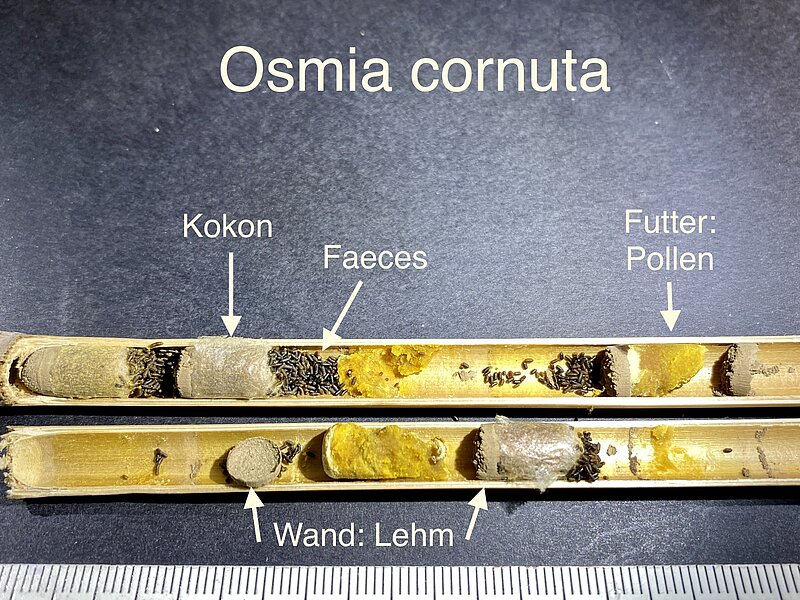
The nest closures on nesting aids provide clues as to which species may have nested in a stem. Often, several species use the same building materials, so it is not possible to make a definitive determination based on the nest closures alone.
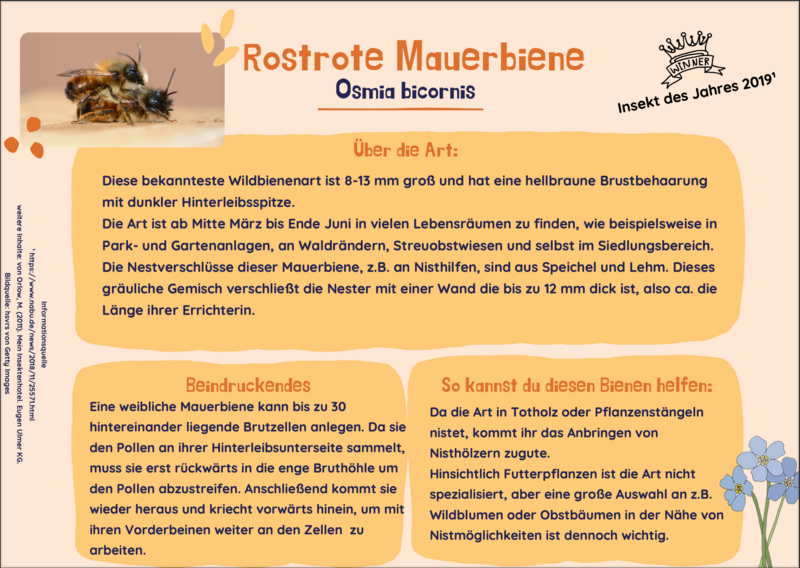
So far, mainly mason bees have been active on our nesting aids. The nest closures of the horned mason bee (Osmia cornuta) and the rusty-red mason bee (Osmia bicornis) consist of brownish mortar and are very loose, coarse, and rough (see right: Update 05.07. lower area).
Garden wool bees can also be observed on our nesting aids. Their nest closures are very similar to cotton wool balls. These consist of plant hairs and glandular secretions (see right: update 05.07. upper arrow).
Masked bees seal their nests with a transparent, thin membrane (see right: update 05.07. lower arrow). They build this membrane from their own bodily secretions.
Other nest closures can also be made of resin (hole bees) or pieces of leaves (leafcutter bees), for example.
Source:
Westrich, P. (2015). Wildbienen - Die anderen Bienen, 5. Auflage. Verlag Dr. Friedrich Pfeil.
By providing nesting aids, we are helping not only wild bees but also many other insects. For example, many wasps, such as digger wasps and robber wasps, also use reeds for nesting. Digger wasps are considered natural pest controllers because they collect animal food such as caterpillars, aphids, or cockroaches for their offspring. Potter wasps, on the other hand, hunt spiders, paralyze them, and bring them to their nests. The larvae then feed on them later. In order to regulate the population of spiders, aphids, etc., nesting opportunities must be available for their predators.
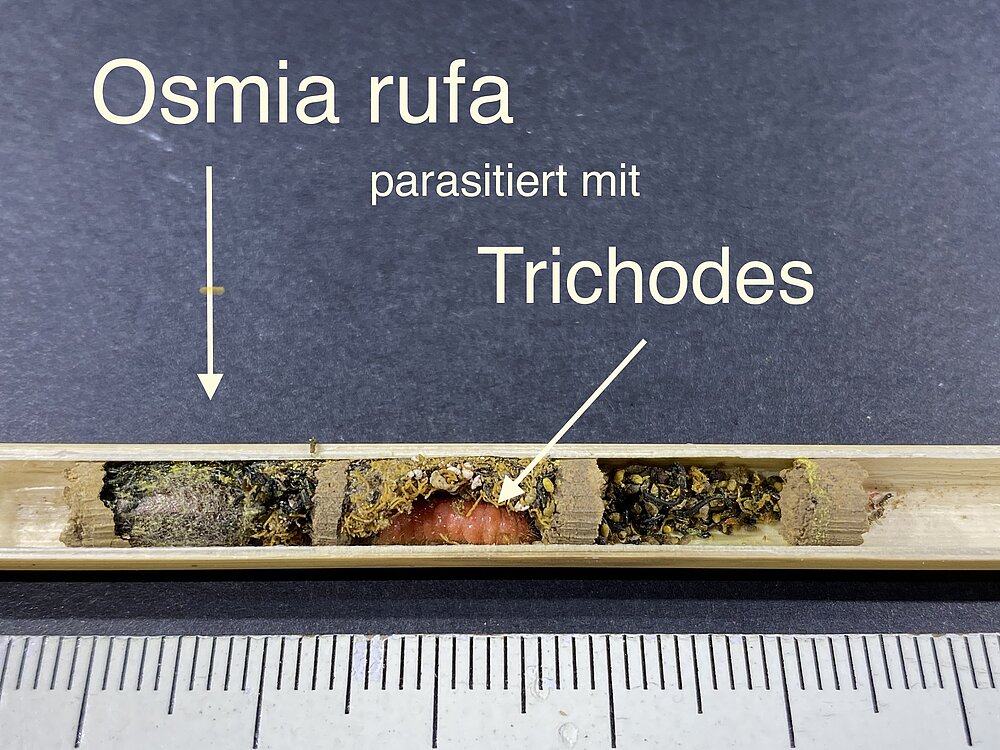
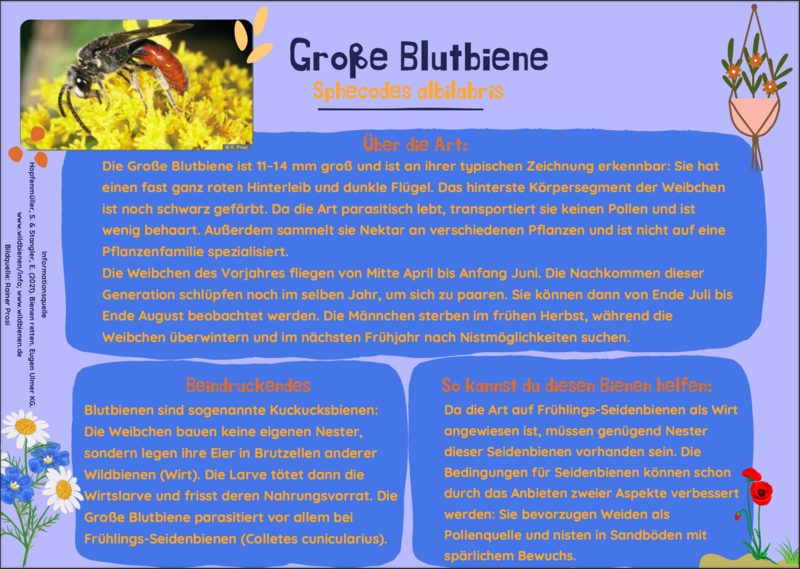
In addition, there are many insects that are adapted to specific species of bees or wasps, as they only lay their eggs in the nests of certain species. For example, the larvae of the jewel beetle (see below) live as predators in the nests of bees that nest above ground. The larvae need the bee nests as food so that they can pupate and later hatch into beetles.
In addition to jewel beetles, even flies such as the dew fly and woolly fly are parasites of wild bees.
The pretty gold wasps are very common in nesting aids, as they mainly parasitize folding wasps and rarely wild bees. The female lays an egg in a brood cell of the host. The larva initially sucks cautiously on the larva of its host, but as soon as the host larva has pupated, it sucks it out and pupates itself.
Source:
Hopfenmüller, S. & Stangler, E. (2021). Bienen retten. Verlag Eugen Ulmer.
Westrich, P. (2015). Wildbienen - Die anderen Bienen, 5. Auflage. Verlag Dr. Friedrich Pfeil.
How many citizens have already set up nesting aids?
72
Why would citizens set up nesting aids?
- 35% to protect wild bees
- 35% to support pollination on balconies/in gardens
- 30% other reasons
***NEU***Im Bayrischen Rundfunk:
https://www.br.de/radio/bayern2/programmkalender/sendung-3185564.html
In der Main-Post:
https://www.mainpost.de/regional/wuerzburg/uni-projekt-warum-wuerzburg-eine-perfekte-bienenstadt-ist-art-10630945#commentsAreaAnchor
https://www.mainpost.de/regional/wuerzburg/insektenhotels-mit-buergerbeteiligung-art-10593511
Fränkische Nachrichten:
https://www.fnweb.de/rhein-main-neckar_artikel,-wuerzburg-wildbienenprojekt-der-uni-wuerzburg-stoesst-auf-reges-interesse-_arid,1819185.html
Aktuelles der JMU:
https://www.uni-wuerzburg.de/aktuelles/einblick/single/news/insektenhotels-mit-buergerbeteiligung/
Stadt Würzburg: