III Herbarium Franconicum
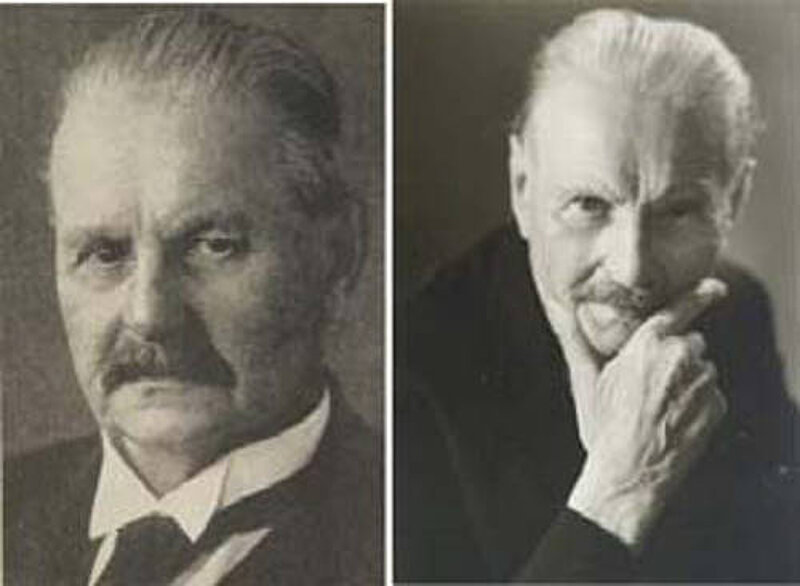
The "centrepiece" of the herbarium at the University of Würzburg is the Herbarium Franconicum. At the end of the 19th century, when Julius von Sachs (1832-1897) increasingly turned his attention to physiological and ecological issues at the Botanical Institute, more and more florists came together who, as "amateur botanists", had made the botanical exploration of their homeland their goal. It was the Sonneberg pharmacist Otto Appel, the last student of Julius von Sachs, who very quickly made contact with the Würzburg and Lower Franconian florists due to his unusual floristic knowledge and his open manner.
Appel founded the Würzburg Botanical Association in 1896, which quickly developed a lively life and set itself the goal of floristic research in Lower Franconia. They met in summer for joint hikes and in winter for regular events with lectures and demonstrations of herbarised material. When Otto Appel left Würzburg in 1898, the realisation of the association's wish, namely the establishment of a Herbarium Franconiae, was announced as a kind of "farewell gift" at the farewell event.
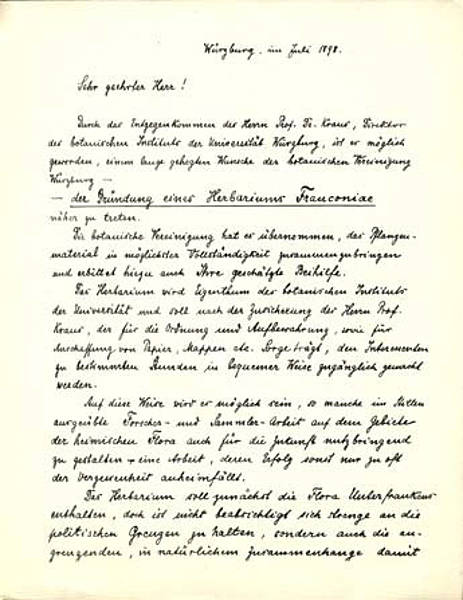
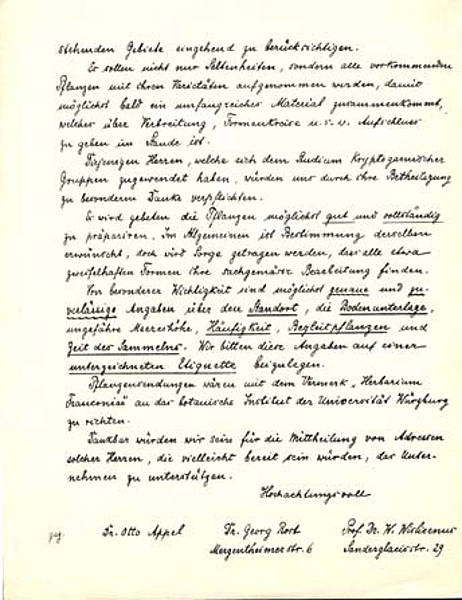
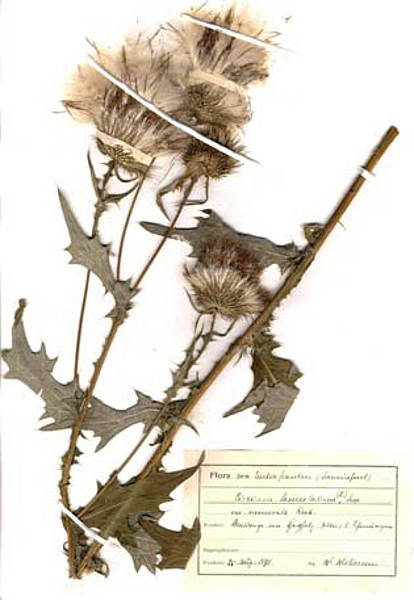
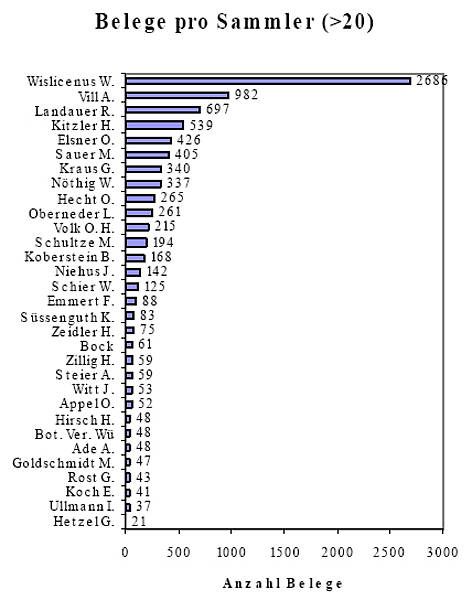
In the founding phase, many specimens were initially made available from existing private herbaria or from bequests, so that almost a quarter of the total of around 9,700 specimens today originate from the time before the Botanical Society was founded. More than half of all specimens date from the period between 1897 and 1915 and are mainly the result of collecting activities by members of the Botanical Society. One collector who stands out in particular is Wilhelm Wislicenus (Professor of Chemistry in Würzburg until 1903), who contributed almost a third of the current size of the Herbarium Franconicum.
With the departure of Appel and Professor Wislicenus, the association lost its driving force and work on the herbarium stagnated. The high school professor August Steier revitalised the association in 1912 and thus also forced the creation of the Herbarium Franconicum again. In 1919, the association was transferred to the Natural Science Association as the Botanical Department.
In the period after the Second World War, there was relatively little targeted collecting activity for the Herbarium Franconicum. Collections from this period can be recognised by the names W. Nöthig, Prof. O. H. Volk, Prof. H. Zeidler, pharmacist W. Schier, B. Koberstein, Prof. I. Ullmann and many others.
If we divide the area on which the Herbarium Franconicum is based into individual finding areas and plot them together with the frequency of finds on a map of Lower Franconia, we can see that the Maindreieck in particular is best documented, with the absolute focus around Würzburg.
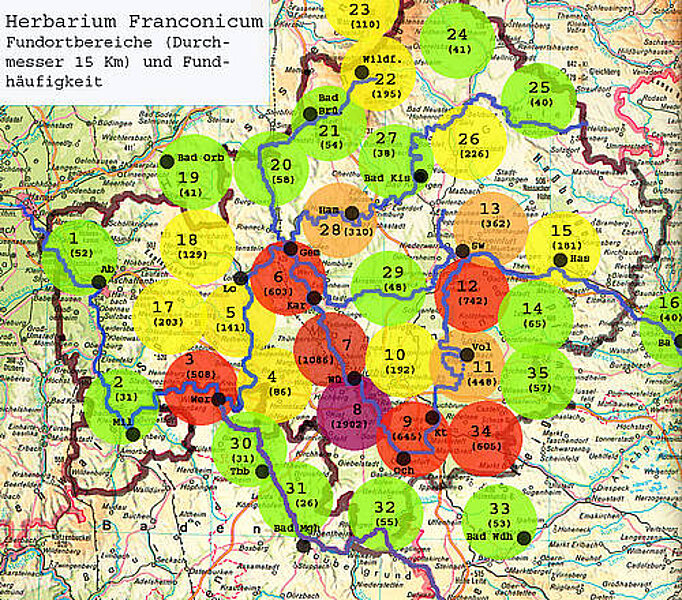
While it had been decided when the herbarium was founded not to adhere strictly to political boundaries, it turns out that the collecting area of the "founding fathers" corresponds more to the area of the Grand Duchy of Würzburg, which forms the basis of Heller's herbarium. The Lower Main region, the Hassberge region and the eastern Steigerwald are relatively poorly represented. The fact that Wertheim and the Spessart are relatively well represented is mainly due to the transfer of the herbarium from the estate of H. Kitzler, the relevant parts of which were incorporated into the Herbarium Franconicum.
Many of the species contained in the Herbarium Franconicum have long since become extinct or their distribution has been greatly reduced. A large number of the localities, especially those in the vicinity of Würzburg and the urban area, no longer exist. If the herbarium of F. X. Heller is also included in the analysis, it is possible, albeit with great caution, to make statements about influences on the change in the flora of Würzburg and the surrounding area for a period of almost 200 years.