

Graduate interview: Anne - Research Assistant
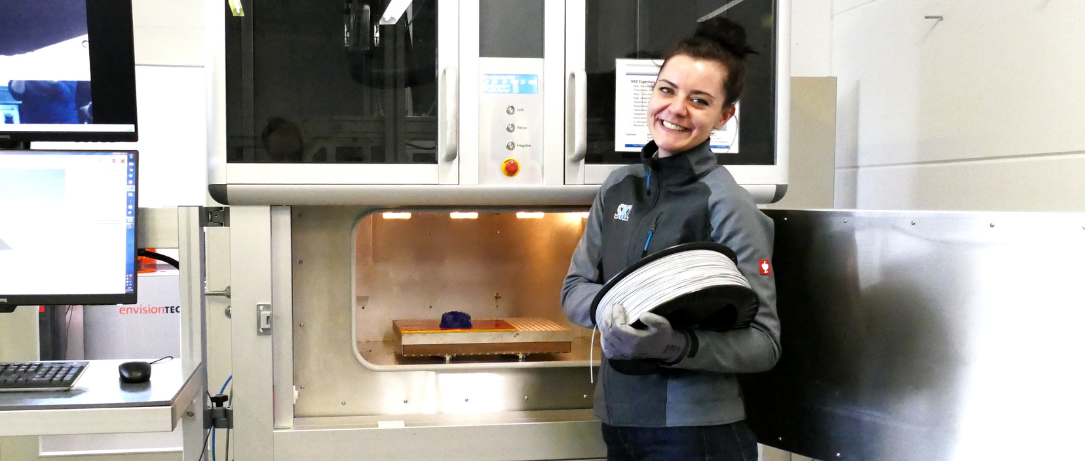
03/24/2021After graduating, Anne knew exactly where she wanted to go thanks to her student job at the SKZ: into research into 3D printing processes. She can now live out this passion as a research assistant at the Plastics Centre. The former chemistry (B. Sc.) and biofabrication (M. Sc.) student not only took part in various training and further education programmes here, but also wrote her Master's thesis there - after which she was allowed to stay. Anne is particularly enthusiastic about her research stay abroad, which enabled her to develop significantly, as well as her voluntary work in the chemistry student council initiative and outside the university in geriatric care.
What did you study at the University of Würzburg?
Chemistry (B. Sc.) and Biofabrication (M. Sc.)
What is your current job?
Research assistant in additive manufacturing (= 3D printing)
Which company/employer do you work for?
SKZ - The Plastics Centre
What are your tasks?
As a research assistant, I conduct research into various 3D printing processes in order to further develop them for their diverse areas of application. To this end, I am in constant dialogue with other research institutions and partners from industry. I am also involved as a lecturer in the SKZ's training and further education programme, which includes lectures and internships for the IHK, the THWS and, of course, the JMU, as well as independent courses.
Which skills from your studies are helpful or essential for your current job?
For my job, I naturally need a deep understanding of the materials I work with, and my chemistry degree gave me that. As my colleagues and I also do a lot of research in the field of medical technology, among other things, my knowledge from the lectures at the Chair of Tissue Engineering and Regenerative Medicine, which I attended during my Master's degree, is proving to be very useful. The ten-month research stay abroad, which was part of the Biofabrication programme, ultimately trained me to become an independent and solution-oriented researcher.
How did you acquire additional skills (e.g. workshops and seminars, internships, part-time job, clubs, voluntary work, traineeships, further training, etc.)?
During my chemistry studies, I was already employed as a student assistant at my current employer, which was not only useful for my professional orientation, but also gave me a lot of experience for my later employment. This activity then also developed into a hobby, so that at some point I bought my own 3D printer, which I still use in my free time today.During my time as a student assistant, I repeatedly took part in the SKZ's broad training and further education programme so that I could learn directly from practical experience and gain an even better understanding of the various manufacturing processes and materials. I also volunteered in the chemistry student council initiative and outside the university in geriatric care.
Do you have any general tips for professional orientation and career planning?
I would recommend doing internships to get a taste of as many areas as possible that you are interested in. Of course, depending on the degree programme and the time available, this can sometimes be difficult to implement. In addition, a stay abroad not only looks good on your CV, but also contributes significantly to your personal development. During the application process, you shouldn't despair at the requirements listed in the job advertisements if you haven't yet acquired certain skills. Ultimately, it is important that you show that you are willing to learn new things, as employment is always a question of personality and motivation as well as the technical side.
What would you recommend to students who want to work in your industry or profession?
3D printing is an extremely interdisciplinary field in which knowledge from areas such as materials science, process engineering, programming or even medicine may be required. There is therefore no such thing as THE degree programme or THE training course that really covers everything down to the smallest detail. That's why I recommend acquiring a core specialised skill, e.g. during your studies, and then continuing to learn by thinking outside the box. Ultimately, lifelong learning is part of every job and 3D printing is definitely a lot of fun!