


Graduate interview: Nicolas - Subject Matter Expert
12/26/2024After completing his studies, Nicolas worked as a Subject Matter Expert at Deutsche Bahn as a business analyst for automatic timetable design, where he acted as the interface between developers and timetable designers. Analytical thinking, knowledge of algorithms and enthusiasm for the railway are essential for his work. Nicolas advises combining personal interests with professional skills, reflecting on potential and always being prepared to expand your knowledge.
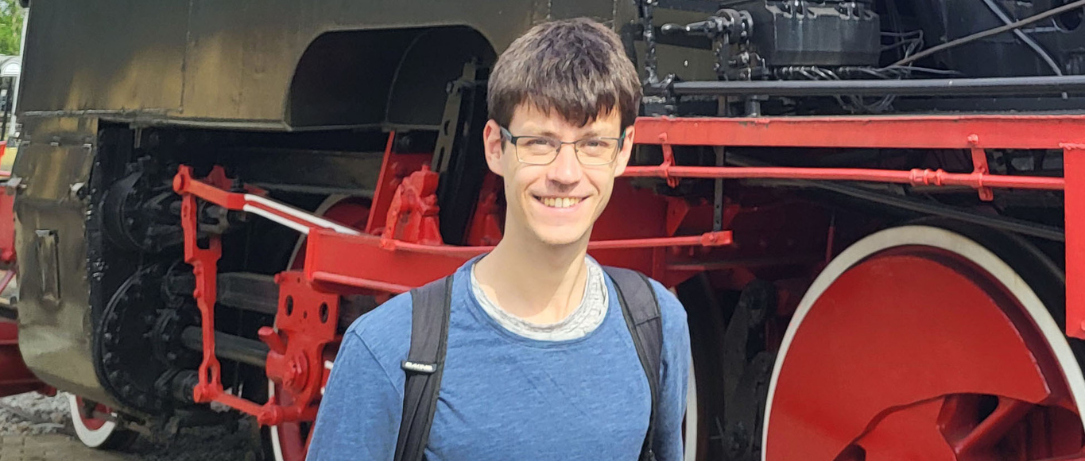
What did you study at the University of Würzburg?
I studied mathematics - both at Bachelor's level (with computer science as an application subject) and at Master's level.
What is your current job?
I am a Subject Matter Expert for automatic timetable construction.
Which company/employer do you work for?
DB InfraGO AG (Deutsche Bahn) in Frankfurt am Main.
What tasks do you perform?
I take on the role of a business analyst in an agile software development team and am therefore responsible for the specification of technical requirements, manual tests, technical approvals and direct customer communication.
How did you orientate yourself professionally during and after your studies?
A voluntary internship in software development at Bosch-Rexroth gave me valuable insights into the world of agile software development. In addition, conversations with friends, relatives and, last but not least, university lecturers helped me to find out which professional fields really suited me. As I am very interested in railways and the technology behind them, I ended up looking specifically for job advertisements at Deutsche Bahn during the application phase.
Did you use any of the university's career guidance services (e.g. Career Centre, alumni office, mentoring programme, guest lectures, etc.)?
I attended the lecture on application basics for mathematics, physics and computer science at the Career Centre and took part in the GSiK lecture on "mathematical timetable optimisation".
How did you find out about the position you applied for? Is there a particular portal that you could recommend to students in the future?
Due to my great interest in the railway, I always kept an eye on DB's job advertisements. In the end, however, it was actually the advice of a friend that persuaded me to apply for this position.
What exactly was your application process like and what was the timeline from the first contact through to acceptance?
Deutsche Bahn has a transparent applicant portal. I uploaded my documents (especially my CV and cover letter) there. About a week later, I received an e-mail inviting me to an online interview. A few days after the interview, I received a phone call in the morning with the verbal confirmation, followed shortly afterwards by a written confirmation by email.
Were there any questions in the interview that you didn't expect? If so, which ones?
Not really. I found it very pleasant that there were no stressful or trick questions at all. One very important question was probably what is important when developing requirements for software. This includes not only what the software must be able to do and how quickly, but also what is explicitly not required.
Which skills from your studies are helpful or essential for your current job?
Analytical thinking is essential both in maths and in the role of business analyst. Any knowledge from my computer science application subject helps when I'm dealing directly with source codes. A confident handling of numbers and knowledge of algorithms are also essential.
How did you acquire additional skills (e.g. workshops and seminars, internships, part-time job, clubs, voluntary work, trainee, further training, etc.)?
In addition to a voluntary internship at Bosch Rexroth in the field of software development, I was able to expand my expertise through my own research and observations while travelling by train. I also learnt a lot from talking to people in my family and circle of friends who are also rail enthusiasts and who work or have worked for the railway.
What advice can you give students for successful preparation for future job interviews?
It is important to prepare in advance in terms of content, to gather knowledge that is listed in the job advert and to think about two or three questions in advance that you can ask at the end of the interview. During the interview, you should listen carefully, ask meaningful questions at appropriate points, show interest, be friendly and, most importantly, be yourself.
Do you have any general tips for professional orientation and career planning?
Personally, talking to family and friends has helped me a lot, as they know me best and know what suits me. I would therefore recommend asking for their opinion and, if you have the opportunity, getting expert opinions from lecturers in your own subject area, as they know what opportunities are open to you with the knowledge and skills you have gained from your degree programme.
What do you recommend to students who want to work in your industry or profession?
It is important to be clear about why you have chosen Deutsche Bahn as an employer so that you can justify your motivation for applying. In any case, you should have a basic knowledge of the railway system. Basically, by working for Deutsche Bahn, you are supporting an environmentally and climate-friendly mode of transport and making a positive contribution to society with your meaningful work.