Overview
Overview
The herbarium of the University of Würzburg contains:
- An extensive collection of the flora of Lower Franconia and the neighbouring areas with specimens since the middle of the 19th century. Many of the localities have become extinct, many of the species are now lost or extinct, threatened with extinction or at least highly endangered
- a good overview collection of European plants in the general herbarium, as well as plants from the north-eastern and south-eastern peripheral regions
- extensive collections of cryptogams (mosses, lichens, partly algae)
- type specimens (evidence material that served as the basis for the first description of species) and locality records
The herbarium of the University of Würzburg is registered in the Index Herbariorum, the international directory of the world's herbaria (Herbarium Acronym WB), and in the ZEFOD, the central register of biological research collections in Germany. The individual collections are currently being entered in a database. The herbarium maintains a lively lending programme with scientific institutions all over the world.
Contact us
Dr Gerd Vogg
Scientific curator
Botanical Garden of the University of Würzburg
Julius-von-Sachs-Platz 4
D 97082 Würzburg
Tel. +49 +931 31 86239
Fax +49 +931 31 86207
vogg@botanik.uni-wuerzburg.de

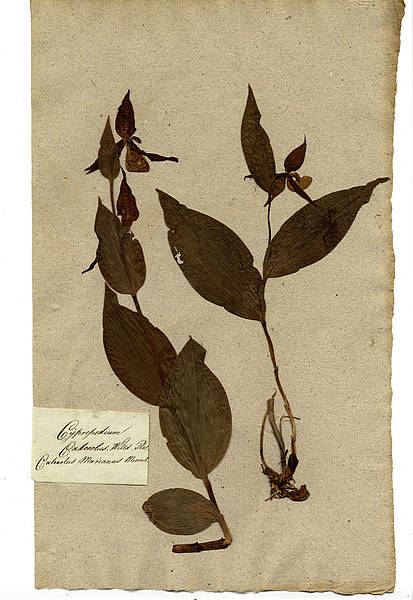
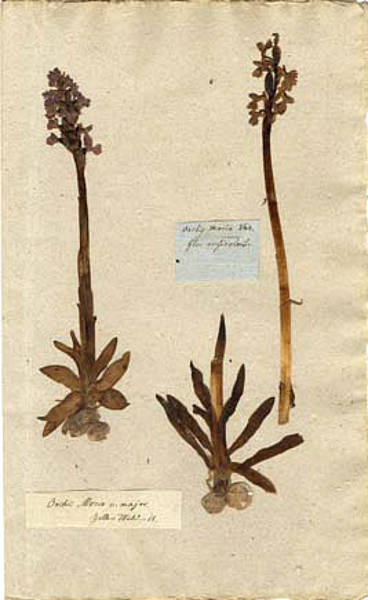
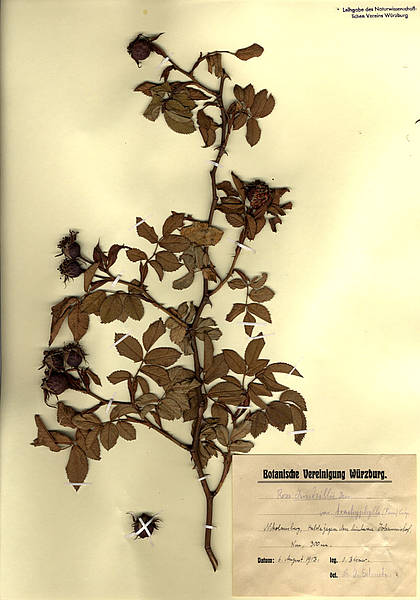
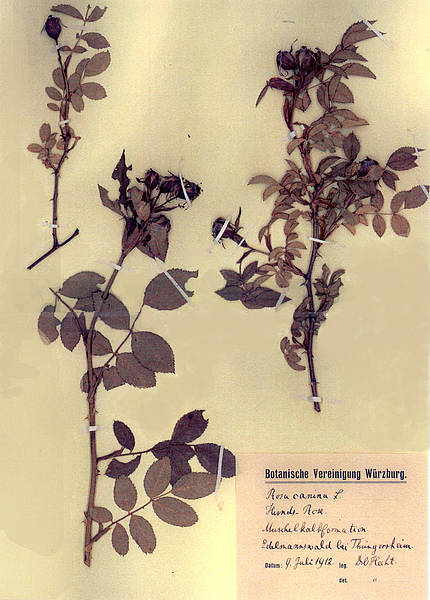
A herbarium (Latin: herba = herb) is a collection of dried and pressed plants or plant parts. These are summarised as a recognisable unit on a herbarium document.
Task of a herbarium
A herbarium allows the botanist to access plants collected in different areas and at different times. This allows the occurrence and distribution of plant species to be recorded and comparative morphological studies to be carried out between plants.
If new, previously unknown plant species are described, the description is always based on a specific herbarium specimen, the holotype, of this species. The characteristics defined by this type can be used as a basis for comparisons with new specimens or for differentiation from other species.
Requirements for a scientific herbarium specimen
The plant pressed on a herbarium specimen must be complete and of good quality. All relevant plant parts (flower, leaf, shoot, root, fruit) should be present and visible as far as possible. The plant material should be pressed and dried without damage (mechanical, fungal attack, yellowing).
It is important for a herbarium specimen to be properly and completely labelled: the minimum information is the scientific name of the plant, place of discovery, date of discovery and collector. It is also important for future observers to provide information on the frequency of the plant at the place where it was found, accompanying plants and location details.
The provision of herbarium material for scientific research is still important today, in accordance with the still valid statement by Carl von Linné (1751): "Herbarium praestat omni icone, necessarium omni Botanico" - "A herbarium is better than any representation, necessary for every botanist."
Preparation of a herbarium record
In order to preserve the plants over very long periods of time, the dry preservation method is used: Most of the water is removed from the plants as quickly as possible. This is achieved by carefully placing the plants in the most absorbent paper possible, which must be changed several times during the drying process.
To dry and press the plants, they are placed in a plant press together with the absorbent paper. For hobby use, heavy books can replace the plant press.
The dried and pressed plants are fixed to herbarium sheets with approx. 3 mm wide self-adhesive strips. The individual herbarium sheets are stored horizontally in shallow compartments. Several herbarium sheets of the same plant species are grouped together to form fascicles.
The herbarium of the University of Würzburg comprises around 100,000 herbarium specimens and is a small scientific collection by international standards. However, as the herbarium mainly contains regional specimens from northern Bavaria, its importance for floristic research in this region should not be underestimated. In addition to seed plants, it includes representatives of all plant groups, such as algae, fungi, lichens, mosses and ferns.
Herbarium specimens can be stored for practically an unlimited period of time if stored properly. They allow the repeated examination of important characteristics, nowadays also of plant genetic information, which is stored in the DNA of the cell nucleus and is still accessible for analysis even when the material is dried. A herbarium is therefore not only important from a historical-botanical and didactic point of view, but also serves current research, including molecular biological methods, e.g. in the fields of systematics and vegetation ecology.
The oldest specimens in the Würzburg herbarium date from around 1810.
In addition to the scientific significance of the collection, the herbarium also reflects the successful scientific history of botanical research at the university and Würzburg scientific associations over the past two centuries.