
Deutsch Intern
IFEX - Interdisciplinary Research Center for Extraterrestrial Studies

UAP & SETI Research

Unidentified Anomalous Phenomena (UAP)

UAP (Unidentified Anomalous Phenomena), formerly commonly referred to as UFOs (Unidentified Flying Objects), encompass observations of unusual phenomena, typically occurring in the sky, whose causes cannot initially be clearly determined. The term UFO was for decades strongly shaped by cultural narratives and partially stigmatized. In contemporary scientific discourse, the more neutral designation UAP has therefore become increasingly established, supporting an open, methodologically rigorous, and interdisciplinary investigation.

The vast majority of such observations can be attributed to known objects or natural phenomena, including birds, aircraft, satellites, drones, atmospheric effects, or perceptual misinterpretations. A small fraction, however, remains unexplained even after careful expert analysis and despite comparatively good data quality. These cases constitute a distinct scientific interest and highlight the need for systematic, technology-driven, and data-centered research.

IFEX contributes to the establishment of this emerging field by developing and operating technical systems for the detection, assessment, and analysis of relevant events, as well as by conducting in-depth investigations of particularly informative cases.

The long-term objective is the creation of an integrated research infrastructure — a “system of systems” — designed to enable the acquisition of high-quality, scientifically robust data. To this end, sensor systems specifically tailored to the characteristics of the phenomenon are conceptualized, developed, and deployed in sustained operations. Observational data are systematically collected, examined, and evaluated in accordance with recognized scientific standards.

Close collaboration with relevant authorities, evidence-based advisory support for policymakers, and transparent, responsible communication with the public and the media are likewise of central importance.

Within this context, IFEX understands itself as a central scientific institution for the consolidation, coordination, and partial implementation of related activities. Its objective is to establish sustainable research structures, further develop scientific standards, and anchor the long-term investigation of UAP within institutional frameworks. Reliable support and adequate resources are essential to achieving these goals.

Insights gained from this research have the potential to advance the understanding of previously insufficiently explained observations while also generating impulses for technological innovation as well as for science, industry, and society.

News

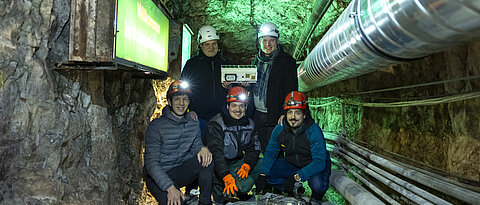
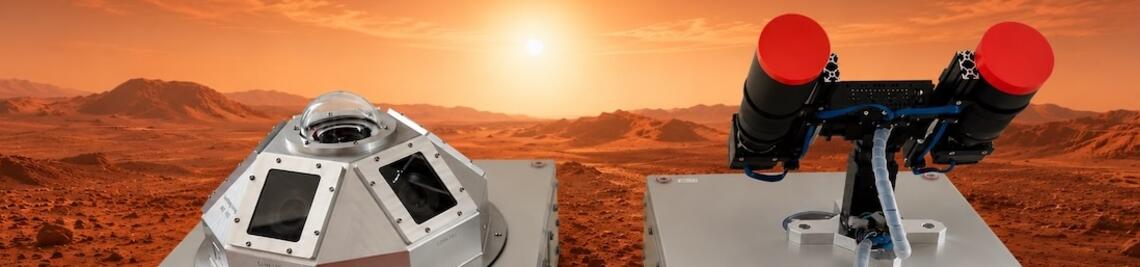
Mars technology put to the test: Würzburg team tests cave robot

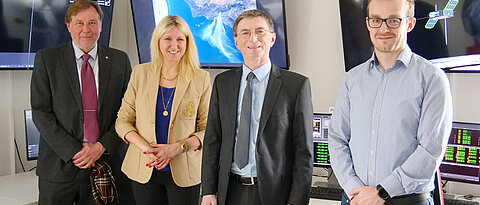
Visit by Dr. Silke Launert, Parliamentary State Secretary to the Federal Minister for Research, Technology and Space

Flying lecture hall: Würzburg AI satellite in orbit for two years

Media Contribution and Publications

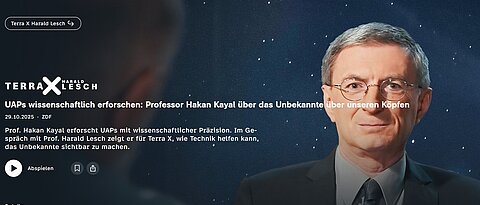
UAPs wissenschaftlich erforschen? So geht's!

October 2025: Prof. Kayal talks with Prof. Harald Lesch in Terra X Lesch & Co on youtube

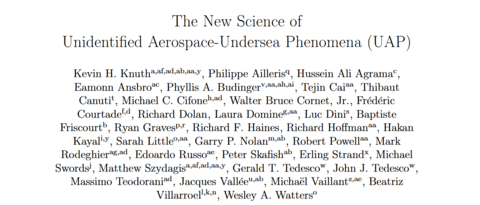
The New Science of Unidentified Aerospace-Undersea Phenomena (UAP)

2025: Co-publication of a paper on the topic of UAP

Research Projects

ADEOS

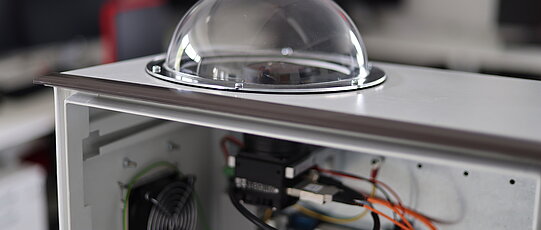
Anomaly Detection and Observation System (ADEOS) is a system for detecting and observing unidentified anomalous phenomena (UAP). It consists of various sensor systems and is to be controlled via a client-server architecture. One of the optical elements of the system is an all-sky camera in the visible wavelength range. Depending on the availability of resources, ADEOS will be expanded over time and operated at various locations.

VaMEx3-MarsSymphony

Demonstration of communication technologies and sensor systems in realistic exploration scenarios with regard to a future Mars mission in the Valles Marineris region

Project start: 01.08.2024
Project end: 31.12.2026
Funding Code: 50RK2451A

UAP Reporting Form for Pilots

Contribute to science – report your sighting and support the scientific investigation of UAP!


Working Groups

Technologies for UAP research

This working group is concerned with the development, operation and evaluation of technical systems for the scientific investigation of UAP. The focus is on sensor technology, multi-sensor systems, observation stations, camera systems, time synchronisation, calibration, data transmission, automatic event detection, AI-supported analysis, sensor fusion and comparison with exclusion data such as air traffic, satellites, weather, astronomical objects or space situational awareness data. A particular focus is on the collection of high-quality, reproducible and scientifically analysable data.

Concepts for SETI and UAP research

This working group develops and discusses fundamental scientific, methodological and strategic concepts for SETI and UAP research. These include suitable observation strategies, evidence criteria, classification systems, research designs, data requirements, international comparative approaches, standards for the evaluation of unusual observations and the differentiation between natural, technical, man-made and as yet unexplained phenomena. The aim is to create a robust conceptual framework that links SETI activities, UAP research, technical developments, case analyses and social issues.

Social aspects and post-detection studies of UAP research

This working group investigates the social, psychological, sociological, legal, cultural, media and science communication aspects of UAP research as well as related questions of SETI and post-detection research. These include stigma and reporting behaviour, the psychology of perception, the legal framework, data protection, institutional responsibilities, media communication, disinformation, social reactions to unusual discoveries and the possible consequences of a confirmed UAP, technosignature or SETI-relevant discovery. The aim is to deal with these topics in an interdisciplinary, scientifically reflective and responsible manner.

Case studies and analyses

This working group deals with the structured investigation, documentation and evaluation of specific UAP cases and unusual reports. This includes technical sighting analyses, reconstructions, comparisons with air traffic, satellite, weather and astronomical data, evaluations of image and video material, witness statements, pilot reports and - within a separate, methodologically sensitive framework - contact, abduction and similar experience reports. The aim is not a hasty interpretation, but a comprehensible, transparent and scientifically critical analysis, taking into account technical, psychological, social and empirically verifiable aspects.