
Project Area B
Boron-Based Functional Materials
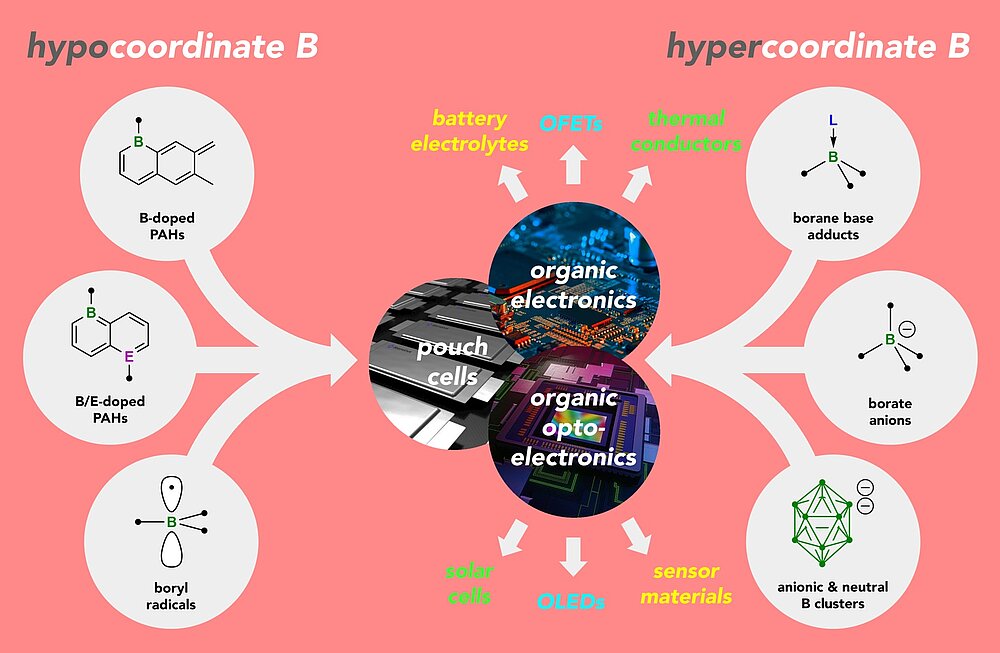
The long-term goal is to establish boron as an eminently versatile and unique element for energy-related applications.
B01
Project B01 “Anionic Boron- and Carbon-Based Heteronuclear Diradicals and Frustrated-Spin Systems” (Ravat, Holthausen & Lambert) targets the development of Kekulé and non-Kekulé diradicals with boron as a radical center, incorporated to polycyclic aromatic hydrocarbons (PAHs). Such compounds shall endow conventional carbon-based diradical systems with enhanced stability, tunable electronic energy levels, and novel redox properties for functional-materials applications. Boron-containing open-shell PAHs will enrich the fundamental knowledge on electron-deficient diradicals and will be added to the toolbox of novel functional materials for optoelectronics.
Project leaders
B02
Project B02 “Engineering Stable Boron-Based Diradicals with Controlled Spin Interactions” focuses on boron-based diradicals with controlled spin interactions. Diradicals based on modular and stable B-containing radical units that exhibit rich photophysics and have potential for application will be addressed. This project aims at establishing the missing links between stability, structure, spin states, and light emission of boron-based diradicals.
Project leaders
B03
Project B03 “Boron-Containing Polycyclic Aromatic Hydrocarbons: Synthesis, Surface Science, and Functional Materials for Organic Electronics” relies on boron as an electronically perturbing dopant element for organic semiconductors. Replacement of sp2-hybridized carbon in polycyclic aromatic hydrocarbons (PAHs) by boron affords electron-deficient scaffolds due to the vacant pz-orbital of three-coordinate boron. Vacuum-processable planar B-containing PAHs (Bn-PAHs) with tunable electronic properties will be investigated concerning their physical properties, self-assembly on surfaces, and their suitability for application in organic electronics.
Project leader
B04
Project B04 “B,E-Doped Acene- and Rylene-Based PAHs, Dyads, and Ladder Polymers” focuses on polycyclic aromatic hydrocarbons (PAHs) doped with B and E atoms (E = N, O, or S). The formal replacement of sp2-hybridized carbon atoms in PAHs by B and E atoms will be used for the design of conjugated heterocyclic compounds with superior optoelectronic properties compared to their carbonaceous counterparts, and materials with a special focus on applications as narrow-band emitters, strong electron acceptors, and small-molecule sensors will be investigated.
Project leader
B05
Project B05 “Towards All-Boron Electronics” will employ selected different types of B-based units as bridges, electron donors, and/or acceptors following the leading design concept of molecular materials for optoelectronic devices. This incorporation of boron will combine the advantages of the element’s easy and cheap availability and its ability to act as electron donating and electron accepting unit, depending on its specific incorporation into an organic framework. The focus during the first funding period will be on the investigation of boron cluster-based building blocks.
Project leader
B06
Project B06 “Chiral Azaboroles and Azaborines for Sensoric Applications” targets the development of helically chiral azaborole and azaborine helicenes, and organoboron photoswitches derived from both overcrowded alkenes (OAs) and diarylethenes (DAEs). The project will further contribute to the development of DAE chiroptical photoswitches displaying high stereoselectivity in photocyclization reactions, high reversibility, large changes in Raman optical activity spectra, and thermal stability of the electronic states (p-type photochromes).
Project leaders
B07
Project B07 “Perfluoroalkylboron Compounds for Battery Applications” aims to develop novel electrolyte components and additives for battery applications based on weakly coordinating perfluoroalkylborate anions and related boranes. Ion-conducting materials that function as electrolytes will be developed, which are essential in modern electrochemical devices, especially in battery applications. Efficient synthetic strategies for selected perfluoroalkylborates will be developed, and the potential of these borate anions as components of conductive salts or electrolyte additives will be assessed.
Project leader
B08
The key objective of Project B08 “Highly Organized Ion-Conducting Materials Based on Borate Anions” is the design of perfluoroalkylborate- and cyanoborate-containing ion conductors based on liquid crystals (LC) that display superior properties in comparison to state-of-the-art non-borate-containing systems. The project will focus on LCs with varying degrees of organization (lamellar, bicontinuous cubic, or columnar), soft crystalline phases, and on materials derived from promising LC candidates such as gels.
Project leader