A05 • Metal-Free Photolytic Activation of N2 and other Inert Small Molecules
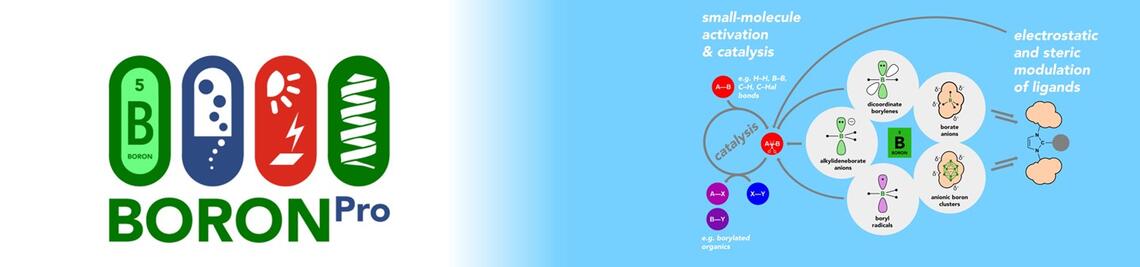
Dicoordinate borylenes, molecules with a boron atom in its +1 oxidation state of the form LBX (L = neutral Lewis donor; X = anionic substituent), are one of the most promising reactive main-group species for the activation of inert small molecules of industrial interest. In the past few years, the group of PI Holger Braunschweig, based partly on the doctoral research of PI Qing Ye, has made a number of critical breakthroughs in this chemistry: (A) The demonstration that dicoordinate borylenes can activate C–H and C–C bonds, and even all three nitrogen-nitrogen bonds in the highly inert substrate N2, and (B) that these dicoordinate borylenes can be generated simply by photolysis of borylene dicarbonyls.
This project aims to synthesize new borylene carbonyl precursors for photodecarbonylation, detect and identify their decarbonylation products (and ultimate decomposition products) in the gas phase, and study their ability to activate challenging small molecules (such as N2, N2/H2 mixtures, methane, etc.) in the gas phase using advanced physical techniques. Information obtained in the gas phase chemistry (e.g. optimal irradiation wavelengths, IR spectra of key intermediates and products, feasible further reactions of the borylene) will be subsequently transferred to condensed-phase benchtop synthesis for testing and development into practical syntheses. This approach brings together the expertise of three PIs: hypovalent boron chemistry and the synthesis of borylene carbonyls (H. Braunschweig, Q. Ye) and the characterization of borylenes and their complexes by gas-phase spectroscopy (I. Fischer).