A04 • Catalysis with Reduced Arylboranes
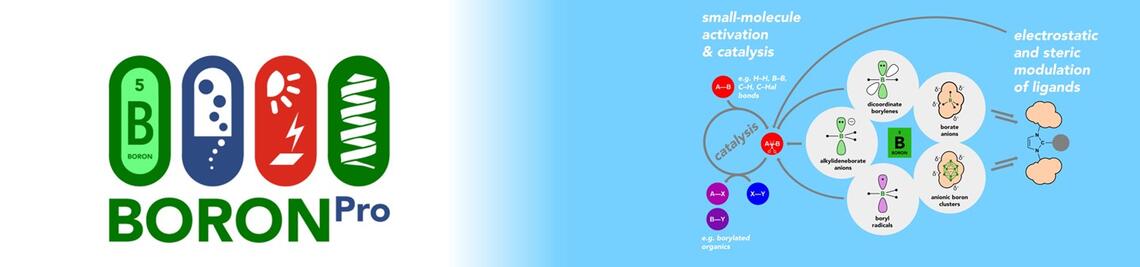
Owing to their vacant pz orbitals, trigonal-planar boron atoms embedded in polycyclic aromatic hydrocarbons (PAHs) impart unique electronic properties to the resulting Bn-PAHs. Particularly, their ability to promote one- or two-electron reductions is significant. As an incentive for this project, we have demonstrated that the dianion salts of doubly reduced 9,10-dihydro-9,10-diboraanthracenes (R2-DBAs; R: B-bonded substituents) represent a promising class of transition-metal-free catalysts.
These catalysts readily mediate the addition of element–element σ- and π-bonds across their two boron centers. Among the activated substrates are molecules containing H‒H, H‒CCR, H‒Bpin, and F‒ArF bonds, as well as R2C=CR2, RC≡CR, and OC=O functionalities. In the context of catalysis, [R2-DBA]2‒ -mediated hydrogenation, hydride-transfer, and CO2-disproportionation reactions have been successfully carried out. Our planned research will cover the following areas: (1) development of chemically more robust R2-DBAs by embedding the boron atoms into rigid planar scaffolds (‘stabilization by structural constraint’).
We will evaluate how this enforced rigidity affects the required planar-to-bowl conformational change of the boron centers upon tetracoordination, potentially shifting the reaction mechanism from oxidative addition or nucleophilic substitution to single-electron transfer. These questions will be addressed using selected fluoroarenes (F‒ArF) as substrates. (2) Activation of diboranes(4) by [R2-DBA]2‒ and utilization of the activation products as B2(OR)4 and [B(OR)2]−-transfer reagents. This subproject is closely linked to (3), the hydroborative conversion of the abundant greenhouse gas CO2 into C1 building blocks for organic synthesis. (4) Transition from chemical reducing agents to electrochemical methods for the (re)generation of the [R2-DBA]2‒ dianions from neutral R2-DBAs during catalytic cycles. Collaboration between experimentalists and theoreticians will be essential for elucidating catalytic mechanisms ‒ particularly single-electron transfer vs. concerted closedshell pathways ‒ designing new catalysts and reactions and clarifying the influence of the countercation.