Project Area A
Boron-Centred Transformations
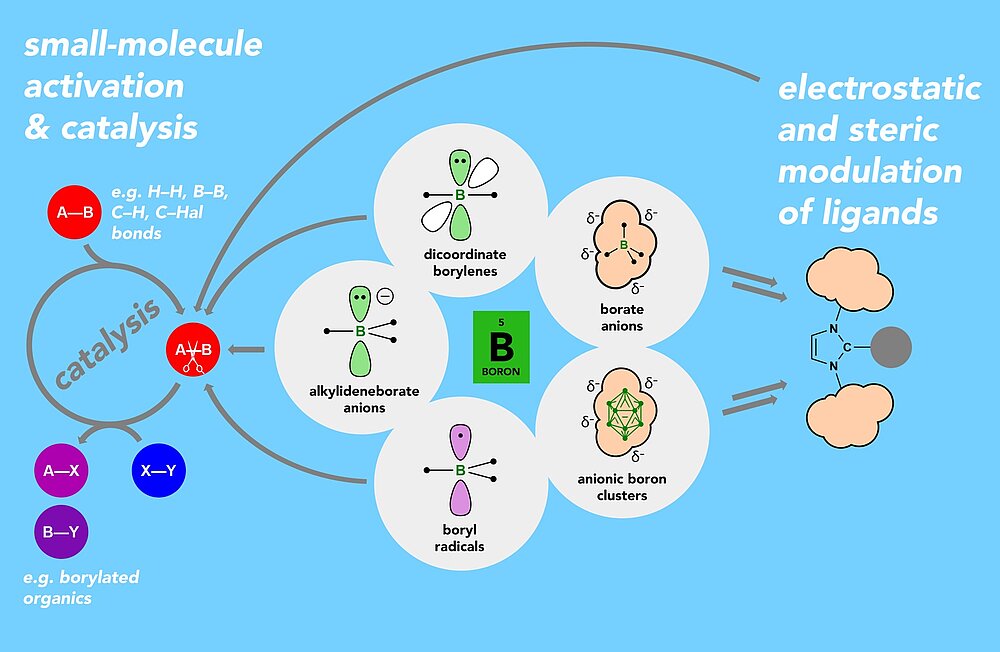
The long-term goal is to leverage boron as a property-determining element in synthesis, thereby moving it out of the shadow of its traditional role as a disposable element in synthetic chemistry.
A01
Project A01 “3d Transition-Metal-Catalyzed Borylations” targets the introduction of boryl moieties into organic molecules using different types of 3d metal catalysts and diborane(4) esters. Highly efficient catalysts based on the cheap and abundant 3d metals nickel and titanium will be developed. A focus will be on the mechanistic understanding. New and efficient methods for 3d metal catalyzed (enantioselective) borylations will be developed.
Project leaders
A02
Project A02 “Boron-Based Super Electron Donors for Transition-Metal-Free Radical Borylation” focuses on the development of boron-based super electron donors (boron-SEDs) and the application of boron-SEDs as catalysts for transition metal-free borylations. Boron-SEDs are highly promising new reagents for catalytic transformations in general and borylations in particular. The project aims to use especially stable – bottleable – boron-SEDs for the introduction of boryl groups using diboranes(4) as starting materials.
Project leaders
A03
Project A03 “Boron-Functionalized Anionic N-Heterocyclic Carbenes for Small Molecule Activation” (Finze & Radius) aims at the development of anionic carbenes, the assessment of their reactivity, and their application in catalysis. The anionic nature is a consequence of the attachment of a single or more chemically robust boron-based groups next to the carbene center in N-heterocyclic carbenes or cyclic (alkyl)(amino)carbenes. The project will develop synthetic strategies towards novel anionic carbenes and study their fundamental properties in main group and transition metal chemistry.
Project leaders
A04
Project A04 “Catalysis with Reduced Arylboranes” focuses on boron-based transition-metal-free catalysts, namely reduced heterocyclic boron compounds, and their application in the activation of small molecules. The project aims to develop the chemistry of reduced heterocyclic boron compounds, to explore their potential for small-molecule activation, and their use as catalysts for the conversion of e.g. CO2 into valuable C1 building blocks.
Project leaders
A05
Project A05 “Metal-Free Photolytic Activation of N2 and other Inert Small Molecules” targets the activation of N2 and other selected small molecules using new borylene carbonyl precursors for photo-decarbonylation. The synthesis of the borylene carbonyls and decarbonylation reactions in the condensed phase as well as in the gas phase will be investigated. Over the long term, the project aims at the photolytic borylene-based activation of inert small molecules on a synthetic scale.
Project leaders