Guest Lectures & Workshops
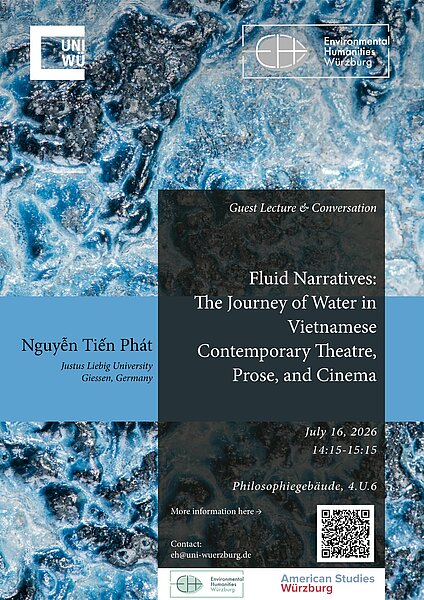
Guest Lecture & Conversation
"Fluid Narratives: The Journey of Water in Vietnamese Contemporary Theatre, Prose, and Cinema"
Nguyễn Tiến Phát (Justus Liebig University Giessen, Germany)
When: 16 July 2026, 14:15-15:15
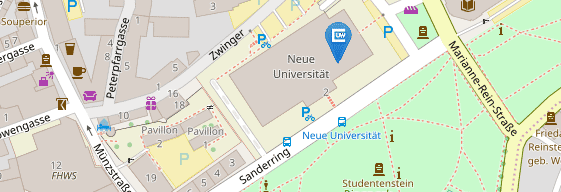
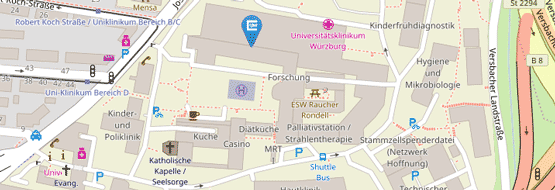
Where: Philosophiegebäude, Room 4.U.6
The event is free of charge and open to the public. Due to restricted room capacities, please register via eh@uni-wuerzburg.de.
Speaker Bio: Nguyễn Tiến Phát (Tien Phat Nguyen) is a doctoral candidate at the Faculty of Language, Literature, and Culture at Justus-Liebig-Universität Gießen. He graduated from the Eberhard Karls Universität Tübingen with a thesis on adaptation, titled “Storytelling across Media in the Case of The Handmaid’s Tale,” and is currently working on his dissertation: “Narrative Techniques in the Twenty-First Century: An Intermedial Approach to the Cognitive Interplay between Theatre, Prose, and Film.” His research interests include narrative theories, cultural narratologies, contemporary literatures, cinemas and theatres, Southeast Asian and East Asian studies, neo-colonialism and postcolonialism, as well as digital and intermedial studies.
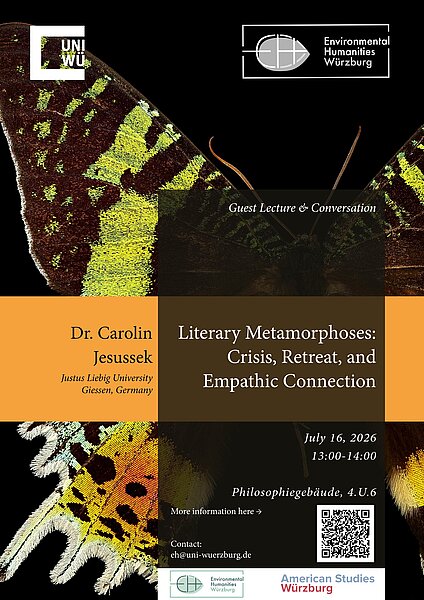
Guest Lecture & Conversation
"Literary Metamorphoses: Crisis, Retreat, and Emphatic Connection"
Carolin Jesussek (Justus Liebig University Giessen, Germany)
When: 16 July 2026, 13:00-14:00
Where: Philosophiegebäude, Room 4.U.6
The event is free of charge and open to the public. Due to restricted room capacities, please register via eh@uni-wuerzburg.de.
Speaker Bio: Carolin Jesussek is a postdoctoral researcher and coordinator of the International PhD Program “Literary and Cultural Studies” (IPP) at Justus Liebig University Giessen, Germany. Her research interests include American gothic studies, contemporary literature, marginalization, space, and environmental humanities. She completed her PhD at the Obama Institute for Transnational American Studies, Department of English and Linguistics, at Johannes Gutenberg University Mainz in 2025 on “Gothic Materialism: Space, Ecosystems, and Marginalization in Contemporary North American Literature.” In her postdoctoral project, she explores metamorphoses as a form of retreat and a response to crises as well as an empathic avenue into connecting with the more-than-human world. She is co-editor of the volume Metamorphosis in the 21st century: Feminist, Queer, and Ecocritical Perspectives (forthcoming with Peter Lang) and has published on intertextual storytelling in MDPI Literature and Monstrum.
Guest Lecture
"Queer(ing) Time in Contemporary (Be)Coming-of-Plants Novels"
Jacqueline Heinzelmann (University of Zurich, Switzerland)
When: 30 June 2026, 16:15-17:45
Where: Philosophiegebäude, ÜR 22
The event is free of charge and open to the public.
When characters coming of age turn plant, more than just societal expectations are uprooted: The radical transformation largely untethers the plant-turning characters from their age(ing), and new temporalities are suddenly accessible to them. This presentation investigates how characters such as Lara from Amy Goldsmith's Predatory Natures (2025) or Math from Jenn Lyon’s Green & Deadly Things (2026) morph into queer vegetal beings and thereby upend expectations of a chrononormative, linear being in time. Freely transitioning between present, past, and future, these characters reimagine what it means to engage in queer(ing) time, thus showing how queer-theoretical approaches to temporality have always already included more-than-human ways of imagining potential futures.
Speaker Bio: Jacqueline A. Heinzelmann is a PhD candidate at the University of Zurich at the Department of Social Anthropology and Cultural Studies - Popular Cultures. She is part of the SNSF-Project "Ökopassionen: Coming of Age im Anthropozän," for which she investigates the narrative moment at which humans turn plant in contemporary fiction. Her research is informed by critical plant studies, narratology and queer theory.

Guest Lecture
"Knowing the Plantation: Global Forms, Local Variations and the Elasticity of Exploitation"
Prof. Dr. Nicholas B. Miller (Flagler Guest Professor)
When: 3 November 2025, 16:15-17:45
Where: Philosophiegebäude, ÜR 15
The event is free of charge and open to the public.

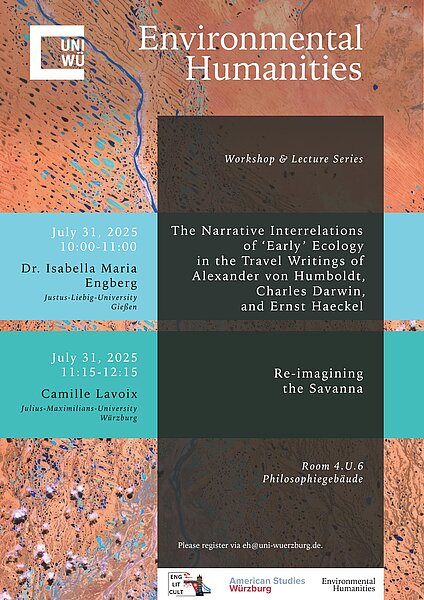
Guest Lecture & Conversation
"The Narrative Interrelations of 'Early' Ecology in the Travel Writings of Alexander von Humboldt, Charles Darwin, and Ernst Haeckel"
Dr. Isabella Maria Engberg (Gießen)
When: 31 July 2025, 10:00-11:00
Where: Philosophiegebäude, Room 4.U.6
In this talk, I present the findings from my PhD, completed in 2024, which explores the role of travel writing in shaping ecological thought during the nineteenth century. Concretely, I examine Alexander von Humboldt’s Relation historique du voyage aux régions équinoxiales du nouveau continent [Personal Narrative] (1814–31), Charles Darwin’s Journal of Researches into the Geology and Natural History of the Various Countries Visited by H.M.S. Beagle Round the World [Voyage of the Beagle] (1839; 2nd edn. 1845), and Ernst Haeckel’s Indische Reisebriefe [A Visit to Ceylon] (1882–3; 2nd edn. 1884, 3rd edn. 1893). These works share some interesting connections: not only were their authors central to the development of the ecological sciences, but the authors also read each other’s works: Darwin read Humboldt’s travelogue during his journey on the Beagle and cited him in his own travelogue; Haeckel drew on the travelogues of both Humboldt and Darwin for his A Visit to Ceylon.
I demonstrate how the two younger naturalists were influenced by the travel writings of their older peers, developing distinct ecological perspectives through literary features of the travel writing genre. I will initially discuss a framework for narrative interrelations, drawing on Jassica Mason’s Intertextuality in Practice (2019). Mason posits that both implicit and explicit ‘points of narrative contact’ allow tracing ‘the perceived connection’ between a ‘base text’ and a new text. This framework makes it possible to see the three travelogues’ ways of representing ecological relationships through particular, recurring literary features as interrelated (p. 85). Next, I will work through the three travelogues chronologically, focusing on the connected literary-scientific aspects of ecology that ‘travelled’ between the three authors and their works. Ultimately, while the literary styles of the three travelogues shared many similarities, their narratives diverged in scope and scientific emphasis. Humboldt concentrated on depicting ecological spaces across multiple scales, Darwin modified this focus to investigate the historical dynamics between organisms and their physical surroundings, and Haeckel combined the two perspectives in his portrayals of how humans and the self relate to the environment. These differences were influenced by the authors’ individual circumstances and the broader material and cultural contexts of their travels. Thusly, each younger naturalist built upon the representational techniques of his older peers, introducing unique approaches to engaging with ecological ideas in literature.
Guest Lecture
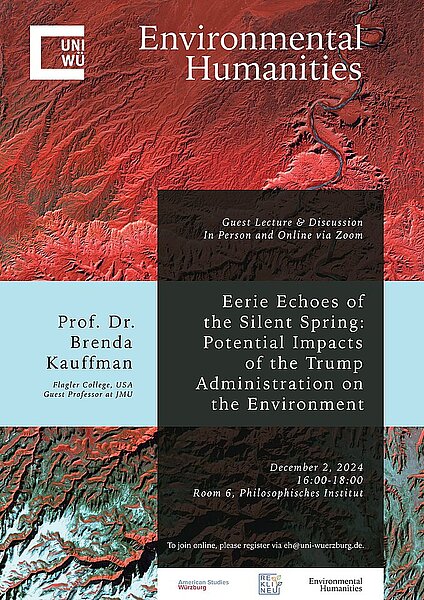
"Eerie Echoes of the Silent Spring: Potential Impacts of the Trump Administration on the Environment"
Prof. Dr. Brenda Kauffman (Flagler Guest Professor)
When: 2 December 2024, 16:00-18:00
Where: Philosophiegebäude, ÜR 6
Please register via eh@uni-wuerzburg.de to receive the Zoom link. No registration is needed to attend the event in person.
Guest Lecture
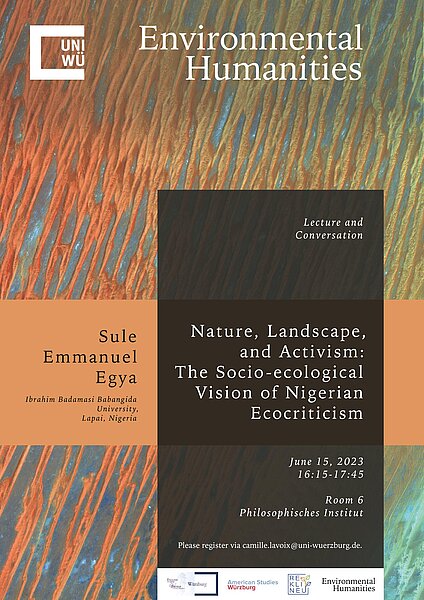
"Nature, Landscape, and Activism: The Socio-ecological Vision of Nigerian Ecocriticism"
Prof. Dr. Sule Emmanuel Egya (Ibrahim Badamasi Babangida University, Lapai, Nigeria)
When: 15 June 2023, 16:15-17:45
Where: Philosophiegebäude, ÜR 6
Author Reading & Discussion
Eleutheria (2022) : A Reading and Discussion
Allegra Hyde (Oberlin College, Oberlin, USA)
When: 13 June 2023, 16:00-18:00
Where: Online
Please register via eh@uni-wuerzburg.de.
The zoom link will be sent to you after registration

Guest Lecture
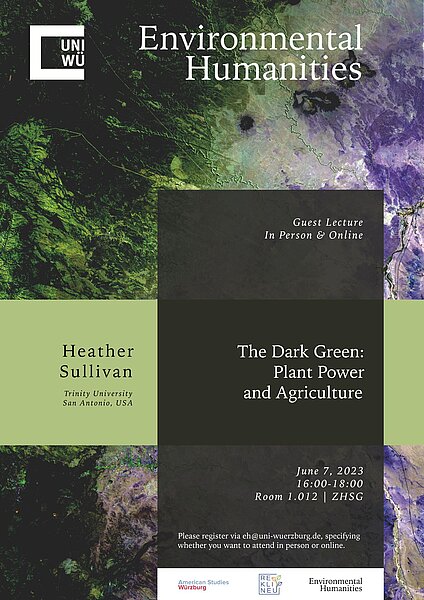
"The Dark Green: Plant Power and Agriculture"
Prof. Dr. Heather Sullivan (Trinity University San Antonio, Texas, USA)
When: 7 June 2023, 16:00-18:00
Where: ZHSG, Room 1.012
Workshop & Discussion
"Ecopoetics in the Anthropocene: Form, Communality and Environmental Catastrophe in the Work of Craig Santos Perez"
Veronika Arutyunyan (University of Hamburg, Germany)
When: 6 June 2023, 14:15-15:45
Where: Philosophiegebäude ÜR 10

Guest Lecture (in German)
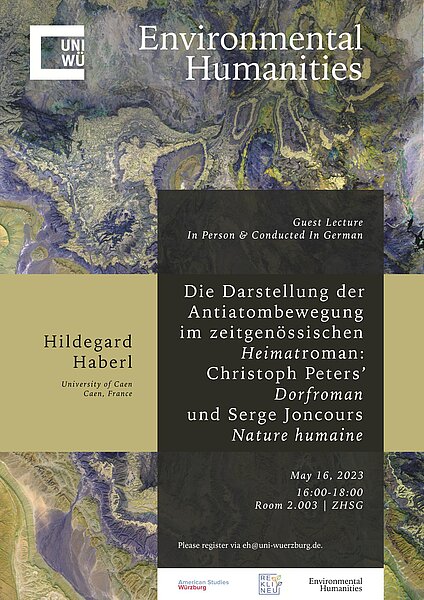
"Die Darstellung der Antiatombewegung im zeitgenössischen Heimatroman: Christoph Peters' Dorfroman und Serge Joncours Nature humaine"
Dr. Hildegard Haberl (University of Caen, France)
When: 16 May 2023, 16:00-18:00
Where: ZHSG, Room 2.003
Workshop for PhDs and Advanced Students
"What Can Fictions Do, When Reality Implodes?"
Prof. Dr. Stephanie LeMenager (University of Oregon, USA)
When: 7 July 2022, 18:00-19:30
Where: Online

Workshop for PhDs and Advanced Students
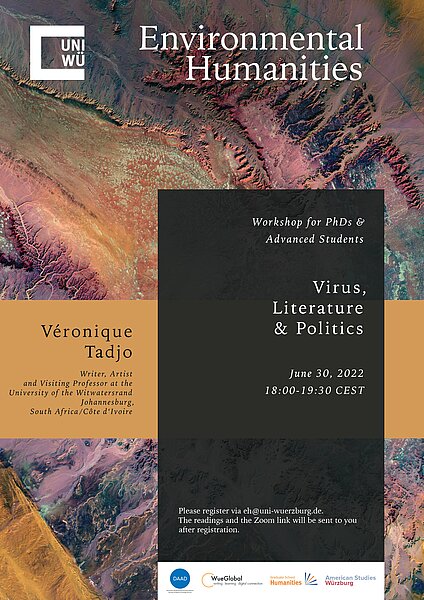
"Virus, Literature & Politics"
Prof. Dr. Véronique Tadjo (Writer, Artist, and Visiting Professor at the University of Witwatersrand, Johannesburg, South Africa)
When: 30 June 2022, 18:00-19:30
Where: Online
Workshop for PhDs & Advanced Students
"Depopulating the Novel: Post-Catastrophe Fiction, Scale, & the Population Unconscious"
Prof. Dr. Pieter Vermeulen (University of Leuven, Belgium)
When: 2 June 2022, 18:00-19:30
Where: Online

Workshop for PhDs & Advanced Students
"Oil and Gender in European Fiction and Film"
Dr. Katie Ritson (Rachel Carson Center, Munich, Germany) & Prof. Dr. Julia Leyda (University of Science and Technology Trondheim, Norway)
When: 19 May 2022, 18:00-19:30
Where: Online