
Leadership Skills for Doctoral and Postdoctoral Researchers
Leadership skills for doctoral candidates and postdocs
With this programme, we prepare doctoral candidates and postdocs for future leadership roles - both within and outside academia. The programme is explicitly aimed at people in academia who do not currently have formal leadership responsibilities.
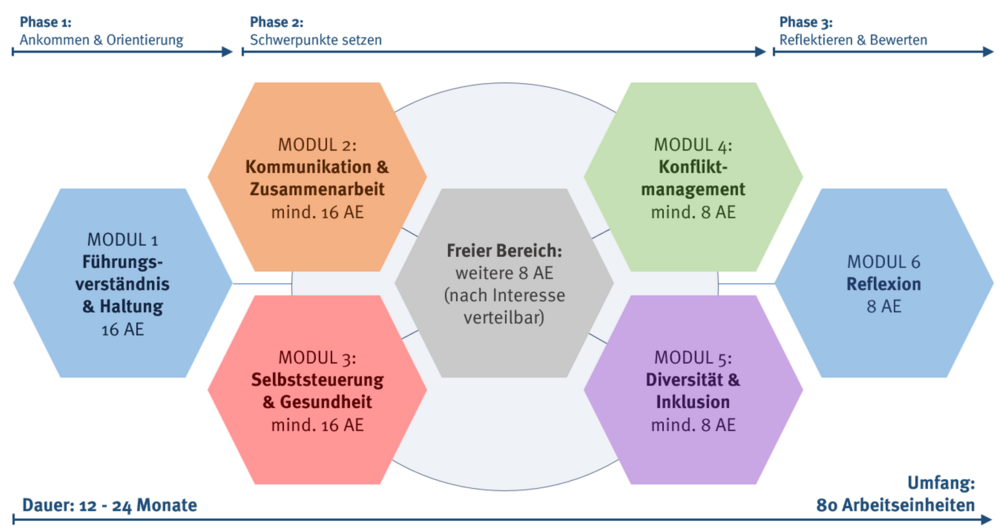
In six modules, you will acquire fundamental knowledge, familiarise yourself with theoretical concepts and models and link these to your current work situations. We always work with practical examples and real-life situations from the participants' working environment. In this way, you will learn to classify and evaluate contexts and behaviour - both your own and that of your colleagues and superiors.
The division into six learning modules, which are completed over a period of 12 to 24 months, enables participants to familiarise themselves with all relevant areas of successful leadership. They have time to reflect and can apply and test the methods and models they have learnt in practice.
Module 1, which provides an overview of key topics, leadership concepts and dynamics , always forms the start of the programme.
Modules 2 to 4 can be organised in any order and in different event formats.
Module 6 concludes the programme, in which participants reflect on their experiences and prepare a case presentation.
Objectives
The programme aims to systematically prepare participants for future leadership roles in science, business and society. The programme focuses on
- Critically analysing key leadership attitudes, roles and methods,
- strengthening conscious and confident self-management
- the targeted development of communication skills as a central prerequisite for effective leadership,
- training in the professional handling of conflict situations and emotionally charged work contexts,
- sensitisation to issues of diversity (in particular interculturality, equal opportunities and age diversity)
- as well as critical reflection on the management culture and management principles at the University of Würzburg.
Target group & requirements
The following criteria must be met in order to successfully apply for the programme:
- Academic employment contract with the University of Würzburg or the University Hospital (only if employment contract with the Faculty of Medicine, otherwise costs may be incurred).
- Academic staff who do not currently have any explicit management responsibility (e.g. group leader or similar).
- Start of the programme: possible at the beginning of the second year of the doctorate up to 6 years after completion of the doctorate (periods of care can be taken into account)
- Agreement, support and coordination of the content with the respective manager are necessary
- An appropriate time budget must be planned in order to realistically complete the programme in one to two years (approx. 8-10 workshop days in total)
Structure of the certificate
The programme has a modular structure and comprises five thematic modules and a sixth reflection module, each of which must be completed with a defined workload. In addition, participants have a flexible portion of 8 work units (WU) at their disposal, which can be taken variably from modules 2-5 in order to deepen specific interests (free area).
Module 1, which is offered twice a year (spring and autumn), marks the start of the programme and provides basic content and a joint clarification of objectives with the participants, which forms a sound basis for the further training elements.
Modules 2 to 5 can be taken in any order. Once a workload of at least 72 AE has been achieved, the reflection workshop (Module 6) can be taken. This one-day workshop concludes the certificate, invites reflection in the group and provides an opportunity to reflect on and discuss your own case. Module 6 - like Module 1 - is always offered directly by the Professional Development team.
Focal points:
- Guidance on clarifying individual causes and goals for all participants as part of the leadership certificate (key questions)
- Models of leadership (e.g. according to Neuberger)
- Leadership attitudes (e.g. transformational / transactional / situational)
- Leadership styles (e.g. according to Goleman)
- Reflection on own attitude / own experiences
- Leadership in the context of university vs. company
- Understanding and culture of leadership at JMU
Learning objectives:
- Understand leadership attitudes and culture at JMU and can explain them to others
- Analyse leadership behaviour that you have encountered or will encounter yourself on the basis of the models considered
- Reflect on and justify their own behaviour in interactions with colleagues
- Consciously recognise the actions and reactions of colleagues and superiors
- Develop their own judgements and place them in the context of their own value system
- Actively participate in shaping the (leadership) culture in their own environment and express their own judgements
- Apply what they have learnt to evaluate their own behaviour and plan and develop it accordingly
- Try out and practise their first conscious leadership actions, e.g. in the context of student employees and students
workshops that can be attended:
- Effective leadership (16 units, held every six months in the programme by PE staff)
Focal points:
- Teaching communication theory (e.g. communication models, use of questioning techniques)
- Application of theories to specific practical communication situations from the target group's everyday working life (e.g. feedback, preparing and conducting structured discussions, moderating meetings, mastering negotiation situations)
- Working in (scientific) teams (phases, dynamics, roles)
- Structuring work (prioritising & delegating)
- Dealing with the expectations of others and defining your own role
Learning objectives:
- identify central models and principles of successful communication
- use targeted communication methods (e.g.e.g. active listeningölistening, paraphrasing, structured moderation) in their work context
- categorise structures and dynamics in teams and groups and find appropriate ways of responding
- reflect on which communication structures are conducive or obstructive in their own academic working context
- value constructive feedback, transparent communication and open collaboration as the basis for successful teamwork.
- recognise their own strengths and preferences for structuring work in a team, reflect on team behaviour and are able to name these accordingly
- name expectations placed on them and compare these with resources in order to formulate realistic goals
workshops that can be documented:
- Moderate meetings efficiently and effectively (16 AE, annually)
- Lateral leadership(16 AE, annually)
- Connecting communication with myself and others(12 AE, annually)
- Understanding team dynamics(8 AE, annually)
- Working successfully in a team(8 AE, annually)
- With questions to new ideas - creative questioning techniques for leadership without a leadership role(16 AE, annually)
- Giving feedback(16 AE, annually)
Focal points:
- Value orientation and personality development (e.g. values square, Big Five)
- Self-motivation and effective goal setting
- Ambiguity tolerance and decision-making skills
- Reflection on power and psychological safety
- Coaching techniques in a leadership context
- Self-care, role modelling and healthy leadership (e.g. resilience factors, warning signals, prevention, stress management techniques)
Learning objectives:
- Recognise own values and personality traits and consciously transfer them to the individual work context.
- Learn techniques for goal setting and decision-making in complex situations and apply these in a practice-orientated way to individual cases
- Know techniques to promote psychological safety and apply them to their own context
- Begin to familiarise themselves with coaching conversation techniques and use them specifically to develop working relationships.
- Develop an individual strategy for healthy self-management and implement concrete measures to strengthen their own role model function.
workshops that can be booked:
- Stress management (8-10 AE, annually)
- Resilience training (8-10 AE, annually)
- "... because I can always do something."Confident, clear and able to act in emotionally difficult situations (12 AE, annually)
- Self-awareness: Dealing with self-doubt and your own potential (16 AE, annually)
- Self-organisation and time management - simply get more done! (8 AE, annually)
Focal points:
- Conflict indicators, types and causes
- Self-care and emotion regulation
- Constructive, fact-based and solution-orientated dialogue management
- Creative techniques for clarifying issues
- Accompanied exchange of experiences and case work
Learning objectives:
- Recognise and name central causes of conflict in the academic context (e.g. role conflicts, power imbalances, divergent goals).
- Analyse their own or observed conflict situations and identify underlying structural and emotional dynamics.
- Assess the effectiveness of various conflict resolution strategies in their working environment.
- Are able to use de-escalation techniques in dialogue situations as appropriate to the situation
- Begin to integrate constructive conflict behaviour into their professional repertoire.
verifiable workshops:
- Conflict prevention from the employee role | Basic (16 AE, 2x per year)
- Conflict Prevention from the Employee Role | Advanced (16 AE, annually)
- Navigating Conflicts in International Contexts: The Power of Communication (16 AE, annually)
- Lectures on the topic of conflict management (2 AE, 2x per year)
- Collegial case discussions (6 AE, annually, or as required)
Focal points:
- Dealing with cultural identities
- Teaching methods for mastering everyday intercultural situations
- Experiencing and learning to appreciate diversity in various dimensions
- Guidance on reflecting on one's own perception and unconscious thought patterns (bias)
- Teaching strategies to promote diversity-sensitive cooperation and leadership
Learning objectives:
- Identify dimensions of diversity (e.g. cultural, social, disciplinary, gender) in the academic context and apply basic concepts of diversity-sensitive behaviour
- Are able to deal with different cultural identities
- Can use methods they have learnt in a targeted manner to successfully deal with everyday situations (work and private) in various constellations
- Can reflect on their own thought patterns and identify biases
- Recognise diversity in various dimensions as valuable for team performance, innovation and scientific culture
- Are able to support diversity-sensitive collaboration through their own actions
- Compare different leadership styles and develop their own attitude concept that recognises and promotes diversity.
workshops that can be attended:
- Intercultural Leadership in Action (10 units, annually)
- Building bridges between generations (4 AE, annually)
- Working in international teams (10 AE, annually)
- Unconscious Bias (3 AE, 2x per year)
- More to follow ...
Focal points:
- Peer exchange and comparison of the experiences made in each case
- Reflection on own learning experience and formulation of concrete individual successes
- Presentation of one's own case that (1) could be successfully mastered with one or more of the contents learnt or (2) should be successfully solved in the future using the approach presented
Learning objectives:
- describe how what has been learnt has been applied in specific situations (e.g. team leadership, conflict dialogue, moderation)
- analyse their own practical case, drawing on theoretical concepts and methods from the certificate programme.
- critically reflect on which strategies were helpful in the specific situation.
- actively contribute to the reflection of the practical cases of others and provide constructive, differentiated feedback.
- recognise their own development and the learning paths of other participants.
- link their personal attitude towards leadership, communication and collaboration with the role of a scientist.
- formulate concrete findings and future action steps clearly and comprehensibly for others.
workshops that can be attended:
- Reflection workshop (8 AE, as required, at least twice a year from 2027)
In addition to the six modules (with a total of 72 units), participants have a flexible, free portion of 8 work units (TUs) at their disposal, which can be taken variably from modules 2-5 in order to deepen specific interests. There are no further requirements for this; the 8 TUs can be bundled from one module or split up from all modules (2-5).
If, for example, a workshop from module 4 is successfully completed with 12 TUs, the minimum required 8 TUs for module 4 would be completed. In addition, the remaining 4 TUs would automatically be credited for the free area.
The cooperation with TwentyOne Skills enables you to bring in up to 6 ECs from modules 2 to 5 through flexible e-learning programmes, or to make up for missing ECs in individual modules with these programmes. Please note, however, that not all of the approximately 50 courses can be credited for the LEAP 4 ECR programme. You will therefore find below a list of the courses eligible for the programme as well as the corresponding work units and modules in which they can be included.
All participants in the programme automatically receive access to the e-learning offer and can use it for three months.
List of programme-compatible courses:
| Courses that can be credited in the LEAP 4 ECR programme (Proof via certificate of attendance) | AE | |
| A Guide to Empathy at Work | MODULE 2 | 2 |
| Teampower: Support each other with Peer Counselling | MODULE 2 | 1 |
| Working with People: Leadership in Academia | MODULE 2 | 2 |
| Time Management: Seven techniques for more efficiency | MODULE 3 | 3 |
| Mental Health in Academia | MODULE 3 | 1 |
| Eight Ways to b e more resilient in Academia | MODULE 3 | 1 |
| Six Tools to support your personal Menal Health | MODULE 3 | 1 |
| How to have a difficult conversation | MODULE 4 | 1 |
| Cognitive Bias | MODULE 5 | 2 |
| Working in diverse teams | MODULE 5 | 1 |
New courses are regularly added to the list.
Participation in the programme
16 people from all faculties are carefully selected for each round (spring and autumn). This exclusive learning group (cohort) starts with Module 1 "Effective Leadership" .
As an ECR, you can discuss any questions about the programme in advance - together with your manager - at a regular online information event or directly with Professional Development (contact: Krischan Brandl). Professional Development provides ongoing support for the programme and is available to you as a contact person at any time.
Information event
This regular online event offers ECRs - together with their line managers / PIs - the opportunity to obtain more detailed information and ask individual questions directly to Professional Development.
The next information event will take place on :
Registration for the information event on 26.02.2026, 12-13 h via Zoom (German & English)
Registration procedure
Before registering, please make absolutely sure that you can reliably plan the necessary time resources and coordinate your participation with your manager / PI. If you decide to participate in LEAP 4 ECR together, the following things need to be done:
1. register
Please register for Module 1 "Effective Leadership" in spring or autumn:
Registration / Application | Modul 1: Wirksam führen (German)
Start on 28.04.2026 / Application deadline is 8 March 2026.
Registration / application | Module 1: Effective Leadership (English)
Start at October 8, 2026 / Application Deadline isSeptember 10, 2026.
2. upload documents
Upload your motivation letter (max. 300 words) and your CV via WueCampus.
(Link on the registration page)