

A new website for the University of Würzburg
The requirements for the design and functionality of websites are constantly changing. After the last revision in 2017, the design, navigation concept and mobile view of the current university website no longer meet current standards. Take a look back at the history of our university website.
Our aim is to create a modern, attractive and intuitive website that attracts prospective students, puts excellent research in the spotlight and brings university life to life. To achieve this goal, we are guided by a clear vision and mission. They give us direction and guide decisions in the relaunch.
The website is of central, strategic importance to the university :
- For many, the website is the first point of contact with the University, whether for prospective students, researchers, potential staff or the interested public. A high-quality digital calling card is crucial to remaining competitive at both national and international level.
- Many members of the University of Würzburg use the website every day. A functional website makes day-to-day work noticeably easier and contributes to an efficient and excellent administration and university.
The website relaunch also forms part of the brand strategy process currently being carried out at the University of Würzburg. The launch of the new corporate identity is scheduled for October 2026, with the first go-live of the website relaunch set for November 2026.
Our product vision in detail:
The JMU website is the digital showcase of an excellent and forward-looking university. It highlights academic excellence, social relevance and a personal touch – for everyone who studies, conducts research or works at JMU, or who wishes to undertake further education. The site is therefore both a strategic communication tool and a promotional resource tailored to specific target groups for university and student marketing. It conveys the JMU brand through both its content and its visual design.
- The University of Würzburg’s new website is modern, intuitive and high-performance, and meets the needs of our target audiences.
- It presents the University as an excellent choice for study, research and careers – as well as an open, accessible institution for the interested public.
- With a clear structure and user-friendly navigation, it ensures that complex content is easy to understand and relevant information can be found quickly.
- All content is always up to date, reliable and available in two languages (German and English).
- An optimised editorial process ensures the efficient maintenance and consistent presentation of all content – across all areas.
- Our aim: to inspire enthusiasm at the very first click – for prospective students, current students, researchers, staff and interested members of the wider community and business world alike.
Project Manager
- Thomas Brune
Press Office
- Dr Esther Knemeyer
- Konstanze Fürst
- Alisa Hemmrich
- Dr Jacob Schmidt
IT Services
- Matthias Funken
- Sabine Müller
- Martin Schuhmann
The website is a daily companion for many university members and is aimed at different target groups. It is therefore particularly important to take into account the diverse requirements and wishes of the university community. Our project group is therefore deliberately broadly based with members from all status groups at the university.
The project group works together with the core team and our external consultant to develop key requirements for the website in several workshops.
Faculties
- Biocentre:
Markus Kiunke - Faculties of Chemistry and Pharmacy, Mathematics and Computer Science and Physics:
Dr Daniel Bellinger, Dr Ludwig Höllein - Faculty of Human Sciences, Faculty of Catholic Theology, Faculty of Philosophy:
Michael Byrd - Faculty of Medicine and University Hospital:
Dr Marc Appel - Faculty of Law and Economics:
Christian Schlosser
Central Facilities
- University Library:
Dr Katharina Boll-Becht - Professional School of Education:
Prof. Dr Thomas Trefzger
University Administration
- Student Service Centre:
Dr Daniel Hartmann - Service Centre InterNational Transfer:
Katharina Göthner
Accessibility
- Contact and Information Centre for Students with Disabilities and Chronic Illnesses (KIS):
Sandra Mölter
Students
- Student Spokesperson Council:
Yannik Bauer
University-wide participation
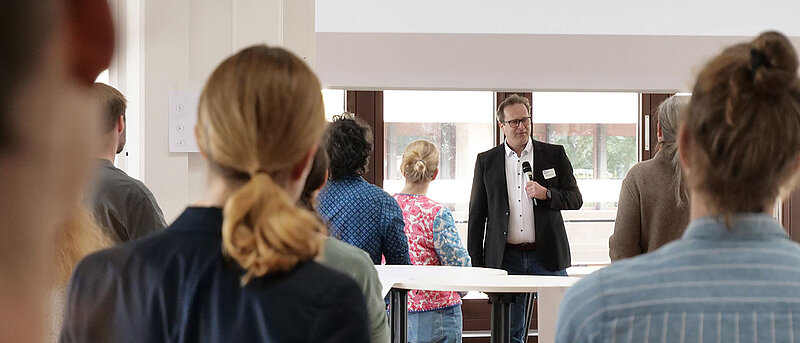
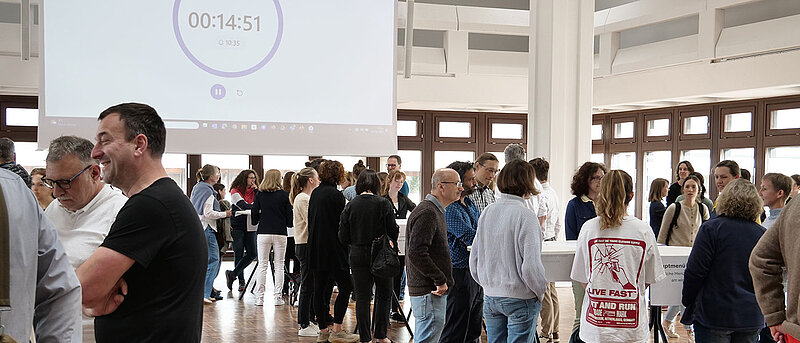
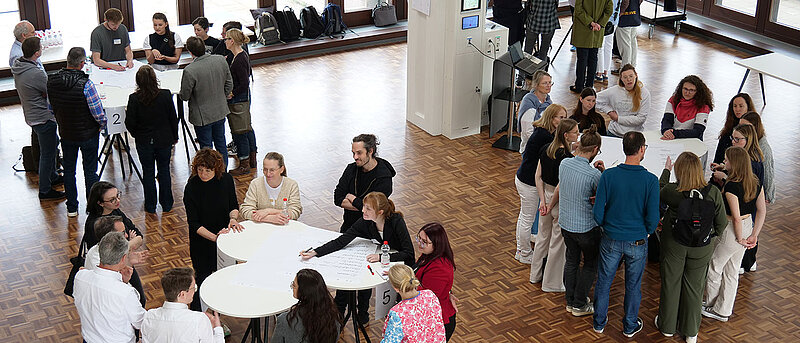
On 7 May 2025, students, teaching staff and employees from the entire university came together to exchange ideas for the future website at the World Café. At the World Café, requirements were collected that were directly incorporated into the technical tender - a fundamental step for the successful implementation of the new website.
30 July 2026: Information session on migration for Phase 1 areas
29 May 2026: Start of technical development of the new system
February/March 2026: Workshops with Brain Appeal to develop the content of the concept as a basis for technical development
15 December 2025: Kick-off meeting with the agency Brain Appeal
18 November 2025: Brain Appeal is awarded the contract for technical implementation
31 October 2025: Start of the university-wide content audit
16 October 2025: Pitch presentations by technical service providers
12 September 2025: Announcement of a major content audit via email to editors (start: end of October)
30 August 2025: Call for tenders for technical service providers published
22 July 2025: Kick-off event with the web design service provider pheenetz
19 May 2025: Workshop with pupils from St Ursula’s School (press office)
13 May 2025: Intensive workshop II (project group and core team)
7 May 2025: World Café (university-wide engagement event)
10 April 2025: Intensive workshop I (project group and core team)
March 2025: Project group convened
Ongoing: Meetings and dialogue with various status groups at the university
What happens next?
The launch of the relaunch has been postponed by a few months and is now scheduled for November 2026. The migration process for the pages and sections forming part of the first phase of the roll-out (primarily sections of the central domain, as well as the Biozentrum, the Faculty of Catholic Theology and the Faculty of Management and Economics as pilot projects) began in mid-August 2026. From early 2027, the faculties – including their Institutes, chairs and other departments – will follow in stages, one after the other. The exact timetable will be finalised in consultation with the relevant departments.
We know that the switch to the new system is a major step for many of you. Our aim is therefore to make things as easy as possible for you. We are therefore planning a largely centralised migration. From mid-August, the online editorial team at the Press and Public Relations Unit will migrate the pages from the first phase of the roll-out to the new system and submit them for approval. In this way, we want to ensure that you are well guided and given the best possible support.
The first phase of the roll-out covers the pages of the main domain as well as selected pilot projects. From early 2027, the faculties – including their Institutes, chairs and other departments – will follow in stages, one after the other. Within the first phase, the specific order will be determined, amongst other things, by the existing site structure and visitor numbers; pages of particular importance or those with high traffic will be prioritised. The exact timetable will be finalised in consultation with the relevant departments.
Migration refers to the process of setting up the pages in the new system behind the scenes – during which time the existing website remains online and accessible as normal. Go-live is the day of the switchover: only then will the newly built pages become visible at the familiar addresses and replace the old pages. Until go-live, nothing changes for users.
No, the future website will also be operated with TYPO3.
We advise against completely reorganising pages now. However, you can already do some tidying up work in preparation for the upcoming revision of the pages:
- Delete and/or revise outdated content (pages, texts, images, news, events, etc.)
- Check translations
- Clean up the file list
If you have any questions, please contact onlineredaktion@uni-wuerzburg.de.
We will inform you in good time about the revision process and how we can support you as an editor with training and consultation hours.
You are welcome to send ideas and suggestions for the new website to the online editorial team at any time.
Currently no. There will no longer be fixed tile sizes on the new website, as the system is modular, dynamic and barrier-free. Content automatically adapts to different screen sizes, and images and text are maintained separately (no more text in the image). As the final modules are flexible, it is currently not worth designing new image tiles or fixed formats.
No, we will be launching the pages in several stages. We will start with the main pages and pilot projects in November 2026. We will then gradually migrate one section at a time to the new system.
The website is currently divided into a public and an internal area. As part of the relaunch process, we are evaluating where internal content can best be displayed.