

A new website for the University of Würzburg
The requirements for the design and functionality of websites are constantly changing. After the last revision in 2017, the design, navigation concept and mobile view of the current university website no longer meet current standards. Take a look back at the history of our university website.
Our aim is to create a modern, attractive and intuitive website. It should attract prospective students, put excellent research in the spotlight and bring university life to life. The website is of central, strategic importance for the university:
- For many, the website is the first point of contact with the universitybe it for prospective students, researchers, potential employees or the interested public. A high-quality digital business card is crucial in order to survive national and international competition.
- Many members of the University of Würzburg use the website on a daily basis. A functional website makes daily work noticeably easier and contributes to an efficient and excellent administration and university.
The relaunch of the website is also part of the brand strategy process currently being carried out at the University of Würzburg. The university's new corporate design should be available in May 2026. The web design is being developed in parallel.
Project Manager
- Thomas Brune
Press Office
- Dr Esther Knemeyer
- Konstanze Fürst
- Alisa Hemmrich
- Dr Jacob Schmidt
IT Services
- Matthias Funken
- Sabine Müller
- Martin Schuhmann
The website is a daily companion for many university members and is aimed at different target groups. It is therefore particularly important to take into account the diverse requirements and wishes of the university community. Our project group is therefore deliberately broadly based with members from all status groups at the university.
The project group works together with the core team and our external consultant to develop key requirements for the website in several workshops.
Faculties
- Biocentre:
Markus Kiunke - Faculties of Chemistry and Pharmacy, Mathematics and Computer Science and Physics:
Dr Daniel Bellinger, Dr Ludwig Höllein - Faculty of Human Sciences, Faculty of Catholic Theology, Faculty of Philosophy:
Michael Byrd - Faculty of Medicine and University Hospital:
Dr Marc Appel - Faculty of Law and Economics:
Christian Schlosser
Central Facilities
- University Library:
Dr Katharina Boll-Becht - Professional School of Education:
Prof. Dr Thomas Trefzger
University Administration
- Student Service Centre:
Dr Daniel Hartmann - Service Centre InterNational Transfer:
Katharina Göthner
Accessibility
- Contact and Information Centre for Students with Disabilities and Chronic Illnesses (KIS):
Sandra Mölter
Students
- Student Spokesperson Council:
Yannik Bauer
31 October 2025: Start of the university-wide content audit
16 October 2025: Pitch presentations by the technical service providers
12 September 2025: Announcement of a major content audit by email to editors (start: end of October)
30 August 2025: Invitation to tender for technical service providers published
22 July 2025: Kick-off event with the web design service provider pheenetz
19 May 2025: Workshop with pupils from St. Ursula School (press office)
13 May 2025: Intensive workshop II (project group and core team)
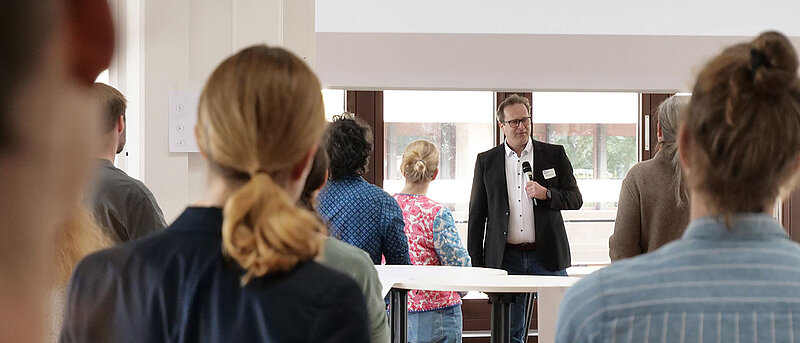
7 May 2025: World Café (university-wide participation event)
10 April 2025: Intensive workshop I (project group and core team)
March 2025: Project group convened
Ongoing: Meetings and dialogue with various status groups at the university
What happens next?
The results of the World Café were evaluated in the second intensive workshop together with the project group, core team and Mr Schubert and translated into requirements and functions for the new website. These form the basis for the tender documents.
We advise against completely reorganising pages now. However, you can already do some tidying up work in preparation for the upcoming revision of the pages:
- Delete and/or revise outdated content (pages, texts, images, news, events, etc.)
- Check translations
- Clean up the file list
If you have any questions, please contact onlineredaktion@uni-wuerzburg.de.
We will inform you in good time about the revision process and how we can support you as an editor with training and consultation hours.
You are welcome to send ideas and suggestions for the new website to the online editorial team at any time.