Publications
RNA-based medicine
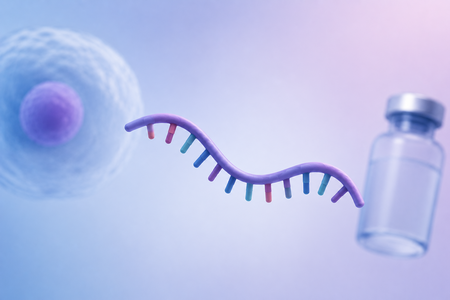
This section provides an overview of publications involving RNAmed PhD students, as well as articles featuring the RNAmed graduate program or covering current developments and emerging topics in RNA-based medicine.
Translation on Demand
Research paper by Tess Vosman (LMU)

Tess Vosman is a PhD student at Ludwig-Maximilians-Universität Munich. Her research focuses on innovative methods for precisely and controllably regulating the translational activity of mRNA.
In the Rentmeister group, she developed a ‘Click-to-Release Switch’ for mRNA. The mRNA is initially kept inactive and can be activated by the addition of a small chemical molecule. As soon as this chemical trigger is added, translation begins. The method enables precise temporal control of protein production in living cells. In addition to its potential for basic research, it could also contribute in future to the development of safer and more controllable mRNA therapeutics.
In April 2026, an article was published in the journal Angewandte Chemie, International Edition. Full article
Append Editing: A Novel Strategy for Genome Editing
Research paper co-authored by Charlotte Kamm (HIRI)
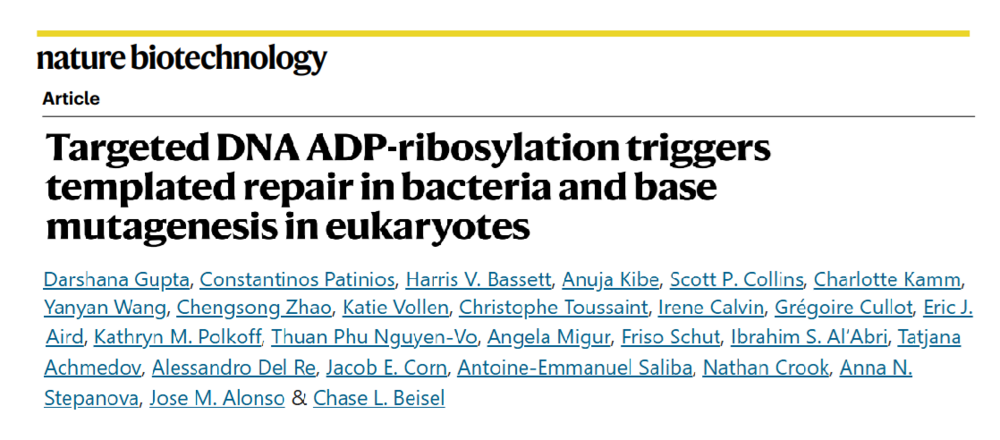
Charlotte Kamm is a PhD student in the group of Chase Beisel (formerly at the Helmholtz Institute for RNA-based Infection Research, HIRI; now at the Botnar Institute in Basel).
Researchers from the Beisel lab have developed a novel CRISPR-based genome editing approach called append editing. Instead of directly changing a DNA base, append editing adds a small chemical group (ADP-ribose) to DNA, creating a new route for targeted genetic modifications. This strategy enables precise DNA repair in bacteria without introducing double-strand breaks and supports targeted base changes in eukaryotic cells. The study establishes a fundamentally new genome editing principle that is distinct from existing base and prime editing technologies.
By expanding the range of possible DNA modifications, append editing opens new opportunities for genome engineering and could inspire the next generation of tools for research, biotechnology, and medicine. Full article
Improving RNA Delivery Using Lipid Nanoparticles
Research paper by Stina Rademacker (LMU)
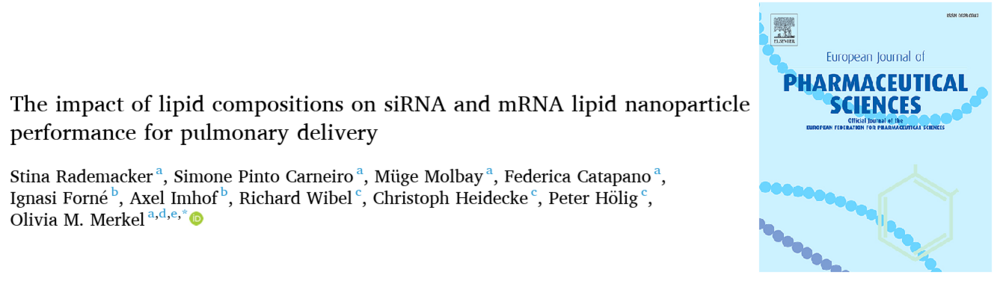
How can lipid nanoparticles (LNPs) be optimised to deliver RNA-based medicines directly to the lungs?
Stina Rademacker, a pharmacist and PhD student in Olivia Merkel’s group at Ludwig-Maximilians-Universität Munich, is investigating how different lipid building blocks influence the performance of LNPs carrying either siRNA or mRNA.
Even small changes in lipid composition can significantly affect particle stability, cellular uptake, endosomal escape, and interactions with proteins in lung mucus. Whilst all tested formulations successfully penetrated the mucus barrier and achieved gene silencing in a physiologically relevant lung cell model, the choice of helper lipid proved crucial for efficient siRNA delivery. The findings of the study provide valuable insights for the development of next-generation inhaled RNA therapies for respiratory diseases.
Full article in the European Journal of Pharmaceutical Sciences via: https://pubmed.ncbi.nlm.nih.gov/40571267/
Efficient protein design
Invited Commentary (News & Views) by Noah Holzleitner (TUM)
Machine learning-trained protein domain insertion for the design of switchable proteins
Noah Holzleitner & Julian Grünewald
Nature Methods
Expanding CAR-T targets in blood cancers
Review with contributions from Alexandre Trubert (UKW)
Multi-targeted CAR-T cell strategies to overcome immune evasion in lymphoid and myeloid malignancies
Peter J, Toppeta F, Trubert A, Danhof S, Hudecek M, Däullary T
Oncology Research and Treatment
A Step Forward for Immunotherapies
Research paper co-authored by Yasmin Gärtner (LMU)
Yasmin Gärtner is a biochemist in the Carell Group at Ludwig-Maximilians-Universität Munich and a co-author of the scientific study “A Phosphotriester-Masked Dideoxy-cGAMP Derivative as a Cell-Permeable STING Agonist".
The protein STING (Stimulator of Interferon Genes) plays a central role in the innate immune system, particularly in antiviral defense and anti-tumor immunity. As a result, STING-activating compounds are considered promising candidates for the development of novel immunotherapies.
However, their therapeutic potential has been limited by their poor ability to cross cell membranes. In this study, researchers chemically modified a STING agonist to enhance its cellular uptake while ensuring that it is converted into its active form only after entering the cell. This prodrug strategy significantly improved its activity in cell culture experiments.
These findings provide an important step toward the development of more effective STING-based therapies for the treatment of cancer and viral infections. Full article
The RNAmed Annual Retreat 2025 on the island of San Servolo (near Venice, Italy) brought together over 40 PhD students, PIs and guests from academia and industry. The program centred on keynote lectures on antisense oligonucleotides, microRNAs and circular RNAs, as well as student presentations on RNA therapeutics, drug delivery, genome editing and AI-assisted molecule design. Panel discussions and career sessions fostered exchange between early-career researchers and experts. The event was of key importance to RNAmed, as it strengthened interdisciplinary collaboration, international networking and the exchange of information regarding basic research and clinical applications. A report on this meeting was published in the RNA Society’s journal . To the original article
Discover how RNAmed – Future Leaders in RNA-based Medicine is training the next generation of RNA scientists through interdisciplinary research, international collaboration, mentoring and industry experience. Read how this innovative PhD program is preparing future leaders to advance precision medicine and RNA-based therapies. Brief Report in EMBO Encounters #48, page 30.
From Molecular Mechanisms to Therapy
RNA-based therapeutics represent a promising new class of medicines, offering innovative strategies to treat diseases that were once considered difficult or impossible to target. This review in The EMBO Journal provides an accessible overview of the major RNA therapeutic platforms, including antisense oligonucleotides, RNA interference, messenger RNA, and CRISPR-based approaches. The authors explain molecular mechanisms underlying each technology, highlights current clinical applications, and discuss key challenges such as delivery, stability, specificity, and manufacturing. Through examples including spinal muscular atrophy, hereditary transthyretin amyloidosis, and inherited retinal diseases, the article illustrates how advances in RNA biology are driving the development of next-generation therapeutics.
This review is an excellent resource for researchers of all stages and anyone interested in the rapidly evolving field of RNA medicine. Read the full article
Potent and long-lasting gene modulation in the heart and muscle using chemically defined lipophilic siRNAs
Research article about long-acting siRNA therapy for muscle disorders
Small interfering RNAs (siRNAs) are promising therapeutics for cardiac and skeletal muscle diseases, yet efficient and scalable delivery remains a major challenge.
In the study “Potent and durable gene modulation in heart and muscle with chemically defined lipophilic siRNAs” Fakih et al. developed a siRNA scaffold with optimized sequence design, chemical modification patterns, and backbone stabilization to achieve potent and durable gene silencing in muscle tissue. Targeting myostatin (MSTN), a single subcutaneous injection in mice induced up to 80% gene silencing for six weeks, while repeated dosing maintained a >95% reduction in circulating MSTN for six months without detectable toxicity. Sustained MSTN suppression increased muscle mass, lean body mass, and grip strength, and effectively mitigated muscle wasting in an inflammatory myopathy model. This modular platform represents a scalable strategy for long-lasting extrahepatic siRNA delivery with broad therapeutic potential for muscular diseases. Full article via: https://pubmed.ncbi.nlm.nih.gov/41432033/.
Julia Alterman (RNA Therapeutics Institute, University of Massachusetts Chan Medical School, Worcester, MA 01605, USA), co-corresponding author of the study, serves on the RNAmed Scientific Advisory Board (SAB).
Ligand Conjugated Multimeric siRNAs Enable Enhanced Uptake and Multiplexed Gene Silencing
Research Article on Advancing siRNA Therapeutics
Small interfering RNAs (siRNAs) have emerged as powerful therapeutic tools, but efficient delivery into target cells remains a major challenge. In this study, the authors developed ligand-conjugated multimeric siRNAs that improve cellular uptake while enabling simultaneous silencing of multiple genes. By chemically linking several siRNA molecules and attaching targeting ligands, they achieved enhanced delivery and potent gene knockdown compared with conventional single siRNAs. The multimeric design also allows combination therapies within a single molecule, offering greater flexibility for treating complex diseases. This work demonstrates a promising strategy to increase the effectiveness and versatility of RNA interference therapeutics and represents an important step toward more efficient, targeted, and clinically applicable siRNA-based medicines. Full article
Hans-Peter Vornlocher (Senior Advisor AxoLabs GmbH, Kulmbach, Germany), corresponding author of the study, serves on the RNAmed Scientific Advisory Board (SAB).