What is WueDMS?
A document management system (DMS for short) stores electronic documents with the support of a database. As this involves the management of written records, the term "records management" is also sometimes used. The document management system is used for the joint processing of files: Revisions are recorded by document versions and work processes can be supported by digital workflows with reminders and deadlines.
We, the employees of the central administration of the University of Würzburg, have been working with WueDMS since mid-2023.
What can you do with WueDMS?
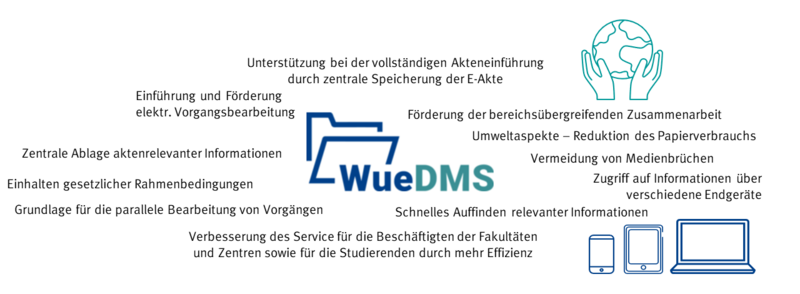
With the introduction of WueDMS, digital files and documents can be accessed and processed from anywhere - whether you are on the move, in the office or working from home. Information and documents are now easier to find. Process statuses can be accessed transparently. Structures for efficient process management have thus been created. Through continuous analysis and optimisation, we are constantly making our processes and working methods more efficient: Together, we are taking the University of Würzburg step by step into the digital future. The DMS offers the following advantages for JMU:
How does WueDMS work?
In WueDMS, employees of the central administration have access to a central filing location for general case files (Sachakten) in the record plan (Aktenplan) or for specialised case files (Fallakten). The DMS allows records in a broad variety of formats. This means that emails, scans and documents from specialized system (e. g. WueStudy) can be stored in one central and audit-proof system . The files and processes can be edited within DMS - even across departments. This means that standard processes and cross-departmental underwriting can be handled digitally in WueDMS. Paper documents and paper mail can be easily and securely replaced by tasks and workflows in the system.
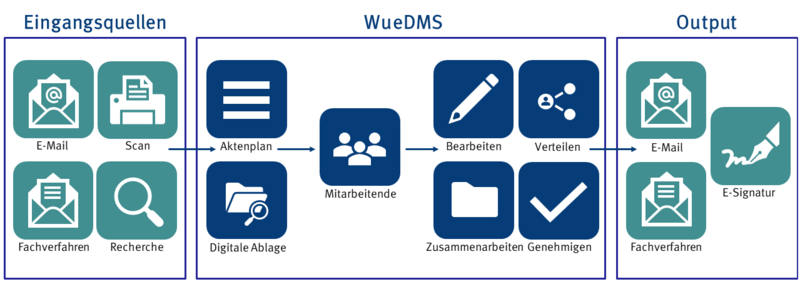
WueDMS can be offered with the following basic functionalities in an implementation project:
- Navigation with the official university records plan
- Creation of case files in the record plan
- Creation of processes in the record plan
- Filing of documents (in a variety of formats) in processes
- Editing the properties of a filed document
- Full text search for documents
- Property search for files, cases and documents
- Creating a PDF document for viewing
- Extraction of the full text from each document
- Inheritance of the "File identifier (Aktenzeichen)" property to transaction files (Vorgang)
- Inheritance of the "transaction indicator (Vorgangszeichen)" property to documents
- Changing the release status of a document
- Versioning of a document
- Local editing of an Office document via d3.one
- Creating a Word document from a provided template
- Use of the standardised basic workflow
The project group assumes that many (standard) tasks can already be completed with these basic functionalities. Further functionalities can be developed at a later date in consultation with the project team (wuedms@uni-wuerzburg.de).
Final documents are stored in an audit-proof digital archive. Editing is possible using versioning. Depending on legal requirements, documents are stored for a predefined period and then automatically transferred to the university archive for storage or deletion. Document properties, the contained full text or direct selection in the file plan can be used to search for documents.
Central business processes are mapped as electronic workflows in WueDMS. This allows important processes to be automated and the work progress to be displayed transparently. The workflows are defined by process participants in the DMS according to a specified sequence of work steps and responsibilities - from document creation, checking and approval through to audit-proof archiving.
WueDMS enables you to work with changing documents. In addition to displaying version statuses, the document status (edited/released/archived) is also visible. Deadlines and reminders also support the work processes.
It is now possible to perform an optimised, topic-specific search. The search not only targets the document titles, but also takes into account the text content of the respective document. It can be refined with all available metadata.
The University of Würzburg already makes extensive use of SAP, HISinOne and Microsoft systems. By setting up the existing interfaces in WueDMS, it is possible to store documents directly from the respective systems without having to temporarily store the documents in other locations.
In the Microsoft Office programmes (Word, Excel, Outlook, etc.), it is possible to store documents directly in WueDMS using an add-in - alternatively, it is also be possible to edit a document directly in the DMS, provided that the appropriate document type (Word document, PowerPoint presentation, Excel spreadsheet) is available.
Below you will find information on the current legal bases in connection with electronic administration, eFiles and document management systems.
Art. 20 Digital procedures as a rule
"(1) 1Stateauthorities shall as a rule conduct appropriate administrative procedures or separable parts thereof digitally. 2Proceduresconducted digitallyshall be designed by the state authorities in a user-friendly manner within the meaning of Art. 10. 3Art. 12 remains unaffected.
Art. 33 Digital files
(1 ) 1Stateauthorities shall, and district authorities and other authorities may, keep their files digitally. 2Theprinciples of proper file management shall be observed. 3Theprocessed data shall be protected against loss of information and unauthorised access and changes.
(2) If an authority uses digital file management, it shall transmit files, processes and documents to other authorities digitally in compliance with the provisions of data protection law.
(3) 1Paper documentsshall be transferred to a digital format and stored. 2Theymay subsequently be destroyed, provided there are no conflicting obligations to return or retain them. 3Duringthe transfer, it must be ensured in accordance with the state of the art that the digital version corresponds to the paper document."
(Act on Digitisation in the Free State of Bavaria(Bavarian Digital Act - BayDiG) of 22 July 2022 (GVBl. p. 374) BayRS 206-1-D
Since 2023, the Bayerische Digitalverordnung (BayDiV) is part of the regulation of digital administrative processes and e-government endeavours.
Art. 2 Application of Regulation (EU) 2016/679
"1Theprovisions of Regulation (EU) 2016/679 (General Data Protection Regulation - GDPR) shall also apply to the processing of personal data by public bodies outside the material scope of Art. 2 (1) and (2) GDPR, unless otherwise stipulated. 2Articles30, 35 and 36 GDPR only apply if the processing is automated or the data is stored or is to be stored in a file system."
(Bavarian Data Protection Act (BayDSG) of 15 May 2018 (GVBl. p. 230) BayRS 204-1-I)
Art. 7 Special automated procedures (on Art. 6 para. 3, Art. 26 GDPR)
"(1) [...] 1. [T]he retrieval is carried out from data sets which are open to consultation by any person without authorisation or after special authorisation, or
2. the procedure takes due account of the rights and freedoms of the data subjects and the tasks of the authorities involved.
2Forretrievals pursuant to sentence 1 no. 2
1. the recipient shall be responsible for the permissibility of the individual retrieval,
2. the body making the retrieval shall ensure that the transmission of personal data can be determined and verified at least by means of suitable sampling procedures; it shall verify the permissibility of the retrievals only if there is reason to do so.
(2) 1Theestablishment of automated procedures which are intended to enable several public bodies to process personal data in a database or in which the participating public bodies are intended to enable mutual access to the stored personal data shall be permissible insofar as this is appropriate, taking into account the rights and freedoms of the data subjects and the tasks of the participating bodies, and insofar as risks to the rights and freedoms of the data subjects can be avoided by technical and organisational measures. 2Procedurespursuant to sentence 1 that may involve a high risk to the rights and freedoms of the data subjects shall only be authorised if they are established by law or on the basis of a law."
(Bavarian Data Protection Act (BayDSG) of 15 May 2018 (GVBl. p. 230) BayRS 204-1-I)
See, among others, § 19 GDPR
"The protection of natural persons with regard to the processing of personal data by competent authorities for the purposes of the prevention, investigation, detection or prosecution of criminal offences or the execution of criminal penalties, including the safeguarding against and the prevention of threats to public security, and the free movement of such data, shall be governed by a specific Union act. Therefore, this Regulation should not apply to processing activities of this kind. However, personal data processed by public authorities under this Regulation, when used for the purposes set out above, should be subject to a more specific Union act, namely Directive (EU) 2016/680 of the European Parliament and of the Council(1). Member States may entrust competent authorities within the meaning of Directive (EU) 2016/680 with tasks which are not necessarily carried out for the purposes of the prevention, investigation, detection or prosecution of criminal offences or the execution of criminal penalties, including the safeguarding against and the prevention of threats to public security, so that the processing of personal data for those other purposes falls within the scope of this Regulation to the extent that it falls within the scope of Union law. With regard to the processing of personal data by those authorities for purposes falling within the scope of this Regulation, Member States should be able to maintain or introduce more specific provisions in order to adapt the application of the rules of this Regulation. Those provisions may specify more precisely the obligations for the processing of personal data by those competent authorities for those other purposes, taking into account the constitutional, organisational and administrative structure of the Member State concerned. (...)"
Source: Regulation (EU) 2016/679 of the European Parliament and of the Council of 27 April 2016 on the protection of natural persons with regard to the processing of personal data and on the free movement of such data, and repealing Directive 95/46/EC (General Data Protection Regulation)