
Research at NUCLEATE: A new approach to nucleic acid science
NUCLEATE adopts a nucleic acid-centric approach with a novel integrated research agenda that redefines nucleic acids in three dynamic roles: as subjects (Research Area A), objects (Research Area B), and tools (Research Area C).
Our three Research Areas:
Research area A will encompass the study of nucleic acids as subjects that execute diverse functions beyond the classical paradigm of information storage. These studies will be conducted across different domains of life and viruses, yet with a special focus on human biology and disease. Here, NUCLEATE will focus on the function of nucleic acids as regulators and guides (A1), catalysts and scaffolds (A2), ligands and signaling molecules (A3), and their key role in the formation of regulatory codes (A4).
In research area B, nucleic acids are seen as objects that are modified, processed, metabolized, or regulated by dedicated quality control mechanisms. We will investigate how these mechanisms affect NA functionality during genetic information storage, transcription, and translation. NUCLEATE will examine how nucleic acids are modified (B1), processed and metabolized (B2), or subjected to sophisticated quality control mechanisms (B3).
Research area C will encompass the development of computational approaches and nucleic acids as tools that can be utilized to garner new biological insights and form the basis of next-generation diagnostics and therapies. NUCLEATE will exploit AI-driven computational biology (C1), develop new nucleic acid-based technologies and diagnostics (C2), and harness the therapeutic potential of nucleic acids in the prevention, diagnosis, treatment, and cure of human disease (C3).
Our Research Objectives:
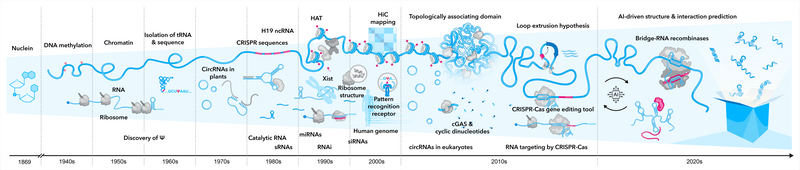
In these three research areas, the cluster pursues six overarching research objectives:
- NUCLEATE will utilize a combination of technologies to define the functional landscape of the non-coding transcriptome including regulatory, structural and catalytic aspects of ncRNAs as well as tissue heterogeneity of their expression and function.
- To decipher nucleic acid immune and signaling pathways, we will investigate complex networks of nucleic acid sensors, restriction factors, and signaling molecules for their roles in health and disease.
- From genome folding to regulation of the epitranscriptome, NUCLEATE will unravel the chemical and structural code of DNA and RNA regulation including the effects of nucleic acid modifications, genome structure and folding, as well as the chemical code of the epigenome and epitranscriptome.
- Throughout the entire nucleic acid life cycle, NUCLEATE will address the composition, dynamics and structures of ribonucleoprotein particles and how genome and transcriptome integrity is detected and ensured by quality control pathways.
- To advance nucleic acid research in general, NUCLEATE will harness artificial intelligence for multi-omics data integration and single-cell omics to capture dynamics and heterogeneity of subcellular nucleic acid complexes.
- All scientific discoveries will ultimately be leveraged to develop the next generation of DNA- and RNA-based technologies and medicine including, e.g., oligonucleotide-based drugs or the design of nucleic acid-directed small molecules.